


The Unseen Psychological Trick That Makes Customers Buy Premium Brands
Table of Contents
TogglePremium Brand Positioning: 9 Powerful Secrets to Win Loyalty
The Unseen Psychological Trick That Makes Customers Buy Premium Brands
Why Do Customers Pay More for Some Brands?
Imagine two products offering similar functionality. One is affordable, while the other costs significantly more. Surprisingly, some customers willingly choose the expensive option even when the cheaper alternative performs just as well.
Why does this happen? The answer lies in the psychology of branding and effective premium brand positioning.
Customers don’t evaluate every purchase based on functionality alone. They also consider how a product makes them feel, what it communicates about their identity, and how much confidence they have in the brand through strategic premium brand positioning.
The psychological secret behind premium branding and successful premium brand positioning is perceived value: customers are often willing to pay more when they believe a brand offers something more meaningful than the product itself.
This perception doesn’t happen by accident. It develops through carefully managed design, storytelling, customer experience, positioning, and reputation built via premium brand positioning.
Let’s explore how premium brands influence purchasing decisions and how businesses can apply these principles ethically to build stronger brands through premium brand positioning.
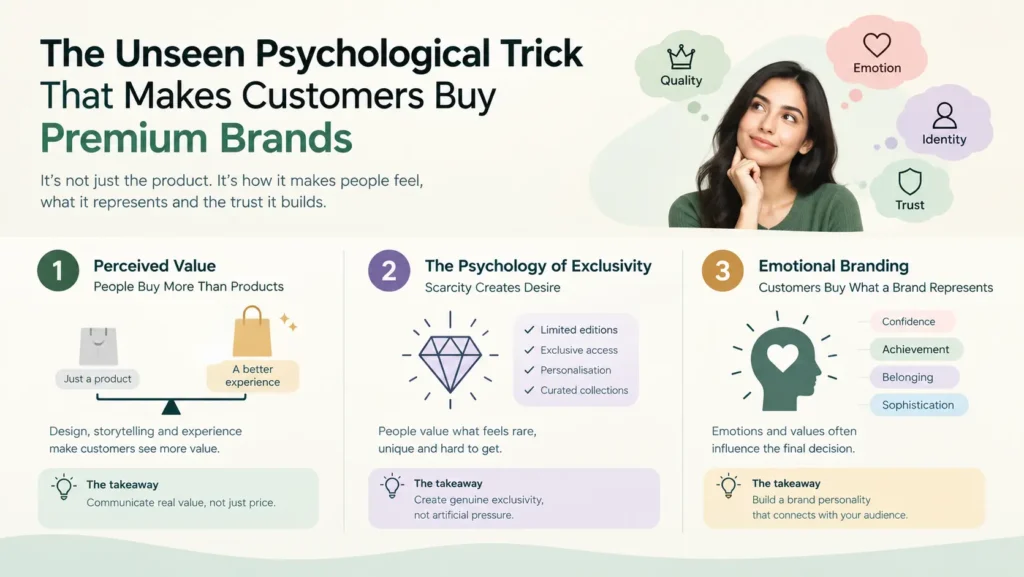
1. The Power of Perceived Value: People Buy More Than Products
A product’s price tells customers how much they must pay. Its branding and targeted premium brand positioning help them understand why it might be worth paying that amount.
Consider two skincare products with similar ingredients. One comes in ordinary packaging with a basic description. The other features sophisticated packaging, clear product information, consistent visual branding, and a carefully communicated product philosophy driven by premium brand positioning.
Customers may perceive the second product as more desirable, even before trying it. This doesn’t automatically mean the second product is better. It means that presentation and communication can influence expectations through sound premium brand positioning.
Premium brands understand that value is not communicated by price alone; it is shaped by the entire brand experience governed by premium brand positioning.
How can your business apply this?
Explain the quality and benefits of your offering clearly.
Use professional, consistent visual design.
Communicate what makes your product distinctive using premium brand positioning.
Support premium claims with genuine evidence.
Ensure the customer experience reflects the price you charge.
The objective is not to make an ordinary product appear extraordinary through design alone. It is to communicate its real value in a way customers can understand and appreciate via premium brand positioning. To review professional design standards and industry frameworks, explore guidelines from the AIGA Design Association
2. The Psychology of Exclusivity: Why Limited Availability Creates Desire
Have you ever noticed how a product can become more desirable when access to it is limited? Scarcity can influence purchasing decisions because people may assign greater value to something they believe is difficult to obtain, which is a core pillar of premium brand positioning.
Premium brands sometimes use this principle through limited-edition collections, exclusive memberships, personalised services, or carefully controlled product releases backed by strong premium brand positioning.
However, scarcity works best when it supports a genuine brand strategy rather than creating artificial pressure.
For example, a designer brand releasing a limited collection may offer distinctive designs and craftsmanship that appeal to customers seeking something uncommon, reinforcing its premium brand positioning. The exclusivity becomes part of the product’s appeal.
The branding lesson: Businesses can create meaningful exclusivity through premium brand positioning by offering:
Special editions with genuine differences.
Personalised products or services.
Exclusive experiences for loyal customers.
Thoughtfully curated collections.
Premium customer support or additional services.
Important: False countdowns, misleading stock claims, and fabricated scarcity may generate short-term interest but can damage long-term trust. Exclusivity should make customers feel valued—not manipulated.
3. Emotional Branding: Customers Often Buy What a Brand Represents
People don’t always choose products through purely rational comparisons when guided by effective premium brand positioning.
A brand may represent confidence, achievement, creativity, independence, sophistication, or belonging. These emotional associations can become powerful reasons to choose one product over another.
For instance, a customer purchasing a premium watch may value its craftsmanship and reliability. They may also appreciate its design, heritage, or symbolic connection to a personal milestone achieved through successful premium brand positioning.
The purchase becomes more meaningful because the product represents something beyond its practical function. This is one reason emotional storytelling plays such an important role in premium branding and premium brand positioning.
How to build an emotional connection:
Understand your audience: Identify the aspirations, values, and motivations that matter to your customers.
Develop a clear brand personality: Decide how your brand should be perceived—elegant, innovative, dependable, adventurous, or sophisticated.
Tell meaningful stories: Communicate the purpose behind your products, the people who create them, or the problems they are designed to solve.
Stay authentic: Ensure your brand’s values are reflected in its actual products and customer experience.
The strongest emotional branding doesn’t simply tell customers what to feel. It gives them authentic reasons to connect with the brand.
4. Visual Identity: Why Premium Brands Pay Attention to Every Detail
Before customers experience a product, they often encounter its visual identity and the visual cues of its premium brand positioning.
The logo, typography, colour palette, packaging, website, and product photography all contribute to their first impression. When these elements work together, they create a recognisable and coherent brand experience aligned with proper premium brand positioning.
When they conflict, the brand may appear inconsistent or less credible. Premium brands often use restrained layouts, carefully selected typography, thoughtful packaging, and consistent visual systems to solidify their premium brand positioning.
However, minimalism alone does not make a brand premium. An effective identity must reflect the product, audience, and value proposition.
Four visual elements worth refining:
Typography: Select fonts that support your brand’s personality and remain readable.
Colour: Develop a consistent palette that reflects your intended premium brand positioning.
Photography: Use clear, professional images that accurately represent your products.
Packaging: Ensure materials, structure, and presentation suit the product’s quality and price.
Ask yourself: If your brand removed its promotional messages and displayed only its logo, packaging, and product photography, would customers still recognise its intended value? If not, your visual identity may need greater clarity and consistency.
5. Social Proof: Why Other Customers Influence Our Decisions
When people are uncertain about a purchase, they often look for evidence that others have made a similar decision successfully, validating a brand’s premium brand positioning.
Reviews, testimonials, recommendations, and customer experiences can help reduce uncertainty. Premium brands benefit from this principle when their reputation is supported by genuine customer satisfaction, credible recognition, or demonstrated expertise tied to their premium brand positioning.
For a first-time buyer, authentic reviews may provide reassurance that a product performs as described. For a business purchasing an expensive service, relevant case studies may demonstrate that the provider has experience delivering results.
How to strengthen social proof:
Encourage customers to share honest feedback.
Display genuine testimonials where they help purchasing decisions.
Use relevant case studies to demonstrate your expertise.
Respond professionally to positive and negative reviews.
Avoid fabricated endorsements or misleading performance claims.
Social proof should help customers evaluate your brand more confidently. A premium image may attract attention, but a credible reputation gives customers stronger reasons to trust it.
6. The Price Quality Connection: Why Expensive Can Feel Better
Price can influence how customers perceive a product, particularly when they have limited information about its actual quality and rely on visual premium brand positioning.
In some situations, customers interpret a higher price as a signal of superior materials, craftsmanship, service, or exclusivity. This is known as the price–quality perception effect.
However, the relationship is not automatic. Customers may also view high prices as unjustified, especially when cheaper alternatives offer comparable benefits. A premium price must therefore be supported by a convincing value proposition rooted in premium brand positioning.
What justifies a premium price? A business may be able to charge more when it provides meaningful advantages such as:
Superior materials or craftsmanship.
Specialised expertise.
Better customer support.
Distinctive design.
Greater convenience.
Proven reliability.
A genuinely differentiated experience.
The key is alignment. If a brand charges premium prices but delivers an ordinary or inconsistent experience, customers may feel disappointed. A premium price creates an expectation. The product and customer experience must fulfil it.
7. Brand Consistency: How Familiarity Builds Confidence
Imagine discovering a business through an elegant advertisement, visiting its professional website, and then receiving a poorly designed invoice with unclear communication. The experience feels disconnected and undermines premium brand positioning.
Now imagine every interaction—from the first advertisement to the final delivery—reflecting the same brand identity and quality standards. The second experience is more coherent and can strengthen customer confidence.
Consistency helps customers recognise a brand and understand what to expect from it. This includes more than visual design. It also involves messaging, service quality, packaging, communication, and the way a business responds to problems.
Build consistency across every touchpoint:
Website and social media.
Advertising and promotional materials.
Product packaging and documentation.
Sales conversations and customer support.
Delivery, returns, and after-sales service.
When these experiences reinforce one another, your brand becomes easier to recognise and trust. Premium branding is not a single impressive advertisement. It is a standard that customers experience repeatedly.
8. The Psychology of Ownership: Help Customers Imagine the Experience
Customers may find a product more appealing when they can clearly imagine how it will fit into their lives, a technique heavily leveraged in premium brand positioning.
This is why product demonstrations, lifestyle photography, interactive previews, and detailed descriptions can be effective. A furniture brand, for example, can help customers visualise how a sofa might look in a living room. A professional service provider can explain how its service fits into a client’s workflow.
A premium skincare brand can clearly describe the product’s texture, intended use, and place within a skincare routine. These approaches help customers move beyond abstract product descriptions and consider the practical experience of ownership.
Make your product easier to imagine:
Show products in relevant real-life settings.
Explain how they are used.
Provide accurate specifications and dimensions.
Use demonstrations to clarify important features.
Answer common questions before customers need to ask.
The goal is to reduce uncertainty and help customers decide whether the product genuinely suits their needs.
9. How to Apply Premium Branding Psychology to Your Business
You don’t need a luxury-sized budget to build a more premium brand or implement effective premium brand positioning. What you need is a clear strategy, a strong understanding of your customers, and consistent execution.
Use this practical framework to begin:
Step 1: Audit your current customer touchpoints against your desired positioning.
Step 2: Refine your visual identity and messaging clarity.
Step 3: Strengthen social proof and remove buying friction.
Step 4: Deliver consistent quality across every interaction.
Start by identifying the biggest gap between how you want customers to perceive your brand and how they experience it today. Then prioritise the improvements that will make the greatest difference.
A complete rebrand may not be necessary. Sometimes, clearer messaging, stronger product photography, or a more consistent customer experience can significantly improve how your brand is perceived.
The Cholanadu Perspective: Premium Branding Is About More Than Looking Expensive
The psychological principles behind premium branding reveal an important business lesson: customers do not evaluate products solely by their functional features or price.
Their decisions can also be influenced by perceived value, emotional associations, visual presentation, reputation, and the confidence they feel when choosing a brand through thoughtful premium brand positioning.
However, these psychological principles work best when they are supported by genuine quality and honest communication. A sophisticated logo cannot compensate for an unreliable product. Artificial scarcity cannot replace customer satisfaction. And an expensive price tag cannot create lasting loyalty without meaningful value.
The real secret is to make your brand’s value visible, credible, and relevant to the people you serve.
At Cholanadu, we believe that effective branding goes beyond aesthetics. It combines strategic positioning, distinctive visual identity, compelling storytelling, and a consistent customer experience to help businesses communicate their value with clarity and confidence. To align your overall growth framework with expert insights, explore our guide on Cholanadu Brand Strategy Services.
When every element works together, your brand doesn’t need to rely entirely on discounts to attract attention. It can build something far more valuable: customer trust, meaningful differentiation, and a lasting place in the customer’s mind.
