


The Real Reason Customers Choose Your Competitor (It’s Not Price)
Table of Contents
ToggleBrand Differentiation Strategy: 7 Proven Ways to Beat Rivals
The Real Reason Customers Choose Your Competitor (It’s Not Price)
When Your Competitor Wins Without Being Cheaper
Imagine two businesses selling almost identical products. Both offer comparable quality, similar pricing, and reliable service. Yet, customers consistently choose one business over the other.
Why?
The answer may have very little to do with price. In today’s competitive marketplace, customers don’t simply purchase products. They choose experiences, emotions, convenience, credibility, and the confidence that they are making the right decision through a solid brand differentiation strategy.
Your competitor may not have a better product. They may simply communicate their value more effectively using a robust brand differentiation strategy.
The real question isn’t whether your product is cheaper. It’s whether customers have a compelling reason to choose your brand through a clear brand differentiation strategy.
Let’s explore the hidden factors that influence customer decisions and discover how your business can stand out without entering a price war by applying a proper brand differentiation strategy.
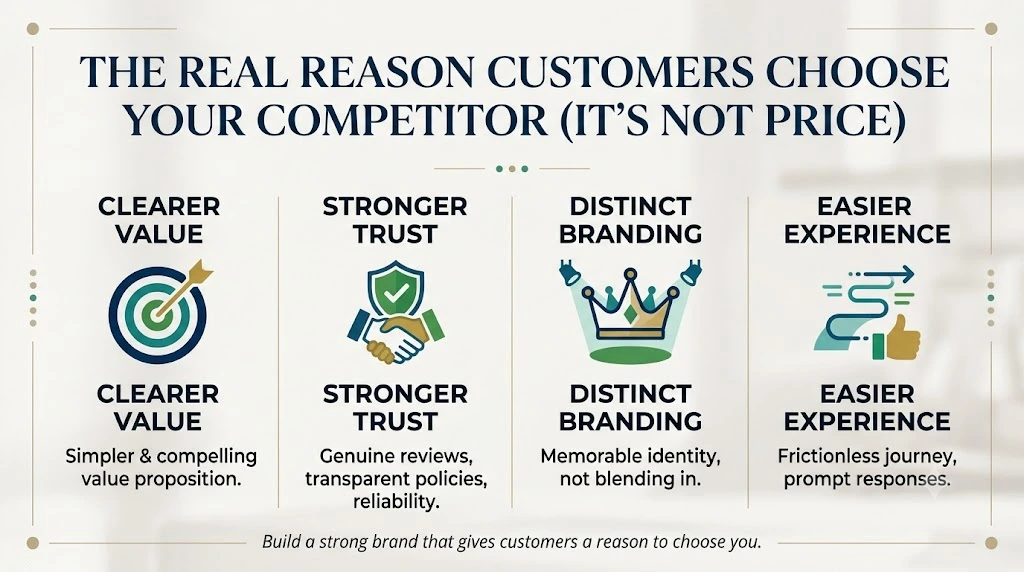
1. Your Competitor Communicates Value More Clearly
Customers rarely spend time trying to understand why a business deserves their attention. They expect brands to communicate their value quickly and clearly as part of an effective brand differentiation strategy.
If your competitor explains their benefits in a simple, compelling way while your messaging is vague or complicated, customers may naturally gravitate towards the competitor.
For example, a digital marketing agency that says, “We provide comprehensive digital marketing solutions” sounds similar to countless other agencies.
However, an agency implementing a clear brand differentiation strategy that communicates how it helps businesses strengthen their online presence, attract relevant audiences, and improve marketing performance gives potential customers a clearer reason to engage.
The difference lies in the message.
How can your brand improve?
Explain what makes your offering different via a distinct brand differentiation strategy.
Focus on customer benefits rather than simply listing features.
Use clear, confident, and relevant messaging.
Communicate your value consistently across your website, advertisements, and social media.
Remember: If customers cannot understand your value, they may compare your business using the easiest available factor—price.
2. Trust Can Be More Powerful Than a Discount
Would you purchase an expensive product from a business you barely trust, even if it offered an attractive discount? Many customers hesitate when they are uncertain about a brand’s credibility or lack a foundational brand differentiation strategy.
They may question the quality of the product, the reliability of the service, or the business’s ability to deliver on its promises. Your competitor may win because their brand appears more established, transparent, and dependable.
Trust develops through multiple interactions, including website quality, customer reviews, transparent policies, professional communication, and consistent service aligned with a strong brand differentiation strategy.
How can your brand build trust?
Display genuine customer testimonials and reviews.
Use professional, high-quality visuals.
Provide accurate product and service information.
Communicate delivery, payment, and refund policies clearly.
Respond to customer enquiries professionally.
Deliver consistently on your promises.
A discount may attract attention, but trust backed by a brand differentiation strategy gives customers a reason to buy with confidence. To review professional industry standards and design guidelines, check resources from the AIGA Design Association
3. Your Brand Looks Similar to Everyone Else
Imagine scrolling through social media and seeing five businesses offering the same service. Their designs look almost identical, their messages sound familiar, and their advertisements make similar promises.
Which one would you remember? If your brand blends into the competition without a visible brand differentiation strategy, customers may struggle to identify what makes you special.
This is where branding becomes a strategic business advantage. A distinctive visual identity, recognisable brand voice, clear positioning, and memorable customer experience help your business occupy a unique place in the customer’s mind through a structured brand differentiation strategy.
Your brand does not need to be louder than every competitor. It needs to be recognisable, relevant, and meaningfully different.
Consider these questions:
Can customers recognise your brand without seeing your business name?
Does your messaging communicate a distinctive point of view?
Is your brand identity consistent across platforms?
Can customers explain why your business is different?
If the answers are unclear, your brand may need a stronger brand differentiation strategy and positioning rather than another promotional campaign.
4. Your Competitor Understands the Customer Better
Sometimes, the difference between winning and losing a customer is understanding what that customer genuinely needs through an advanced brand differentiation strategy.
A business might focus heavily on promoting its products while overlooking the concerns, frustrations, and expectations of its target audience. Meanwhile, a competitor leveraging a smart brand differentiation strategy may communicate directly with those concerns.
For example, a customer looking for skincare products may not simply want a moisturiser. They may want a solution that suits their skin type, fits their routine, and offers clear guidance on how to use it.
A brand that understands these expectations via a targeted brand differentiation strategy can create a more relevant and reassuring experience.
How to understand your customers better:
Listen: Review customer enquiries, feedback, and recurring complaints.
Observe: Study how customers interact with your website, advertisements, and social media content.
Ask: Conduct surveys or conversations to understand what influences their decisions.
Adapt: Refine your messaging and customer experience based on what you learn.
The objective is not to assume what customers want. It is to understand what matters to them and respond accordingly.
5. Your Customer Experience Creates Unnecessary Friction
A customer may appreciate your product, trust your brand, and consider your pricing reasonable. Yet, they may still choose your competitor because the buying process is easier and supported by a seamless brand differentiation strategy.
Consider a website with confusing navigation, slow-loading pages, unclear pricing, or a complicated checkout process. Even interested customers may become frustrated and leave.
Your competitor, on the other hand, might offer a straightforward website, accessible information, faster responses, and a smoother purchasing journey. That convenience can become a core pillar of their brand differentiation strategy.
Improve the customer journey:
Make important information easy to find.
Simplify enquiries and purchase processes.
Optimise your website for mobile users.
Respond promptly to customer questions.
Explain the next steps clearly.
Provide support before and after the purchase.
An excellent product attracts interest. A frictionless experience driven by a clear brand differentiation strategy helps turn that interest into action.
6. Your Competitor Sells an Experience, Not Just a Product
Customers often remember how a brand makes them feel long after they forget the details of an advertisement. Think about businesses that create memorable experiences through thoughtful packaging, personalised communication, responsive support, or a consistent brand differentiation strategy.
These details help transform an ordinary transaction into a more meaningful customer relationship. Your competitor may be offering something beyond the product itself: reassurance, convenience, recognition, or a sense of belonging rooted in a sound brand differentiation strategy.
This doesn’t mean every brand needs an elaborate customer experience. The experience simply needs to reflect what its audience values. For a premium brand, that may mean personal attention and sophisticated presentation. For a budget-conscious brand, it may mean convenience, transparency, and dependable value.
The strongest customer experience is not necessarily the most expensive. It is the one that feels right for your audience and fits your overall brand differentiation strategy.
7. Your Marketing Focuses on Selling Instead of Connecting
Constantly promoting offers, discounts, and product features can make your marketing feel repetitive. Customers may see your advertisements without developing any meaningful connection with your business if you lack a genuine brand differentiation strategy.
Your competitor might take a different approach by sharing useful information, answering common questions, telling authentic brand stories, or helping customers make better decisions.
This approach creates opportunities to build familiarity and credibility before asking for a purchase, which forms the cornerstone of a healthy brand differentiation strategy.
Build a stronger content strategy:
Addresses your audience’s most common problems.
Explains how your products or services create value.
Shares useful insights and practical advice.
Demonstrates your expertise through relevant examples.
Communicates your brand’s purpose and personality.
Not every interaction needs to generate an immediate sale. Sometimes, helping a potential customer today is what makes them remember your business when they are ready to buy tomorrow.
8. Your Brand Promises More Than It Delivers
Attracting customers through impressive claims is one thing. Meeting their expectations requires executing a reliable brand differentiation strategy.
If your advertisements promise exceptional service but customers experience delays, inconsistent quality, or poor communication, trust can quickly weaken. Meanwhile, a competitor that consistently fulfils its promises via a proven brand differentiation strategy may earn repeat purchases and recommendations.
Your brand reputation is shaped not only by what you communicate but also by what customers experience.
Close the promise–experience gap:
Make realistic and specific promises.
Set clear expectations before purchase.
Maintain consistent quality standards.
Address complaints promptly and professionally.
Use customer feedback to improve your service.
A strong brand is built when its promises and performance reinforce one another through a disciplined brand differentiation strategy.
9. How to Compete Without Starting a Price War
Reducing prices may seem like the quickest way to attract customers, but continuous discounting can put pressure on profit margins and make it harder to communicate the value of your offering without a strong brand differentiation strategy.
Instead, strengthen the reasons customers should choose your business:
Differentiate your brand: Develop a clear identity and communicate what makes your offering distinctive using a formal brand differentiation strategy.
Demonstrate your value: Show customers the benefits they receive, supported by credible information and evidence.
Build relationships: Use helpful communication, responsive service, and consistent experiences to encourage trust.
Improve convenience: Make it easier for customers to discover, evaluate, purchase, and use your products.
Deliver consistently: Ensure that your product quality and customer experience match your brand promises.
Price remains important, particularly in highly competitive markets. However, it is only one part of the buying decision. When customers understand and appreciate the value of your offering through a well-crafted brand differentiation strategy, your business has a stronger foundation for competing beyond price alone.
The Cholanadu Perspective: Customers Choose the Brand That Gives Them a Reason to Believe
When customers choose your competitor, the immediate temptation may be to lower your prices, increase your advertising budget, or introduce another promotional offer.
But before making those changes, look deeper. Perhaps your competitor communicates more clearly. Perhaps their branding creates greater confidence. Perhaps their customer experience is more convenient, or their messaging speaks more directly to the needs of your audience via a winning brand differentiation strategy.
Understanding these differences helps you address the real problem instead of simply reacting to the competition. Your goal should not be to become the cheapest option in the market. It should be to become a compelling choice for the customers you want to serve.
At Cholanadu, we believe that effective branding combines strategic positioning, meaningful communication, distinctive design, and a consistent customer experience. When these elements work together via a dedicated brand differentiation strategy, businesses can build stronger identities and communicate their value more effectively. To align your growth framework with expert insights, explore our guide on Cholanadu Brand Strategy Services.
One Final Question for Every Business Owner: If your competitor offered the same product at the same price, what would make a customer choose you?
If your answer is clear, you have the foundation of a strong brand. If it isn’t, implementing a robust brand differentiation strategy may be the most important branding question your business needs to answer next.
