


De Beers “A Diamond Is Forever”: How Strategic Marketing Built a Multi-Billion Dollar Habit
Table of Contents
ToggleEmotional Marketing: 9 Powerful Lessons from De Beers
How One Powerful Marketing Campaign Transformed Diamonds into a Symbol of Eternal Love
Emotional marketing can transform the way consumers understand a product by connecting it with feelings, beliefs, traditions, and personal experiences.
What makes a diamond valuable? Is it its rarity, brilliance, or the emotional meaning people attach to it?
For generations, diamonds have been associated with love, commitment, luxury, and everlasting relationships. But this connection did not happen entirely by chance. Behind it lies one of the most successful marketing strategies in business history.
In 1947, De Beers introduced a simple yet powerful slogan: “A Diamond Is Forever.”
More than just an advertising tagline, it became a cultural belief that transformed how people viewed diamonds, particularly engagement rings.
This campaign did something extraordinary. It turned a luxury product into an emotional necessity and established a purchasing tradition that continues to influence consumer behaviour today.
So, how did De Beers achieve this? Let’s explore the marketing brilliance behind one of the world’s most iconic brand campaigns.
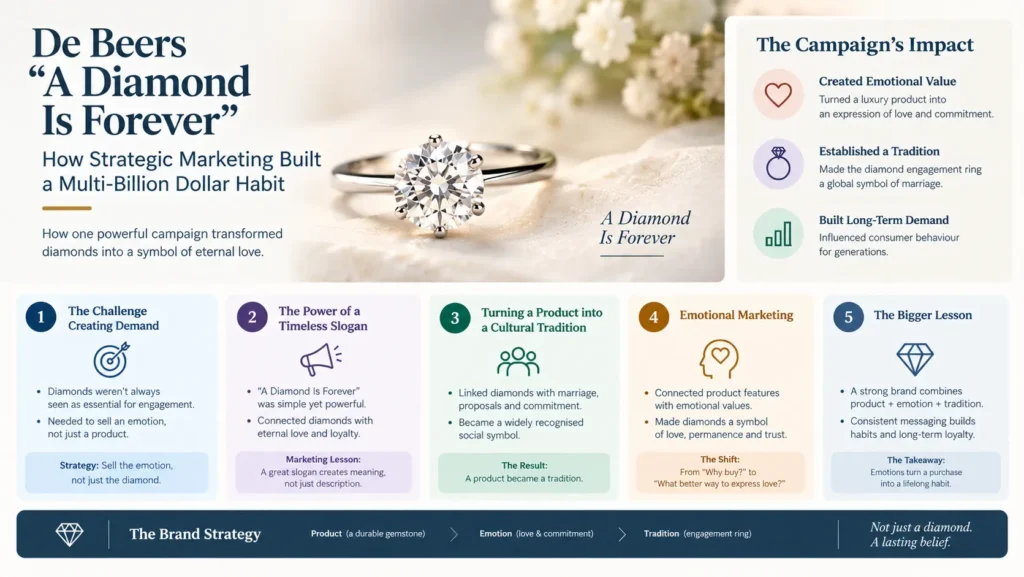
1. The Challenge: Creating Demand for a Luxury Product
Before the campaign, diamonds were not universally considered essential for engagement rings.
Although diamonds had luxury appeal, consumer demand was not as deeply connected to marriage traditions as it is today.
De Beers faced a significant marketing challenge: How could a company encourage people to purchase diamonds not just as jewellery, but as a meaningful expression of love?
Instead of focusing entirely on the product’s physical qualities, the brand needed to influence consumer perception.
The strategy was simple but revolutionary: Sell the emotion, not just the diamond.
Rather than highlighting brilliance, carat weight, or rarity alone, De Beers positioned diamonds as symbols of commitment that would last forever.
This is a core principle of emotional marketing: connect a product with a feeling that matters to the customer.
2. The Power of a Timeless Slogan
The slogan connected two powerful ideas: diamonds and eternal love.
Its brilliance was in its simplicity.
Instead of explaining why diamonds were valuable, the campaign gave consumers an emotional reason to believe in their value.
The word Forever communicated permanence, loyalty, and emotional security.
It also subtly established an important consumer expectation: a diamond should not be resold because its value was connected to a lasting personal commitment.
Marketing Lesson
A powerful slogan does more than describe a product. It creates a meaning that customers can emotionally connect with.
For De Beers, four simple words helped shape an entire category of consumer behaviour.
This demonstrates how emotional marketing can turn a short message into a much larger brand association.
3. Turning a Product into a Cultural Tradition
One of the most remarkable achievements of De Beers was its ability to influence social behaviour.
The campaign did not simply encourage people to buy diamonds. It helped establish the diamond engagement ring as a widely recognised symbol of marriage.
Through consistent advertising, romantic storytelling, celebrity associations, and cultural messaging, diamonds became closely connected with proposals and lifelong commitment.
The brand moved beyond traditional product marketing and entered the emotional space of relationships.
This created a powerful psychological association:
- Diamonds represented love.
- Engagement rings represented commitment.
- Expensive diamonds represented a significant romantic gesture.
- Giving a diamond became a recognised expression of seriousness in a relationship.
Over time, this association became deeply embedded in popular culture.
The real marketing achievement was not selling more diamonds. It was influencing what people believed a meaningful engagement should look like.
This is where emotional marketing becomes especially powerful: the product becomes connected to a cultural meaning that extends beyond its physical features.
4. Emotional Marketing: Selling Feelings Instead of Features
De Beers understood something that many brands still struggle to recognise: Consumers do not always purchase products based on practical benefits.
Sometimes, they purchase what a product represents.
A diamond has physical characteristics such as hardness, brilliance, and durability. However, De Beers connected these characteristics with emotional values such as loyalty, permanence, and eternal love.
This approach transformed the product’s positioning.
Instead of asking:
Why should I buy a diamond?
Consumers were encouraged to think:
What better way is there to express a love that lasts forever?
This emotional marketing positioning made the diamond more than a luxury purchase.
It became a symbolic investment in a relationship.
The Strategy Behind the Emotion
De Beers successfully connected three elements:
- Product: A naturally durable gemstone.
- Emotion: Love, commitment, and permanence.
- Tradition: The engagement ring as a meaningful relationship milestone.
When these three elements work together, a brand can build stronger emotional connections and long-term consumer loyalty.
5. Creating a Habit Through Consistent Brand Messaging
Building a consumer habit requires more than a successful advertisement. It requires repetition, consistency, and cultural reinforcement.
De Beers maintained its diamond messaging over several decades, helping the diamond engagement ring become an established purchasing convention.
One particularly influential campaign was the promotion of the idea that an engagement ring should cost approximately two months’ salary.
This concept was popularised through advertising and gradually became a familiar reference point for diamond purchases in certain markets.
Although it was a marketing-created guideline rather than a universal financial rule, it demonstrates how advertising can influence purchasing expectations.
The strategy worked because it connected a commercial decision with an important personal milestone.
Instead of treating an engagement ring as an ordinary jewellery purchase, consumers began viewing it as something deserving of significant financial consideration.
A successful brand does not always create a new need. Sometimes, it creates a new standard for fulfilling an existing emotional need.
This shows how consistent emotional marketing can reinforce a behaviour over time.
6. Visual Storytelling: Making Diamonds Aspirational
De Beers’ marketing success was not built on words alone.
Its advertising frequently used romantic imagery, elegant jewellery presentation, and aspirational lifestyles to reinforce the emotional value of diamonds.
The visual communication focused on:
- Romantic proposals and meaningful relationships.
- Timeless elegance and sophistication.
- Diamonds as symbols of lasting commitment.
- Emotional moments that audiences could relate to.
This approach made diamonds desirable beyond their material properties.
The brand was not simply showing consumers what a diamond looked like. It was showing them what owning and gifting one could represent.
This is an important lesson in visual brand communication.
When a product is associated with a memorable experience, its perceived value can extend far beyond its functional purpose.
Visual storytelling can therefore strengthen emotional marketing by giving consumers a clear picture of the feeling or experience associated with a product.
7. Building a Market Through Cultural Influence
De Beers’ strategy also demonstrates how marketing can shape consumer expectations across generations.
Its campaigns influenced not only individual purchasing decisions but also the broader social understanding of engagement and marriage traditions.
The brand’s marketing reached beyond conventional advertising channels through magazine placements, celebrity associations, films, and broader cultural messaging.
One notable example was the expansion of diamond engagement ring marketing in Japan during the post-war period.
Through sustained promotion, diamond engagement rings became increasingly associated with marriage in a market where they had not previously been a dominant tradition.
This illustrates the potential of strategic marketing to introduce and establish new consumer behaviours across different cultures.
However, it also raises an important question for modern brands:
Where is the line between creating consumer demand and shaping consumer expectations?
De Beers’ story offers a powerful case study in both the opportunities and responsibilities of persuasive marketing.
It also demonstrates why emotional marketing should be approached responsibly, particularly when campaigns influence important personal or financial decisions.
8. The Business Lessons Modern Brands Can Learn
The De Beers campaign remains relevant because its underlying marketing principles can be applied across industries.
Whether a business sells luxury products, fashion, technology, skincare, or everyday essentials, the lessons remain valuable.
Lesson 1: Build Emotional Connections
Consumers remember how a brand makes them feel.
A product with a meaningful emotional identity can create stronger customer relationships than one marketed only through specifications.
This is one of the most important principles of emotional marketing.
Lesson 2: Create a Distinctive Brand Message
A short, memorable message can become a powerful brand asset when supported by consistent communication.
Lesson 3: Position Products Beyond Their Functional Value
Successful brands communicate not only what their products do but also what they represent.
Lesson 4: Build Long-Term Associations
Strong brands are not created overnight. Repeated messaging, visual consistency, and meaningful experiences help establish lasting recognition.
Lesson 5: Influence Behaviour Responsibly
Marketing can shape consumer habits and expectations. Modern businesses should use this influence transparently, avoiding misleading claims or unnecessary financial pressure.
9. The Changing Diamond Market: A New Era of Consumer Choices
Although De Beers helped establish diamonds as symbols of eternal love, the market has evolved significantly.
Today, consumers have access to natural diamonds, lab-grown diamonds, alternative gemstones, and different jewellery preferences.
Younger consumers are increasingly considering factors such as affordability, sustainability, personal expression, and ethical sourcing.
This creates a new challenge for traditional diamond marketing.
The original emotional positioning remains powerful, but modern consumers may define commitment differently.
For brands, the lesson is clear: A strong legacy creates recognition, but continuous relevance requires adaptation.
De Beers’ historical success demonstrates the power of building a cultural association. Its future relevance depends on how effectively it responds to changing consumer values.
Modern emotional marketing must therefore evolve with changing consumer expectations rather than relying only on historical associations.
Cholanadu Takeaway
When Marketing Becomes a Belief
De Beers’ “A Diamond Is Forever” campaign is more than an example of successful advertising. It is a masterclass in emotional marketing, emotional positioning, cultural influence, and long-term brand building.
By connecting a gemstone with the universal idea of everlasting love, the brand helped transform diamonds from luxury products into symbols of personal commitment.
Its greatest achievement was not simply increasing product awareness. It was helping establish a purchasing tradition that became part of popular culture.
For modern businesses, the message is powerful:
The strongest brands do not merely sell products. They create meanings, influence perceptions, and become part of the stories people tell about their lives.
And sometimes, four simple words can build a legacy that lasts for generations.
A product may attract attention through its features, but a powerful emotional story can make it memorable for a lifetime.
De Beers proved that when marketing connects a product with a deeply meaningful human emotion, it can influence not just what people buy, but why they buy it.
External DoFollow links
De Beers Sustainability Timeline – official website — useful for supporting the 1947 “A Diamond Is Forever” reference. De Beers itself records 1947 and credits copywriter Frances Gerety with the slogan.
De Beers – Empowering Women and Communities — useful as an additional official De Beers source when discussing the continued significance of the “A Diamond Is Forever” phrase.
International Gem Society – Diamond Marketing History — useful for the historical discussion of how De Beers’ advertising influenced the engagement-ring market.
Cholanadu internal links
Use these naturally inside the article:
brand audit → Cholanadu Brand Audit – SGR 777
brand identity → Cholanadu Jaguar Brand Audit Report
Cholanadu / contact CTA → Cholanadu Contact Us
