


The Maggi Crisis & Comeback: Masterclass in Brand Reputation Management
Table of Contents
ToggleReputation Management: 9 Powerful Lessons from the Maggi Crisis
What happens when a product that has been part of millions of homes suddenly becomes a national controversy?
Few brands demonstrate the power of reputation management as clearly as Maggi.
In 2015, Maggi noodles faced one of the biggest brand crises in India’s FMCG industry. What followed was a product recall, intense media attention, regulatory scrutiny, consumer uncertainty and eventually, one of the most remarkable brand comebacks in the Indian market.
The Maggi story is more than a crisis story.
It is a masterclass in how a powerful brand can rebuild trust after losing it.
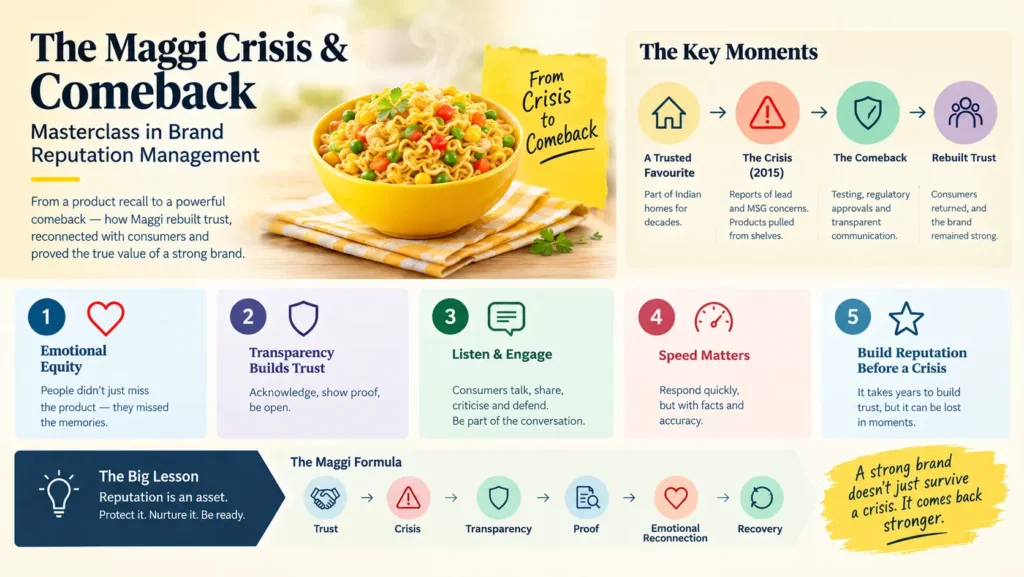
The Brand That Was Almost a Household Habit
For decades, Maggi had positioned itself as more than just instant noodles.
It represented:
Convenience. Comfort. Childhood. Quick meals.
Its famous “2-Minute Noodles” positioning made the product deeply familiar to Indian consumers.
For generations, Maggi became part of college hostels, family kitchens, late-night snacks and children’s meals.
That emotional familiarity created something extremely valuable:
Brand Trust.
And that trust would soon be tested.
This is where reputation management becomes important. A brand’s reputation is built long before a crisis happens.
The Crisis That Changed Everything
In 2015, reports emerged regarding the presence of lead and concerns surrounding monosodium glutamate (MSG) in Maggi noodles.
The controversy quickly escalated.
Regulatory action followed, and Maggi products were removed from shelves across India.
Suddenly, one of India’s most recognisable food brands was facing an extraordinary reputation crisis.
The problem wasn’t simply:
“Can Maggi sell noodles?”
The bigger question was:
«“Will consumers trust Maggi again?”»
That distinction is critical.
A product can return to the market.
Trust has to be earned.
This is one of the central lessons of reputation management: returning a product to the market and rebuilding consumer confidence are two different challenges.
When the Product Disappears, the Brand Remains
One of the most interestig aspects of the Maggi crisis was the emotional reaction from consumers.
People didn’t respond as if they were simply losing another packaged food product.
They shared memories.
They talked about childhood.
They posted emotional reactions online.
Some even joked about stockpiling packets.
This demonstrated the enormous emotional equity Maggi had accumulated over decades.
The lesson for brands:
A strong brand is not built only through advertising.
It is built through years of repeated experiences.
When a crisis arrives, that accumulated goodwill can become one of a company’s greatest assets.
This accumulated goodwill is an important foundation for effective reputation management.
The Comeback Strategy
Maggi’s comeback was not based on simply saying:
“We are back.”
The brand had to rebuild credibility.
Testing, regulatory approvals, communication and transparency became central to the recovery process.
The comeback involved several important elements:
1. Address the Problem
A brand cannot repair its reputation by pretending the crisis doesn’t exist.
Acknowledging concerns is the first step toward rebuilding credibility.
Silence creates space for speculation.
Strong reputation management begins with acknowledging the situation rather than ignoring it.
2. Let Evidence Speak
During a reputation crisis, emotional advertising alone isn’t enough.
Consumers want proof.
Testing, compliance, safety checks and regulatory validation become extremely important.
The message shifts from:
“Trust us.”
to:
“Here is why you can trust us.”
That is a much stronger communication strategy.
3. Reconnect Emotionally
Maggi had something many brands would spend decades trying to build:
emotional familiarity.
Its comeback communication leveraged the relationship consumers already had with the brand.
The strategy wasn’t about creating a completely new Maggi.
It was about reminding consumers why Maggi mattered to them in the first place.
Effective reputation management therefore needs both evidence and emotional understanding.
The Power of “#MissYouMaggi”
During the period when Maggi disappeared from shelves, consumer conversations became a major part of the story.
The absence itself created demand.
People were talking about the product even when they couldn’t buy it.
This created an unusual situation:
The brand was physically absent but culturally present.
That is powerful brand equity.
When Maggi eventually returned, the comeback benefited from this emotional anticipation.
The reputation management lesson is that consumer conversations can continue shaping a brand even when the product itself is temporarily unavailable.
Turning a Crisis Into a Conversation
One of the smartest lessons from the Maggi story is the importance of listening to consumers.
Modern reputation management is no longer controlled entirely by television advertisements, newspapers or press releases.
Consumers have their own platforms.
They can:
- Comment
- Share
- Criticise
- Defend
- Meme
- Review
- Create conversations
A crisis can spread within hours.
But positive consumer sentiment can also spread just as quickly.
Reputation is now a two-way conversation.
Brands need to participate not simply broadcast.
Why Maggi Could Come Back
The comeback wasn’t powered by advertising alone.
It was powered by brand equity.
Consider what Maggi already had before the crisis:
High awareness + emotional connection + familiarity + habit + cultural relevance
This created a powerful foundation for recovery.
Imagine a relatively unknown brand facing the same crisis.
The recovery challenge could be dramatically different.
That’s why building reputation before a crisis matters.
A strong reputation management strategy therefore begins before the first crisis appears.
The Biggest Lesson: Reputation Is an Asset
Businesses often measure assets in terms of:
- Revenue
- Market share
- Distribution
- Infrastructure
- Technology
But reputation deserves a place on that list.
Because when something goes wrong, reputation influences:
How quickly consumers forgive you.
How willing they are to listen.
How much credibility your response receives.
Whether they give your product another chance.
This is why reputation management should be treated as a long-term business function rather than something used only during emergencies.
What Brands Can Learn From the Maggi Crisis
Lesson 1: Don’t Build Your Brand Only Around the Product
Build emotional meaning around it.
When consumers feel connected to a brand, they are more likely to remain engaged during difficult periods.
This emotional connection strengthens reputation management before and during a crisis.
Lesson 2: Crisis Management Starts Before the Crisis
Brands should already have:
- Crisis-response plans
- Communication protocols
- Spokespeople
- Social-media monitoring
- Consumer-response strategies
- Regulatory processes
You shouldn’t create a crisis strategy after the crisis begins.
Lesson 3: Transparency Beats Evasion
Consumers are increasingly capable of finding information themselves.
Trying to hide uncomfortable facts can create even more distrust.
Clear communication creates credibility.
Transparency is therefore one of the most important principles of reputation management.
Lesson 4: Speed Matters
A reputation crisis can move faster than traditional corporate communication.
Brands need to monitor conversations and respond quickly but without sacrificing accuracy.
Fast + factual + transparent is a powerful combination.
Lesson 5: Emotional Equity Takes Years to Build
Maggi’s comeback demonstrates why consistent brand building matters.
Advertising may create awareness.
But repeated positive experiences create trust.
And trust becomes extremely valuable when the brand enters difficult territory.
From Crisis to Comeback
The Maggi story remains one of India’s most fascinating examples of brand resilience.
Its greatest achievement wasn’t simply returning to supermarket shelves.
It was rebuilding the consumer relationship.
Because ultimately, brands don’t live inside factories.
They don’t live on packaging.
They don’t even live inside advertisements.
Brands live in people’s minds.
And when consumers continue to believe in a brand after its most difficult moment, that belief becomes one of the strongest competitive advantages a company can possess.
Cholanadu Takeaway
Every Crisis Tests the Strength of a Brand
Every successful brand will eventually face a difficult moment.
A product problem.
A public complaint.
A regulatory issue.
A social-media backlash.
Or an unexpected controversy.
The real test isn’t whether a crisis happens.
The real test is how a brand responds when it does.
Maggi’s crisis and comeback offer a powerful reminder for every modern business:
Protect your reputation before you need it and when trust is challenged, rebuild it with facts, transparency and consistency.
Because a strong brand is not one that never faces a crisis.
It is one that knows how to come back from one.
External DoFollow links
Cholanadu internal links
Use these naturally inside the article:
brand audit → Cholanadu Brand Audit – SGR 777
brand identity → Cholanadu Jaguar Brand Audit Report
Cholanadu / contact CTA → Cholanadu Contact Us
