


Harley-Davidson Cult Branding: Turning Customers into Brand Evangelists
Table of Contents
ToggleCult Branding: 9 Powerful Lessons from Harley-Davidson
How Iconic Brands Transform Customer Loyalty into a Powerful Community
Cult branding is about creating emotional connections, shared identities, and communities that customers genuinely want to belong to.
In today’s competitive marketplace, building a successful brand is no longer just about selling exceptional products. It is about creating emotional connections, shared identities, and communities that customers genuinely want to belong to.
Few brands demonstrate this better than Harley-Davidson.
More than a motorcycle manufacturer, Harley-Davidson has built a global community of passionate riders who identify with its values, lifestyle, and distinctive brand identity. Its customers do not simply purchase motorcycles; they embrace a culture.
This is the essence of cult branding—transforming ordinary customers into loyal advocates who voluntarily promote a brand through their experiences, conversations, and communities.
For modern businesses, Harley-Davidson offers a valuable lesson: The strongest brands do not just attract customers. They give people something meaningful to believe in.
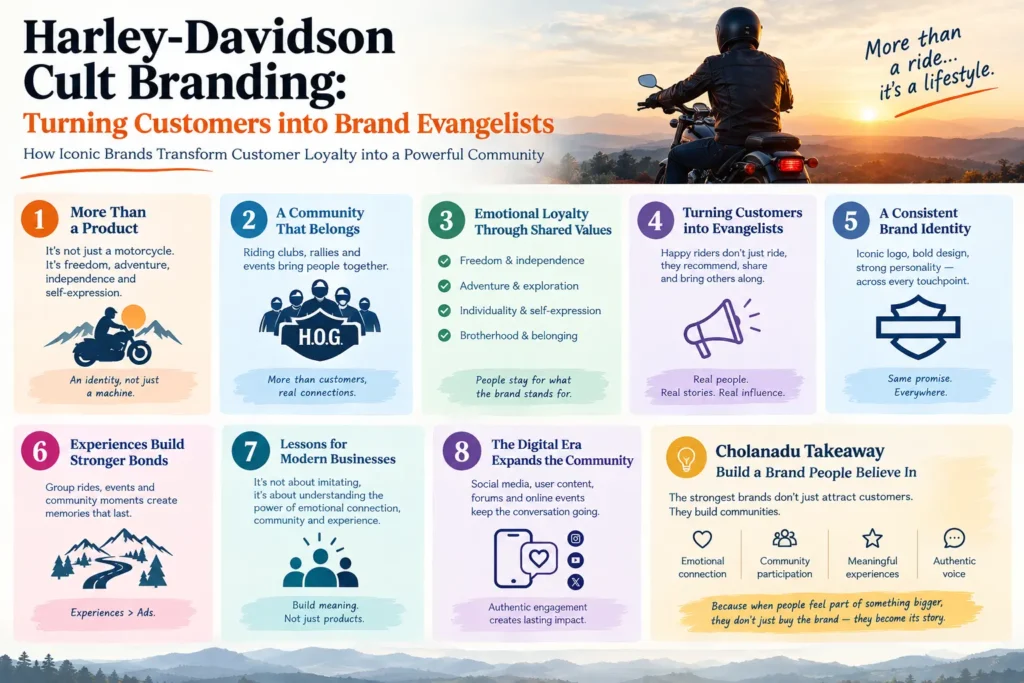
1. Beyond Products: Selling an Identity, Not Just a Motorcycle
Harley-Davidson understands that its customers are not purchasing transportation alone. They are buying into an identity associated with freedom, independence, adventure, and individuality.
Its powerful brand positioning goes beyond engine performance and technical specifications.
The motorcycle becomes a symbol of personal expression.
This emotional connection allows customers to associate the brand with their aspirations and lifestyle.
Branding Lesson: When customers see a product as an extension of their identity, their relationship with the brand becomes significantly deeper than a conventional buying decision.
This identity-driven approach is one of the strongest foundations of cult branding.
2. Creating a Community That Customers Want to Belong To
One of Harley-Davidson’s most distinctive branding strategies is its ability to bring customers together.
Through riding clubs, community gatherings, rallies, and organised experiences, the company has created opportunities for customers to connect beyond the showroom.
The Harley Owners Group (H.O.G.), established in 1983, is a prominent example of this community-driven approach.
These communities encourage riders to share experiences, participate in events, and develop relationships with people who share similar interests.
Instead of limiting customer engagement to transactions, Harley-Davidson makes the brand part of an ongoing social experience.
Branding Lesson: A brand becomes more memorable when customers develop relationships with each other through it.
Community is therefore a central element of cult branding. Harley-Davidson’s official H.O.G. programme continues to provide members with access to rides, events, chapters, and other community experiences.
3. Building Emotional Loyalty Through Shared Values
Strong brands often succeed because they represent something beyond their products.
Harley-Davidson has consistently associated itself with values such as:
- Freedom and independence
- Adventure and exploration
- Individuality and self-expression
- Brotherhood and belonging
- A distinctive riding culture
These values create a common emotional foundation among customers.
When people connect with a brand’s beliefs, they are more likely to remain engaged even when competitors offer alternative products.
This emotional loyalty is particularly valuable because it is not built entirely around discounts, pricing, or promotional campaigns.
Branding Lesson: Customers may purchase products for their features, but emotional connections give them reasons to stay.
This emotional connection is an important characteristic of cult branding.
4. Turning Customers into Brand Evangelists
A brand evangelist is a customer who voluntarily recommends and promotes a brand because of a genuine personal connection.
Harley-Davidson riders often become powerful brand advocates by sharing their riding experiences, recommending motorcycles, participating in community events, and introducing others to the brand.
This creates an organic marketing ecosystem.
Instead of depending exclusively on traditional advertising, the brand benefits from conversations between existing and potential customers.
Consider the difference:
Traditional Customer: Purchases a motorcycle and uses it.
Brand Evangelist: Purchases a motorcycle, participates in riding communities, shares experiences, recommends the brand, and encourages others to explore the same lifestyle.
The second relationship creates value beyond the original purchase.
Branding Lesson: The most influential brand ambassadors are often customers who promote a brand without being asked.
Turning customers into advocates is one of the defining outcomes of cult branding.
5. Consistent Brand Identity Across Every Touchpoint
Harley-Davidson’s identity is reinforced through its distinctive visual language, product design, merchandise, retail experience, and community activities.
Its iconic shield-and-bar logo, recognisable motorcycles, and bold brand personality contribute to a consistent identity.
This consistency ensures that customers experience a familiar brand personality across different interactions.
Whether someone encounters the brand through a motorcycle, riding event, branded merchandise, or digital platform, the underlying identity remains recognisable.
Consistency is essential for developing long-term brand recognition and emotional familiarity.
Branding Lesson: Every customer touchpoint should strengthen the same brand promise rather than communicate disconnected messages.
Consistent identity strengthens cult branding because customers repeatedly encounter the same recognisable signals and associations.
6. Creating Experiences That Strengthen Brand Attachment
Products can attract attention, but experiences create lasting memories.
Harley-Davidson understands the importance of experiences that allow customers to actively participate in the brand.
Group rides, motorcycle rallies, dealership interactions, and community celebrations provide opportunities for customers to experience the brand beyond ownership.
These experiences create emotional associations that traditional advertising alone cannot easily replicate.
For example, participating in a memorable group ride can strengthen a customer’s relationship with the brand because the experience becomes part of their personal story.
Branding Lesson: Brands should create opportunities for customers to experience their values rather than simply read about them.
Experiences help transform cult branding from a marketing message into something customers actively participate in.
7. What Businesses Can Learn from Harley-Davidson's Cult Branding Strategy
Harley-Davidson’s approach offers valuable lessons for businesses across industries, including fashion, technology, beauty, hospitality, and lifestyle products.
The objective is not to imitate Harley-Davidson’s motorcycle culture but to understand the underlying principle: customers become more loyal when they feel emotionally connected and socially included.
The lesson from cult branding is not about copying another company’s community. It is about identifying what customers genuinely value and creating meaningful ways for them to participate.
8. Cult Branding in the Digital Era
In today’s digital environment, building a brand community is no longer restricted to physical gatherings.
Social media platforms, online forums, customer-generated content, and digital membership programmes provide new opportunities for brands to strengthen customer relationships.
Businesses can encourage customers to:
- Share authentic product experiences.
- Participate in branded challenges and campaigns.
- Connect with like-minded individuals.
- Share personal stories and testimonials.
- Become active participants in brand communities.
However, successful community building requires authenticity.
Customers can easily recognise when a brand is attempting to manufacture emotional engagement without genuinely supporting its audience.
The focus should remain on creating meaningful relationships rather than simply increasing followers or engagement numbers.
Digital cult branding works best when online interaction supports a genuine brand experience rather than replacing it.
9. The Difference Between Customer Loyalty and Cult Branding
Although customer loyalty and cult branding are closely connected, they are not identical.
Cult branding represents a deeper relationship in which customers become active contributors to the brand’s identity.
Customer loyalty may encourage repeat purchases, while cult branding can encourage customers to participate in communities, share experiences, recommend the brand, and identify with its values.
Cholanadu Takeaway
Build a Brand People Believe In
Harley-Davidson demonstrates how a company can transform a product-based business into a powerful lifestyle brand.
Its success in cultivating passionate customers comes from a combination of emotional positioning, consistent identity, community participation, and meaningful customer experiences.
The most important lesson for businesses is that brand loyalty should not end with a purchase.
When customers feel understood, valued, and connected to a larger community, they can become some of the strongest voices supporting a brand.
A successful brand earns customers. An iconic brand builds a community. And a truly influential brand inspires that community to tell its story.
At Cholanadu, we believe that the future of branding lies not only in creating products people recognise, but in building identities and experiences people genuinely want to associate with.
The deeper lesson of cult branding is simple: build something customers do not just buy, but something they want to belong to.
External DoFollow links
Harley Owners Group (H.O.G.) — useful for the section about community and customer participation. Harley-Davidson describes H.O.G. as its official riding club and provides membership/community information.
Harley Owners Group – Official Harley-Davidson
H.O.G. Local Chapters — useful for the community/riding-club section. Harley-Davidson currently states that there are more than 1,400 official H.O.G. chapters worldwide.
H.O.G. Local Chapters – Harley-Davidson
Harley-Davidson H.O.G. history — useful for supporting the 1983 history mentioned in your article. Harley-Davidson’s own archive records the official launch of H.O.G. in 1983.
H.O.G. History – Harley-Davidson
Cholanadu internal links
Use these naturally inside the article:
brand audit → Cholanadu Brand Audit – SGR 777
brand identity → Cholanadu Jaguar Brand Audit Report
Cholanadu / contact CTA → Cholanadu Contact Us
