


Domino’s 30-Minute Guarantee: Positioning Your Brand Around One Core Promise
Table of Contents
ToggleHow a Simple Promise Became a Powerful Brand Positioning Strategy
In a marketplace filled with competing products, attractive offers, and endless advertising messages, what makes a brand truly memorable?
Sometimes, it is not the product itself. It is a promise.
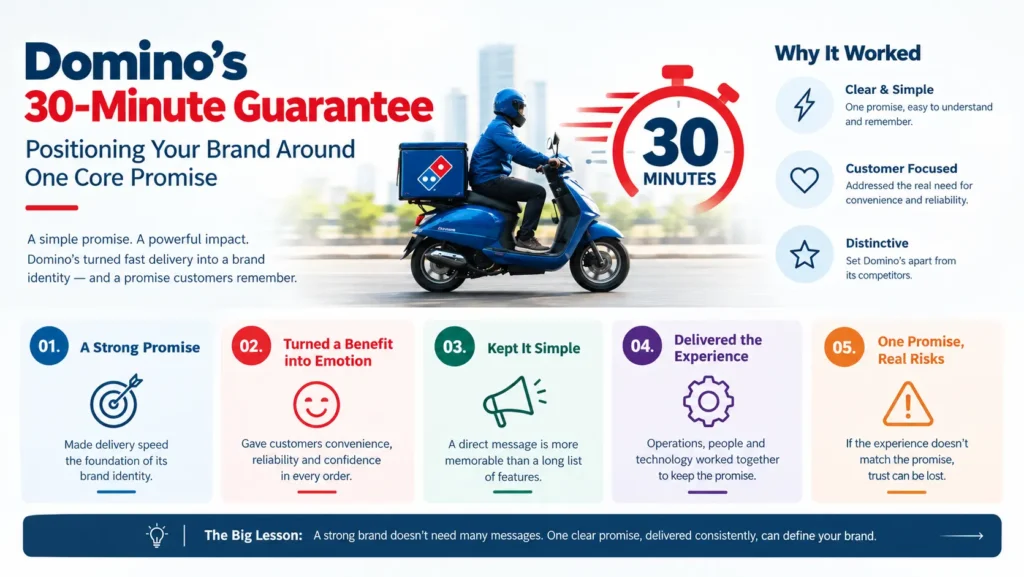
Domino’s transformed the way consumers perceived pizza delivery by building its brand identity around one simple yet powerful commitment: Your pizza will be delivered within 30 minutes.
Rather than competing solely on taste, ingredients, or pricing, Domino’s positioned itself around speed, convenience, and reliability. This strategy demonstrated how a single, customer-focused promise could become the foundation of an entire brand experience.
For businesses looking to establish a distinctive market identity, Domino’s 30-minute guarantee offers an important lesson: a strong brand does not always need multiple messages. Sometimes, one promise is powerful enough to define everything.
This is the foundation of effective brand positioning: giving customers a clear reason to remember what makes a business different.
1. The Power of One Clear Brand Promise
A brand promise is more than an advertising slogan. It is a commitment that communicates what customers can consistently expect from a business.
Domino’s understood that customers ordering pizza were not simply looking for food. They were also looking for convenience, quick service, and a predictable experience.
By emphasizing delivery speed, the company addressed a specific customer expectation and created a clear point of differentiation.
Instead of communicating several unrelated benefits, Domino’s concentrated on one central idea.
The Strategic Insight: When customers can immediately understand what makes your brand different, remembering your brand becomes easier.
For businesses, this means identifying the one benefit that matters most to their target audience and building their communication around it.
A focused brand positioning strategy begins with identifying that meaningful customer benefit.
2. Turning a Functional Benefit into Brand Identity
Fast delivery is a functional benefit. But Domino’s transformed this operational advantage into an emotional brand association.
Think about what happens when someone orders food after a long working day.
They are not necessarily thinking about delivery logistics. They want their food without unnecessary waiting.
Domino’s positioned itself as the brand that understood this need.
Its delivery promise communicated:
- Convenience when customers needed it.
- Reliability through a clearly defined expectation.
- Efficiency in an increasingly time-conscious lifestyle.
- Confidence in the ordering experience.
This demonstrates an important branding principle: Customers remember how a brand makes their lives easier, not merely what the brand sells.
A business selling a product or service should therefore look beyond its features and identify the customer experience those features create.
This is where brand positioning turns a functional feature into a recognisable identity.
3. Why the 30-Minute Guarantee Became a Memorable Marketing Strategy
One of the most interesting aspects of Domino’s strategy was its simplicity.
The 30-minute promise was easy to understand, easy to communicate, and closely connected to the customer’s purchase decision.
Compare these two messages:
Message A: We provide delicious pizzas with excellent ingredients, convenient ordering, and efficient delivery.
Message B: Your pizza in 30 minutes.
The second message is more direct and immediately communicates a specific benefit.
This is the strength of focused brand positioning.
A memorable brand promise generally possesses three characteristics:
Clarity: Customers understand the promise without needing additional explanation.
Relevance: The promise addresses an actual customer need.
Distinctiveness: The promise gives customers a reason to remember the brand.
Domino’s demonstrated how a straightforward proposition could become a powerful competitive differentiator.
4. The Connection Between Brand Promise and Customer Experience
A brand promise is only valuable when the customer experience supports it.
If a company advertises exceptional delivery speed but consistently disappoints customers, the promise becomes a source of frustration rather than trust.
This is why brand positioning must extend beyond advertising.
For Domino’s, a speed-focused positioning strategy required operational coordination across several areas:
- Order processing and preparation.
- Kitchen workflow and efficiency.
- Delivery personnel coordination.
- Technology-enabled order management.
- Customer communication.
The promise was not simply a marketing statement. It influenced how the business organized its operations.
Branding Lesson: Your marketing communicates the promise, but your operations must deliver the experience.
For growing businesses, this distinction is particularly important. A company should never build its identity around a promise that its operational capabilities cannot consistently support.
5. The Risks of Building a Brand Around One Promise
Although focused positioning creates strong brand recognition, depending entirely on one promise also carries risks.
Domino’s delivery guarantee became closely associated with its brand, but a speed-based promise also created operational and reputational challenges.
A. Customer Expectations Become Higher
Once customers associate a brand with speed, they naturally expect fast service every time.
Even minor delays can affect their perception.
B. Operational Pressure Increases
A strict delivery commitment can place pressure on employees, logistics, and service systems.
Businesses must ensure that customer promises do not compromise safety, quality, or employee well-being.
C. Brand Identity Can Become Too Narrow
When a brand focuses exclusively on one benefit, customers may overlook other valuable attributes.
For example, a customer might associate a delivery brand only with speed rather than food quality, menu innovation, or customer service.
D. Market Conditions Can Change
Customer expectations evolve. Technology, competition, delivery infrastructure, and consumer behaviour can influence which benefits matter most.
A successful brand must therefore preserve its central identity while adapting its delivery model.
Importantly, Domino’s original 30-minute guarantee should be understood as a historical brand-positioning strategy, not as a universal current delivery commitment. Its terms and availability have varied across markets and periods.
6. What Businesses Can Learn from Domino’s Positioning Strategy
Domino’s approach provides valuable lessons for companies across industries, particularly startups, service businesses, and emerging brands.
The objective is not to copy the 30-minute guarantee. It is to understand the strategic thinking behind it.
For example:
A digital marketing agency could position itself around transparent reporting.
A skincare brand could focus on gentle, science-informed formulations.
A logistics company could emphasize dependable tracking and communication.
A professional service provider could build its identity around personalized attention.
In every case, the strongest promise is one that customers value and the business can genuinely deliver.
Effective brand positioning connects the customer need with a capability the business can consistently support.
7. How to Identify Your Brand's One Core Promise
Creating a focused brand promise requires strategic thinking rather than simply choosing an attractive tagline.
Businesses should identify the benefit customers value most and determine whether the company can consistently deliver that benefit.
The strongest brand positioning comes from the intersection of customer expectations, business capability, and differentiation.
8. One Promise, Multiple Customer Touchpoints
A brand promise should not exist only in advertisements.
It must be reflected throughout the customer journey.
Consider a brand that promises convenience.
Its website should be easy to navigate. Its ordering process should be simple. Its customer support should be accessible. Its delivery experience should reinforce the same expectation.
When every interaction supports the central promise, customers begin to recognize a consistent brand personality.
This is how positioning moves from marketing communication into the actual customer experience.
For businesses, the objective should be to create alignment between what they say, what they do, and what customers experience.
Consistent brand positioning helps connect these customer touchpoints.
9. The Bigger Lesson: Strong Brands Stand for Something Specific
Domino’s 30-minute guarantee demonstrates that powerful branding does not necessarily come from communicating everything a company offers.
It comes from identifying what matters most and making that benefit unmistakably clear.
A brand that tries to be everything to everyone may struggle to establish a distinctive identity.
However, a brand built around a meaningful core promise can create stronger recognition, clearer communication, and more consistent customer expectations.
The real challenge is not creating a bold promise.
It is creating a promise that is relevant, credible, achievable, and sustainable.
Strong brand positioning is ultimately about making one meaningful promise and consistently connecting that promise with the customer experience.
Conclusion:
Make One Promise. Deliver It Consistently. Build a Lasting Brand.
Domino’s 30-minute guarantee remains an important example of focused brand positioning because it connected a simple customer expectation with a recognizable brand identity.
Its strategy illustrates a fundamental principle of modern branding: A brand becomes memorable when customers know exactly what to expect from it.
For businesses developing their market identity, the lesson is clear.
Do not begin by asking how many things your brand can communicate.
Start by asking what single promise your customers should remember.
Because in a competitive marketplace, clarity creates recognition, consistency builds trust, and a meaningful promise can become the foundation of a lasting brand.
Interactive Brand Strategy: What Is Your One Core Promise?
Imagine you are launching a new business today.
Which single promise would you choose to make your brand memorable?
- Speed: We respect your time.
- Quality: We never compromise on standards.
- Trust: We deliver what we promise.
- Simplicity: We make complicated things easier.
- Personalization: Every customer receives individual attention.
A final question for business owners and marketers:
If your customers could remember only ONE thing about your brand, what would you want that to be?
That answer could be the starting point of your entire brand-positioning strategy.
Cholanadu – Exploring the Strategy Behind Powerful Brands
For businesses developing their market identity, a clear brand positioning strategy can help connect their promise, customer experience, and long-term brand identity.
External DoFollow links
Domino’s 30-minute delivery heritage → use on the paragraph discussing the historical 30-minute promise. Domino’s own corporate material says the guarantee ended in 1993 in the U.S., while Domino’s India has separately used 30-minute service guarantees.
Domino’s official 30-minute delivery history
Domino’s India service guarantee → use when discussing the current/historical distinction in the article. Domino’s India currently describes different service-guarantee times depending on restaurant/location and circumstances.
Domino’s India Service Guarantee Terms
Trademark/brand protection → use around the section about protecting brand identity. WIPO explains trademarks as signs capable of distinguishing one enterprise’s goods or services from another’s.
WIPO – Trademarks
Cholanadu internal links
Use these naturally inside the article:
brand audit → Cholanadu Brand Audit – SGR 777
brand identity → Cholanadu Jaguar Brand Audit Report
Cholanadu / contact CTA → Cholanadu Contact Us
