


Marvel Cinematic Universe: How to Build a Multi-Product Brand Ecosystem
Table of Contents
Toggle9 Brand Ecosystem Secrets: Power Lessons From the MCU
What if your business could become more than a single product?
Imagine a customer discovering your brand through one product, becoming interested in another, following your content, engaging with your community, purchasing merchandise, and eventually becoming a long-term advocate.
That is the power of a brand ecosystem. Few entertainment brands demonstrate this idea as clearly as the Marvel Cinematic Universe (MCU).
Marvel did not simply build a collection of successful movies. It created a connected network where characters, stories, films, series, merchandise, experiences, communities, and digital content continuously reinforce one another.
For modern businesses, this offers a powerful branding lesson: Don’t build products that exist separately. Build a brand where every product strengthens the others.
What Is a Multi-Product Brand Ecosystem?
A multi-product brand ecosystem is a structure where multiple products, services, content formats, and customer experiences are connected under one larger brand identity.
Instead of: Product A → Customer Product B → Customer Product C → Customer
The modern approach looks more like: Brand → Product → Experience → Content → Community → More Products
Every interaction creates another opportunity to deepen the relationship.
Think of Marvel:
Movie → Character → Series → Merchandise → Game → Fan Community → Next Movie
The customer isn’t experiencing isolated products. They’re entering an interconnected world.
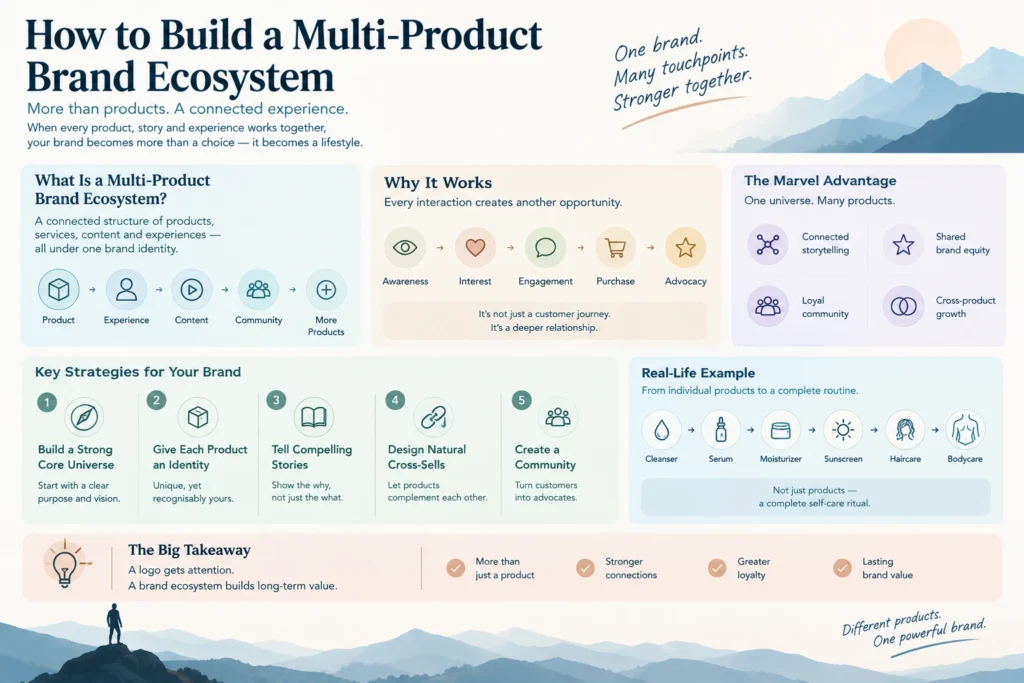
Marvel's Biggest Branding Advantage: One Universe, Many Products
Marvel has an enormous number of characters and stories.
Yet the brand doesn’t feel fragmented. Why? Because the individual products are connected through a larger narrative world.
Iron Man isn’t just a character. Captain America isn’t just a movie franchise. The Avengers isn’t just a film series. Each exists within a larger Marvel universe.
That creates something extremely valuable for brands: Shared Brand Equity
When one product succeeds, it can increase awareness and interest in other offerings. A customer who discovers one character can naturally discover another.
A successful product becomes an entry point into the wider brand.
The Connected Product Strategy
One of the strongest lessons from Marvel is the power of connection.
A company may have:
Multiple products
Different customer segments
Several services
Multiple content channels
Physical and digital offerings
But if customers don’t understand how everything connects, the business can feel like a collection of unrelated offerings rather than a cohesive brand ecosystem. Marvel solves this through a common identity and interconnected storytelling.
For businesses, the question becomes: Can your products tell one larger story?
For example, imagine a skincare company offering: Cleanser → Serum → Moisturizer → Sunscreen → Haircare → Bodycare
Instead of marketing each product independently, the company could build: “Your Complete Everyday Self-Care Ritual.”
Now the products aren’t competing for attention. They’re completing an experience.
1. Build a Strong Core Universe
Before expanding into multiple products, a company needs a powerful foundation. Marvel has its universe.
Your business needs its own equivalent.
It could be:
A brand philosophy
A lifestyle
A customer mission
A distinctive methodology
A cultural idea
A signature experience
For example: Instead of: “We sell skincare products.”
Build around: “We make natural skincare part of everyday Indian living.”
Now every future product has a place within the same umbrella.
2. Create Products With Individual Identity
A connected portfolio doesn’t mean every product should look identical. Marvel characters have different personalities, costumes, stories, and audiences.
Yet they remain recognisably Marvel. Your products should work similarly.
Each product should have its own: Purpose + Personality + Positioning
while still carrying: Brand Identity + Brand Values + Visual Language
This creates a powerful balance: Different Products. One Brand.
3. Turn Products Into Stories
One reason Marvel creates strong engagement is that its products are surrounded by stories. This is an important lesson for businesses. Don’t simply communicate:
“New Product Available.”
Give the product a reason to exist.
Tell customers:
Why was it created?
What problem inspired it?
Who is it designed for?
What makes it different?
How does it connect with the rest of the business?
What happens after customers use it?
A product with a story becomes easier to remember.
4. Design the Cross-Sell Naturally
The strongest brand ecosystem strategies don’t make customers feel like they’re constantly being sold something. Instead, the next product feels like a natural continuation.
Marvel’s setup encourages discovery: Watch one story → discover another character → explore another film → engage with merchandise → return for the next release.
Businesses can create the same journey: Buy Shampoo → Learn Haircare Tips → Discover Conditioner → Explore Hair Oil → Join Haircare Community
The customer journey becomes: Discovery → Purchase → Experience → Exploration → Loyalty
5. Content Should Connect the Business
A multi-product company needs more than product advertisements. It needs a content engine.
Your content can include:
Educational Content: “How to choose the right product”
Storytelling: “Why we created this product”
Behind the Brand: “Meet the people behind the formulation”
Lifestyle Content: “How to build a simple daily routine”
Community Content: “How our customers use our products”
Product Content: “What’s inside and why it matters”
Every content format becomes another doorway into the business.
Explore our insights on Cholanadu Strategy and explore framework guides at Cholanadu Brand Architecture. Learn more about global strategy building on Harvard Business Review and corporate growth on Adweek.
6. Build a Hero Product
Marvel has iconic characters that act as powerful entry points into its universe. Businesses can use the same principle. Don’t assume every product needs to become equally famous. Identify products that can become primary entry points.
For example:
Your hero product is not merely a revenue generator. It can become your brand gateway.
7. Expand Without Diluting the Brand
Growth creates a major branding challenge. More products can mean more opportunities. But too many unrelated products can weaken your positioning. Before launching something new, ask:
“Does this belong in our universe?”
If the answer is unclear, the product may require stronger positioning or may not fit the structure.
A successful brand ecosystem is not about maximum products. It is about meaningful connections between products.
8. Build a Community, Not Just a Customer Base
Marvel’s platform is strengthened by its enormous fan community. Fans don’t simply consume content.
They discuss it. Share it. Create theories. Collect products. Attend experiences. Recommend it to others.
Brands can create similar communities around shared interests:
Product Users → Community → Conversations → Content → Participation → Advocacy
This changes the relationship from: “I bought from this brand.” to: “I’m part of this community.”
That is a much deeper form of brand loyalty.
9. Create Multiple Entry Points
Not every customer discovers your business in the same way. One person may discover you through Instagram.
Another through Google. Another through a product. Another through YouTube. Another through a recommendation. Another through an event.
A strong brand ecosystem gives each customer multiple entry points.
Your Business Model Could Look Like:
Website → Products → Social Media → Educational Content → Community → Events → Reviews → New Products
Every entry point should eventually lead customers back to the larger brand.
The Marvel Lesson for Modern Businesses
Marvel demonstrates a fundamental branding principle: The real value isn’t always in individual products. It is in the connections between them within a unified brand ecosystem.
One successful product can attract attention. A connected business model can create continuous engagement.
That’s the difference between:
A Product Portfolio “Here are all the things we sell.”
and
A Brand Ecosystem “Here is the world our brand has created and there is always something more to discover.”
How Businesses Can Build Their Own Brand Universe
Here’s a simple framework:
STEP 01: Define Your Core Idea — What does your brand ultimately stand for?
STEP 02: Identify Your Hero Product — Which product can introduce customers to the brand?
STEP 03: Build Supporting Products — What other products naturally extend the customer experience?
STEP 04: Connect the Products — Create logical journeys between them.
STEP 05: Build a Content Engine — Turn products, people, stories, education, and experiences into continuous content.
STEP 06: Create Community — Give customers reasons to participate beyond purchasing.
STEP 07: Expand Carefully — Every new product should strengthen the overall brand ecosystem rather than confuse it.
The Future of Branding Isn't Just Multi-Product. It's Multi-Experience.
Customers don’t experience brands through a single touchpoint anymore.
They discover. They watch. They search. They compare. They purchase. They review. They share. They participate. They return.
The brands that understand this can move beyond simply selling products. They can create worlds customers want to return to. Marvel’s biggest branding lesson is therefore not simply about superheroes or blockbuster entertainment.
It is about architecture. One Brand. Multiple Products. Connected Experiences. One Larger Story.
That is how a collection of products can become a thriving brand ecosystem.
And when every product gives customers another reason to explore the brand, growth becomes connected rather than isolated.
Cholanadu Takeaway
Your next product should not feel like the beginning of a new business. It should feel like the next chapter of the same story. Because the strongest brands don’t just ask:
“What should we sell next?”
They ask: “What should our customers discover next?”
That shift from products to experiences, from transactions to relationships, and from portfolios to an integrated brand ecosystem is where modern brand building begins.
Cholanadu – Building Brands That Think Beyond the Logo.
Cholanadu Perspective
At Cholanadu, we believe a brand should do more than look good. It should communicate positioning, personality and ambition. Whether your business needs a subtle visual refresh or a complete strategic transformation, the right question isn’t:
“Do we need a new logo?”
It’s:
“Does our current identity still represent the value of our brand?”
If the answer is no, it may be time to evolve.
Cholanadu – Building Brands That Stay Relevant.
