


The Invisible Brand Barrier: Why Customers Click Away Without Buying
Table of Contents
ToggleCustomer Buying Friction: 7 Powerful Secrets to Stop Drop-Offs
The Invisible Brand Barrier: Why Customers Click Away Without Buying
When Interest Doesn’t Turn Into Sales
Imagine a customer visiting your website. They explore your products, examine your services, and perhaps even add an item to their cart. Yet, instead of completing the purchase, they leave without buying anything.
What went wrong? The product may be excellent. The price may be competitive. Your website may even look visually attractive. Still, something prevents the customer from taking the final step.
This is the invisible brand barrier—a collection of subtle issues that weaken customer confidence, create hesitation, and cause customer buying friction that makes people choose a competitor instead.
For modern businesses, attracting attention is only half the challenge. The real success lies in making customers feel confident enough to buy by removing every trace of customer buying friction.
Let’s explore what creates these invisible barriers and how your brand can overcome customer buying friction.
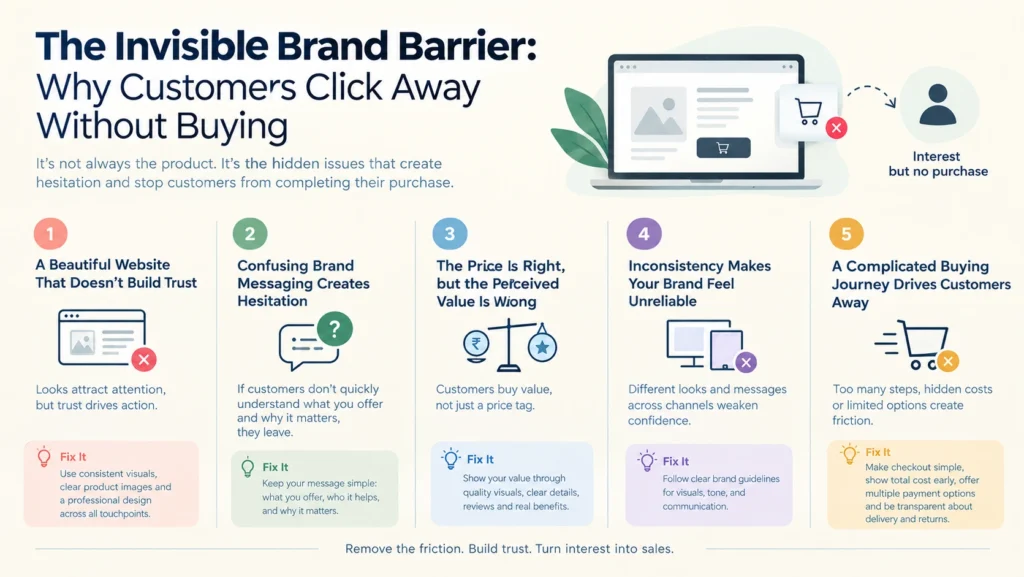
1. A Beautiful Website That Doesn't Build Trust
Visual appeal attracts attention, but trust encourages action. A website with inconsistent colours, outdated visuals, confusing layouts, or poor-quality product images can make customers question the credibility of a business, directly increasing customer buying friction.
Even if your products are exceptional, an unprofessional digital presence can create doubts about their quality.
Ask yourself:
Does my website look professional and reliable?
Are my product images clear and consistent?
Does my brand communicate quality at first glance?
Can visitors easily understand what my business offers?
The solution: Create a consistent visual identity across your website, social media platforms, advertisements, and product packaging. Every customer touchpoint should communicate the same level of professionalism to reduce customer buying friction.
Remember, customers often form an impression of your brand before they fully understand your product. To review professional design and web standards, check guidelines from the AIGA Design Association
2. Confusing Brand Messaging Creates Customer Hesitation
Customers rarely have the patience to decode complicated marketing messages. Unclear copy creates customer buying friction right from the start.
If your website doesn’t clearly explain what you offer, who you serve, and why your product matters, visitors may leave before discovering its value.
For example, a skincare brand that promotes ten different benefits without explaining its primary advantage may struggle to communicate what makes it special. The customer is left wondering: Why should I choose this brand over another?
The solution: Simplify your messaging. Your homepage should communicate three essential things:
What you offer: Make your product or service immediately clear.
Who it helps: Identify the audience you serve.
Why it matters: Explain the meaningful benefit customers receive.
A clear message reduces confusion and helps customers make decisions with greater confidence, eliminating unnecessary customer buying friction.
3. The Price Is Right, but the Perceived Value Is Wrong
Have you ever seen a customer reject a reasonably priced product while happily paying more for a competitor’s offering?
The difference may not be the price. It may be the perceived value. When value isn’t communicated effectively, pricing creates unexpected customer buying friction.
Customers evaluate more than the amount they spend. They also consider product quality, convenience, reliability, customer service, and the overall experience associated with a brand. When your branding fails to communicate these benefits, even a competitive price can feel expensive.
The solution: Make your value visible. Use professional product photography, clear descriptions, authentic customer reviews, transparent pricing, and meaningful explanations of your product’s benefits to lower customer buying friction.
Instead of simply telling customers that your product is premium, demonstrate what makes it worth their investment.
Interactive question: If a first-time visitor landed on your website today, would they immediately understand why your product deserves its price?
4. Inconsistency Makes Your Brand Feel Unreliable
Imagine seeing a sophisticated advertisement on Instagram, visiting a website with a completely different visual style, and receiving a poorly designed confirmation email. Each interaction may seem minor, but together they introduce customer buying friction.
Customers expect a certain level of continuity. When your messaging, visual identity, and service experience contradict one another, confidence can weaken.
Brand consistency doesn’t mean making every design identical. It means ensuring that every interaction reflects the same identity, personality, and quality standards.
The solution: Establish clear brand guidelines covering:
Logo usage and visual identity.
Typography and colour palettes.
Tone of voice and messaging.
Photography and creative direction.
Customer communication and service standards.
Consistency makes your brand easier to recognise and helps customers develop familiarity over time, successfully dismantling customer buying friction.
5. A Complicated Buying Journey Drives Customers Away
Even interested customers can abandon a purchase when the buying process becomes frustrating. Poor checkout design is a primary source of customer buying friction.
Common obstacles include:
Too many checkout steps.
Unexpected delivery charges.
Limited payment options.
Unclear return and refund policies.
Slow-loading pages.
Mandatory account creation before checkout.
These problems introduce unnecessary effort at the exact moment customers are ready to buy.
The solution: Make purchasing simple and transparent. Display the total cost early, minimise unnecessary checkout fields, offer convenient payment methods, and clearly explain delivery, returns, and refunds to erase customer buying friction.
Every additional obstacle creates another opportunity for a customer to reconsider their decision.
A useful exercise: Try purchasing a product from your own website using your mobile phone. Identify every moment that feels confusing, slow, or unnecessary. Sometimes, the barriers affecting your customers become obvious when you experience your website as a customer yourself.
6. Missing Social Proof Leaves Customers Searching for Reassurance
First-time customers may hesitate because they have no previous experience with your brand. Uncertainty regarding quality creates severe customer buying friction.
They may wonder whether the product will meet their expectations, whether the business is trustworthy, or whether other customers have had a positive experience. Without sufficient reassurance, they may postpone the purchase or choose a more familiar competitor.
The solution: Build credibility through genuine evidence. Consider incorporating:
Verified customer reviews.
Authentic testimonials.
Clear product specifications.
Relevant case studies.
Transparent business information.
Responsive customer support.
Avoid fabricated reviews or exaggerated claims. Trust is difficult to establish and easy to damage. Your objective should be to help customers make informed decisions—not pressure them into buying—thereby dissolving customer buying friction.
7. Your Brand May Be Selling Features Instead of Solutions
Customers don’t always buy a product simply because it has impressive features. They buy because they believe it will solve a problem, improve an experience, or fulfil a need. Focusing on technical specs over benefits generates unnecessary customer buying friction.
For example, a business selling project management software might focus entirely on technical features. However, its customers may care more about saving time, improving collaboration, and reducing missed deadlines.
When your marketing focuses only on what a product contains rather than what it helps customers achieve, its relevance may be lost.
The solution: Connect features to meaningful benefits. Instead of simply listing what your product does, explain how it makes the customer’s life or business better to eliminate customer buying friction.
The more clearly customers understand the value of your offering, the easier it becomes for them to see why they should choose your brand.
8. How to Identify the Invisible Barriers in Your Brand
Not every customer who leaves your website does so because of poor branding. Some are comparing options, researching prices, or simply not ready to purchase. However, identifying patterns of customer buying friction is essential.
Use practical analytics methods to understand what may be preventing conversions. Start by examining the evidence, identifying your biggest obstacle, making a focused improvement, and measuring whether customer behaviour changes.
A thoughtful improvement to one important page suffering from high customer buying friction may be more valuable than redesigning your entire brand without understanding the root problem.
9. Turning Customer Hesitation Into Brand Confidence
Overcoming invisible brand barriers and eliminating customer buying friction requires more than attractive design. It demands a coordinated approach to branding, communication, and customer experience.
Here is a simple framework to begin:
Step 1: Review your first impression. Evaluate whether your website and marketing materials communicate credibility and quality.
Step 2: Clarify your message. Make your offering, audience, and unique value immediately understandable.
Step 3: Remove unnecessary friction. Simplify navigation, product discovery, and checkout.
Step 4: Strengthen credibility. Provide genuine reviews, transparent policies, and reliable customer support.
Step 5: Measure and improve. Track relevant conversion metrics and test changes rather than relying entirely on assumptions.
The objective is not merely to persuade customers to buy. It is to create an experience in which buying feels like a natural, confident decision free of customer buying friction.
The Cholanadu Perspective: Your Brand Should Remove Doubts, Not Create Them
Customers don’t always explain why they leave without purchasing. Sometimes, the reason is an unclear message. Sometimes, it is an inconvenient checkout process. In other cases, it is a lack of trust or a failure to communicate value.
These small obstacles may appear insignificant individually, but together they can weaken your brand’s ability to convert interest into sales through persistent customer buying friction.
A strong brand does more than attract attention. It builds confidence at every stage of the customer journey.
At Cholanadu, we understand that effective branding goes beyond logos and visual aesthetics. It involves creating a clear identity, communicating meaningful value, and delivering a consistent experience that encourages customers to choose your business with confidence. To align your growth strategy with expert frameworks, explore our guide on Cholanadu Brand Strategy Services.
The question every business owner should ask is simple: Are your customers leaving because your product isn’t right for them or because your brand hasn’t given them enough reasons to trust it?
Finding the answer could be the first step towards building a stronger brand and a more effective customer journey free of customer buying friction.
