


The Intel Inside Campaign: How B2B Brands Build Consumer Trust Through Audits
Table of Contents
ToggleB2B Branding: 7 Powerful Intel Inside Trust Lessons
How Transparency, Third-Party Validation, and Strategic Branding Turn Invisible B2B Technology into Consumer Confidence
When Trust Becomes a Competitive Advantage
In a world where consumers interact with finished products rather than the technologies powering them, how does an invisible B2B brand become a trusted household name?
The answer lies in one of the most successful ingredient-branding strategies in business history: Intel Inside.
For decades, Intel operated primarily behind the scenes, supplying microprocessors to computer manufacturers. While consumers recognised computer brands such as Dell, HP, and Lenovo, they rarely understood which processor powered their devices.
Intel changed this perception by making its technology visible, recognisable, and trustworthy.
However, building consumer trust requires more than a memorable logo or advertising campaign. It requires credibility, consistency, and proof of quality. This is where audits, certifications, and independent validation become essential tools for B2B branding.
The Intel Inside strategy demonstrates how a company selling components to other businesses can establish a direct emotional connection with end consumers.
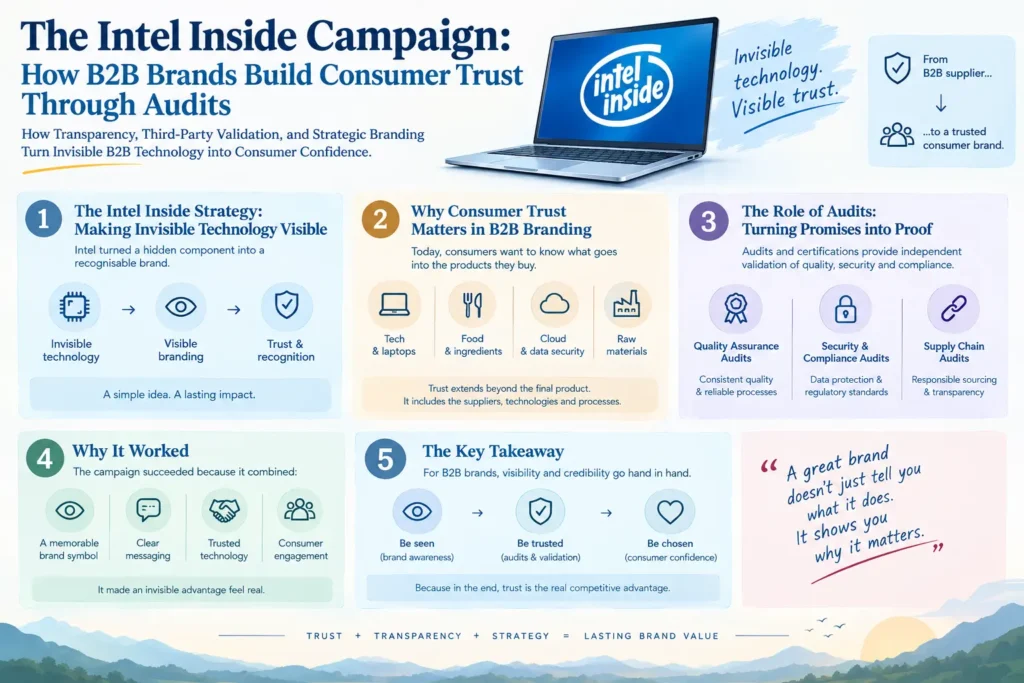
1. The Intel Inside Strategy: Making Invisible Technology Visible
When consumers cannot see the technology, branding helps them recognise its value.
Before Intel’s ingredient-branding strategy gained prominence, microprocessors were largely invisible to ordinary computer buyers.
Consumers purchased computers based on their manufacturer, design, specifications, and price. The processor was simply another technical component.
Intel recognised an important marketing opportunity: instead of allowing computer manufacturers to own the entire customer relationship, it could establish its own identity within the finished product.
The Intel Inside campaign, introduced in 1991, transformed the company’s marketing approach.
Its distinctive logo became a familiar symbol displayed on computer packaging, advertisements, and product labels.
This created a powerful connection between two brands:
- The original equipment manufacturer (OEM): The company producing the computer.
- The ingredient brand: Intel, supplying the processor technology.
Consumers gradually began recognising Intel as an important factor in computer performance and quality.
The Strategic Lesson :
B2B companies do not always need to remain invisible suppliers. By communicating their contribution effectively, they can influence consumer preferences even when their products are not directly purchased by end users.
This is a central principle of B2B branding: make an invisible contribution visible and understandable.
2. Why Consumer Trust Matters in B2B Branding
B2B purchasing decisions are traditionally driven by technical specifications, pricing, reliability, and long-term business relationships.
However, modern consumers increasingly want to understand what goes into the products they purchase.
Consider these examples:
- A consumer buying a laptop wants to know which processor powers it.
- A customer purchasing packaged food may look for certified ingredients.
- A business selecting cloud infrastructure wants confidence in data security.
- A manufacturer choosing raw materials needs assurance of quality and consistency.
In each situation, trust extends beyond the final product manufacturer.
It also depends on the suppliers, technologies, and processes behind the product.
This creates an opportunity for B2B brands to develop consumer-facing credibility.
Trust is no longer built only through what a brand promises. It is strengthened through what a brand can demonstrate.
For modern B2B branding, this distinction between promises and proof is particularly important.
3. The Role of Audits: Turning Brand Promises into Verifiable Proof
A powerful advertising campaign can attract attention, but independent verification helps establish credibility.
Audits provide structured methods to examine whether a company follows defined standards, maintains quality controls, and fulfils its commitments.
For B2B brands, audits can support trust in several ways.
A. Quality Assurance Audits
Quality audits evaluate whether products and manufacturing processes consistently meet established requirements.
For technology companies, this may include examining manufacturing controls, testing procedures, and product reliability.
For ingredient brands, quality assurance can help demonstrate that their contribution meets specified performance expectations.
B. Security and Compliance Audits
Businesses operating in technology, finance, healthcare, and digital services often handle sensitive information.
Independent security assessments can provide evidence that appropriate controls are implemented.
For example, certifications and independent assessments such as ISO/IEC 27001 can help organisations demonstrate their information security management practices.
C. Supply Chain Audits
Consumers increasingly care about where products come from and how they are manufactured.
Supply chain audits can examine supplier practices, traceability, sourcing standards, and operational compliance.
This is particularly relevant for brands operating across multiple countries and manufacturing locations.
D. Environmental and Sustainability Audits
Sustainability claims require credible supporting information.
Environmental audits and independently verified assessments can help companies communicate their environmental performance more transparently.
Important distinction: An audit does not automatically guarantee that a product is flawless. Its value depends on its scope, methodology, independence, and findings.
For B2B branding, this means audits should support specific claims rather than become generic marketing symbols.
4. How Intel Inside Built Trust Through Brand Partnerships
Trust becomes stronger when multiple brands communicate a consistent value proposition.
Intel’s success was not based entirely on consumer advertising.
Its ingredient-branding model encouraged computer manufacturers to highlight Intel processors as part of their product offering.
This created a mutually beneficial relationship.
For Intel:
Increased consumer recognition.
- Stronger differentiation from competing processor manufacturers.
- Greater influence over consumer purchasing preferences.
- A recognisable identity beyond its direct business customers.
For computer manufacturers:
- An opportunity to communicate processor credibility.
- Additional product differentiation.
- Access to an established technology brand.
- Greater consumer familiarity with an important product component.
The Intel Inside logo became a recognisable assurance cue.
However, brand recognition and technical verification serve different purposes.
A logo communicates identity. An audit or certification provides evidence about specific standards or processes.
For B2B brands, combining both can create a stronger foundation for consumer confidence.
This combination is an important part of effective B2B branding because recognition and verification address different aspects of consumer uncertainty.
5. From Certification to Consumer Confidence: The Psychology Behind Trust
Consumers rarely have the time or technical knowledge to evaluate every component of a product.
They often depend on familiar signals that simplify purchasing decisions.
These signals may include:
- Recognised ingredient-brand logos.
- Independent certifications.
- Product testing disclosures.
- Quality assurance statements.
- Transparent manufacturing information.
This is known as a trust-signalling mechanism.
When a consumer recognises a familiar technology provider or a credible certification, it may reduce uncertainty surrounding the product.
For example, a laptop displaying an Intel processor badge communicates more than the presence of a component. It connects the finished product with a technology brand that consumers may already recognise.
Similarly, a B2B company that communicates verified quality standards can help consumers understand the reliability of its contribution.
The important principle is authenticity.
A certification should never be used merely as a decorative marketing element. Its relevance must be clear, and its claims must accurately reflect what has been assessed.
Authentic evidence is therefore an important foundation for B2B branding.
6. How B2B Brands Can Build Their Own Intel Inside Strategy
Intel’s branding model offers valuable lessons for businesses that supply products, components, technology, or services to other companies.
Here are five practical strategies.
1. Identify Your Invisible Value
Understand which part of your product or service creates measurable value for the end consumer.
It could be:
- A specialised technology.
- A high-quality raw material.
- A manufacturing process.
- A security solution.
- A performance-enhancing component.
Your branding strategy should make this contribution understandable.
2. Build a Recognisable Brand Identity
Develop a consistent identity that business partners can incorporate into their communication.
This may include a logo, product badge, certification mark, or approved brand messaging.
The identity should communicate the value of your contribution without confusing consumers about who manufactures the finished product.
A recognisable identity can strengthen B2B branding when it clearly communicates the role of the supplier.
3. Establish Independent Verification
Identify relevant quality, security, safety, or sustainability standards.
Work with qualified independent auditors or certification bodies where appropriate.
Ensure that the verification process is documented and that claims remain within the scope of the assessment.
4. Collaborate With Your Business Partners
Create co-branding opportunities with manufacturers, distributors, and service providers.
Provide partners with clear guidelines explaining how your brand, certification, and product claims should appear.
This ensures consistent communication across different customer touchpoints.
5. Communicate Evidence, Not Just Promises
Instead of relying exclusively on statements such as “premium quality” or “industry-leading technology”, communicate specific, verifiable information.
Evidence-based communication creates clarity and helps consumers make informed decisions.
This approach can make B2B branding more credible because the brand promise is connected to evidence.
6. Common Mistakes B2B Brands Should Avoid
Although ingredient branding can create strong market recognition, it requires careful execution.
Some common mistakes include:
Overpromising through marketing: Making claims that cannot be supported by technical evidence can damage credibility.
Misusing certification logos: Displaying a certification mark without proper authorisation or outside its approved scope can create legal and reputational risks.
Confusing audits with guarantees: An audit evaluates defined criteria. It does not necessarily establish that every product or business activity is completely risk-free.
Ignoring the end consumer: Technical language may impress industry professionals but fail to communicate value to ordinary buyers.
Treating co-branding as a logo exercise: A successful ingredient-branding strategy requires meaningful product differentiation, partner cooperation, and consistent quality.
The strongest B2B brands connect their marketing promises with operational evidence.
Strong B2B branding therefore requires consistency between what a company communicates and what it can demonstrate.
7. The Future of B2B Branding: Transparency as a Brand Asset
The future of B2B branding will increasingly involve transparency, traceability, and independently supported claims.
Consumers are becoming more interested in understanding how products are developed, sourced, tested, and delivered.
At the same time, businesses face growing expectations around cybersecurity, sustainability, product quality, and responsible sourcing.
This creates opportunities for B2B brands to move beyond traditional supplier relationships.
Digital product information, traceability systems, third-party assessments, and accessible certification details can help businesses communicate their value more effectively.
The next generation of ingredient brands may not simply tell consumers what is inside a product.
They may also provide clearer information about how that component was produced, tested, and verified.
For businesses, this means that transparency is not merely a compliance requirement. It can become an important part of brand differentiation.
The Power of Being Recognised and Verified
The Intel Inside campaign demonstrated that a B2B company does not have to remain behind the scenes to create consumer influence.
By transforming an invisible component into a recognisable brand asset, Intel established a powerful connection between technology, manufacturers, and consumers.
But the larger lesson extends beyond branding.
Recognition creates awareness. Verification builds credibility. Transparency strengthens trust.
For modern B2B companies, combining strategic branding with credible audits and independent validation can help communicate value beyond traditional business relationships.
Ultimately, the brands that earn lasting confidence will be those that do more than promise quality. They will make their contribution visible and their claims verifiable.
Cholanadu Takeaway
A strong B2B brand does not simply sell a component. It builds confidence in the entire product ecosystem.
The Intel Inside model reminds businesses that even an invisible contribution can become a powerful competitive advantage when supported by meaningful brand identity, trusted partnerships, and verifiable quality.
For companies building long-term B2B branding strategies, the key is simple: make value visible, support claims with evidence, and communicate consistently.
External DoFollow links
Intel Inside / Ingredient Branding — use anchor text “Intel Inside ingredient branding strategy”
Intel – Ingredient Branding
ISO/IEC 27001 — use anchor text “ISO/IEC 27001 information security standard”
ISO/IEC 27001 – Information Security Management
Internal links
Anchor: branding services in Chennai → Cholanadu Branding Services
Anchor: brand audit → Cholanadu Brand Audit Case Study
Anchor: logo design and brand identity → Cholanadu Logo Design Services
