


- Prepared for: SGR 777
- Prepared by: Cholanadu Media Corporation pvt, ltd
- Date: 22-12-2025
BRAND OVERVIEW
SGR 777 Foods Pvt. Ltd. was established in the early 20th century, with its roots in Hotel Sri Rama Bhavan, a popular vegetarian restaurant in Chennai known for authentic South Indian cuisine. The brand formally entered the packaged food segment in the 1950s, responding to consumer demand for traditional podis, masalas, and pickles for home use. The name “777” was derived from the company’s Fruit Products Order (FPO) license number, which later became its brand identity. During the 1960s–1980s, the brand expanded its product range and strengthened its presence across South India. 777 Foods gradually diversified into pickles, spice blends, instant mixes, and syrups while retaining traditional recipes. By the 1990s, the brand achieved national distribution through established retail networks. The company entered international export markets to serve the Indian diaspora. Over the decades, SGR 777 Foods built strong consumer trust through consistent quality rather than aggressive advertising. Today, the brand is recognised as a heritage Indian FMCG brand. SGR 777 Foods continues to represent authentic, home-style South Indian flavours in packaged form.
VISION & MISSION
Serve the finest quality traditional packaged food products to all homes globally, thereby preserving our priceless culinary traditions and serving wholesome home-cooked food.
BRAND VALUE
1. Authenticity & Heritage
SGR 777 Foods places strong emphasis on preserving traditional South Indian culinary flavours and recipes, creating products that reflect time-honoured home-style food preparations. This commitment to tradition and authentic taste is central to the brand identity.
2. Quality & Consistency
The brand has maintained consistent quality across its product range—spices, pickles, instant mixes, chutneys, and more—by integrating modern food processing technology with traditional methods to ensure flavour and hygiene.
3. Trust & Reliability
Over decades, SGR 777 Foods has built consumer trust through product reliability rather than heavy marketing, becoming a household choice for everyday cooking staples.
4. Accessibility & Convenience
By converting restaurant-style traditional foods into ready-to-use packaged formats, the brand makes cultural Indian flavours accessible to busy consumers at home both domestically and abroad.
5. Cultural Continuity
The company inherently values cultural continuity by providing products that connect users—especially Indian households and diaspora—to familiar, nostalgic flavours of their regional cuisine.
BRAND ARCHETYPE
The Caregiver
SGR 777 Foods strongly aligns with The Caregiver archetype, which focuses on nurturing, protection, and providing comfort through dependable support.
Rationale:
- The brand delivers home-style, traditional food, closely associated with care, nourishment, and family well-being.
- Products are positioned as safe, trustworthy, and familiar, rather than exciting or experimental.
- The brand’s long-standing presence across generations reinforces its role as a reliable household companion.
777 Foods: Comprehensive Brand Visual Audit Report
Prepared for: 777 Foods (SGR 777 Foods Private Limited)
Date: December 2025
Focus: Visual identity, packaging design, and competitive benchmarking against key Tamil Nadu spice brands
Executive Summary
777 Foods has strong heritage equity and deep consumer familiarity as a Madras-based spice and convenience foods brand with roots dating back to 1933. However, the current visual system shows inconsistent architecture, dated logo treatment, and color palettes that underdeliver on shelf impact and modern premium Ness. Compared with direct competitors (Aachi, Sakthi, Everest, Eastern Condiments), 777’s visual identity lacks the clarity, scalability, and psychological alignment needed to compete effectively in today’s highly visual, crowded FMCG retail environment. This audit identifies gaps and strategic opportunities to modernize while retaining brand heritage.
Logo and Brandmark Analysis
Current state: 777 Seal
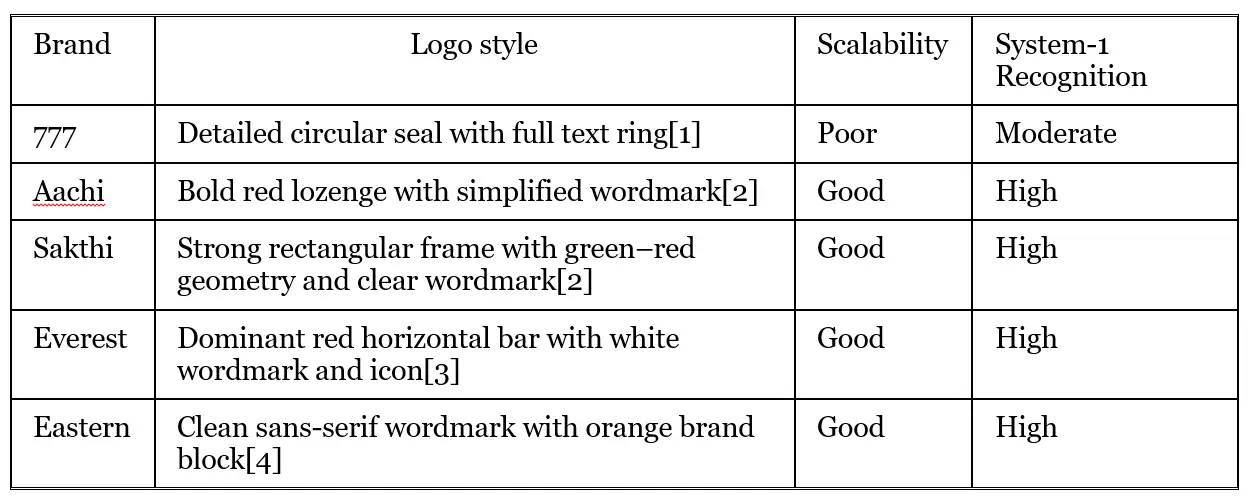
The brand’s primary mark is a circular seal bearing “SRI GANESHRAMS 777 BRAND FOOD PRODUCTS – MADRAS – INDIA” with a red background and intricate inner typography.[1] The mark conveys authenticity, tradition, and geographic origin—valuable equity in a heritage-conscious market—but suffers from critical usability and scalability issues.
Strengths
- Instantly signals heritage and Indian/Tamil Nadu authenticity [1]
- Memorable circular form creates distinctive shape differentiation
- Includes geographic origin marker (“MADRAS”) which builds local pride and trust[1]
Weaknesses
- Complex outer ring text and dense central typography reduce legibility at small sizes (pouches, cartons, digital icons)[1]
- Does not scale efficiently across media; detail is lost below 40mm diameter[1]
- Takes cognitive effort to read, reducing System-1 (fast) recognition versus simpler wordmarks[1]
- Long brand name “SRI GANESHRAMS” is difficult to abbreviate, limiting visual shorthand usage
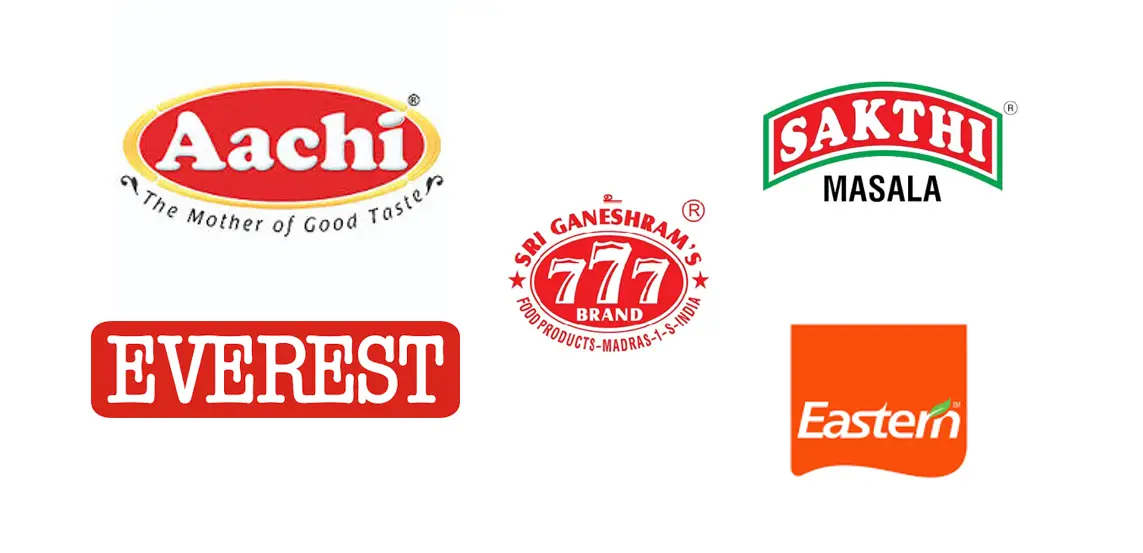
Competitive logo comparison
Recommendation
Develop a simplified master brand mark: retain the circular heritage geometry but reduce text clutter. Consider a two-version system: full seal for heritage context (e.g., below-the-line, corporate) and a simplified “777” wordmark + optional small seal for primary pack and digital use. This approach preserves equity while enabling faster recognition on shelf.
Color Palette and Psychological Alignment

Current color system
777’s primary palette consists of:
- Brand red: #ED1D21 (core masala/spice cue)[1]
- White: primary background for contrast and lightness[1]
- Category-specific secondary colors: variable green, blue, purple, pink for instant mixes and specialty items[1]
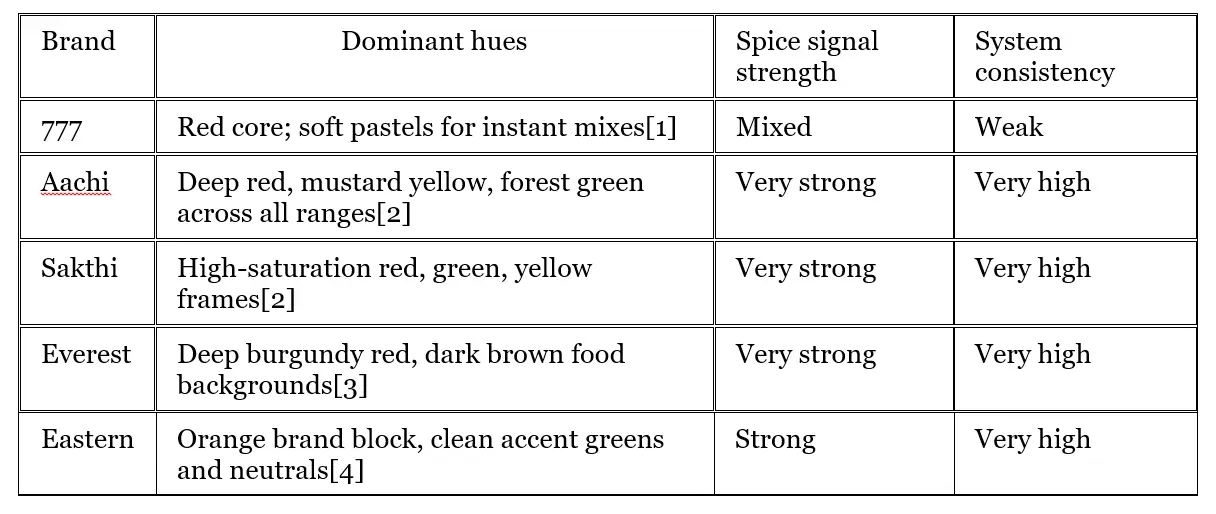
The red is strong and appropriate for savoury, spice-forward items, but the secondary palette—soft pastels (light blue, lilac, pink, light green)—undercuts the “masala warmth” and “spice intensity” expectations for items like rava idli, vegetable upma, and khatta poha.[1]
Psychology of current palette choices
For instant mixes (pastel approach)
- Soft, cool colors signal mildness, lightness, and sophistication—appropriate for sweets (gulab jamun, besan ladoo) but misaligned with savoury tempering and masala.[5]
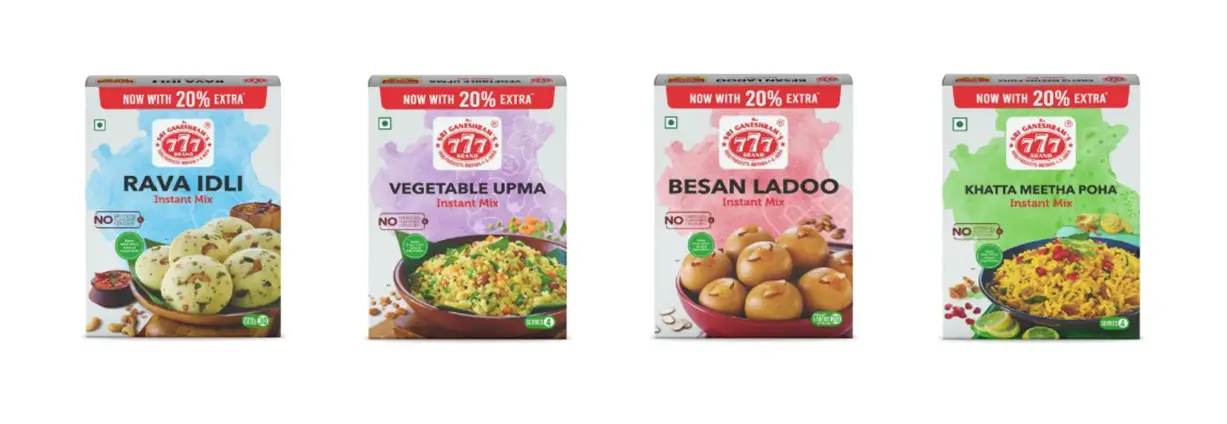
- Pastels reduce cognitive “spice cues” at first glance, weakening taste expectations and impulse appeal in a competitive shelf environment where shoppers make decisions in 1–3 seconds.[6]

For masala powders (red approach)
- Primary red correctly cues heat, aroma, and flavor intensity, aligning with how consumers perceive spices.[5]
- However, the lack of secondary color variety across masala range variants makes it harder to distinguish individual SKUs quickly, potentially reducing variant pick-up rate.[1]
Competitor color strategy
Key insight: Instant-mix colour misalignment
The most critical gap is the pastel palette for savoury instant mixes (rava idli, vegetable upma, khatta poha). While these items are “light” in texture and digestion, they are not flavourless—they contain mustard seeds, cumin, curry leaves, green chillies, and turmeric.[7] Soft pastels signal mildness, which is a poor cue for “lightly textured but flavourful and spiced” positioning.
Better approach: Use warmer, more saturated secondary palettes—e.g., deeper teals, richer purples, warm golds—that maintain modernity and lightness while communicating savoury warmth and masala presence. Reserve true pastels for sweet/dessert mixes only.
Packaging Design and Architecture
Current pack characteristics
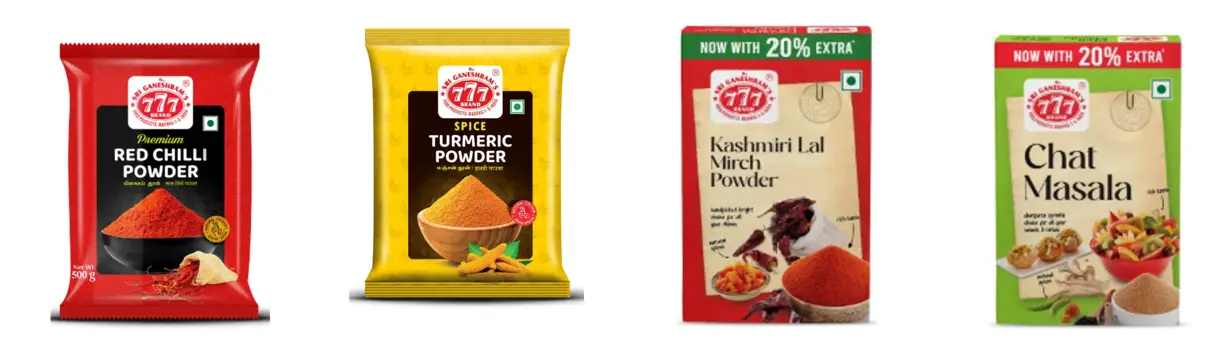
777’s packaging spans multiple categories (instant mixes, masala powders, vermicelli, oils, ready-to-eat chutneys, beverages) with inconsistent design approaches:
- Front-of-pack typically includes: red “NOW WITH 20% EXTRA” band, circular seal, product name, food photography, and category icons.[1]
- Layout hierarchy varies by category; no single “777 visual system” that consumers can quickly recognise across aisles.[1]
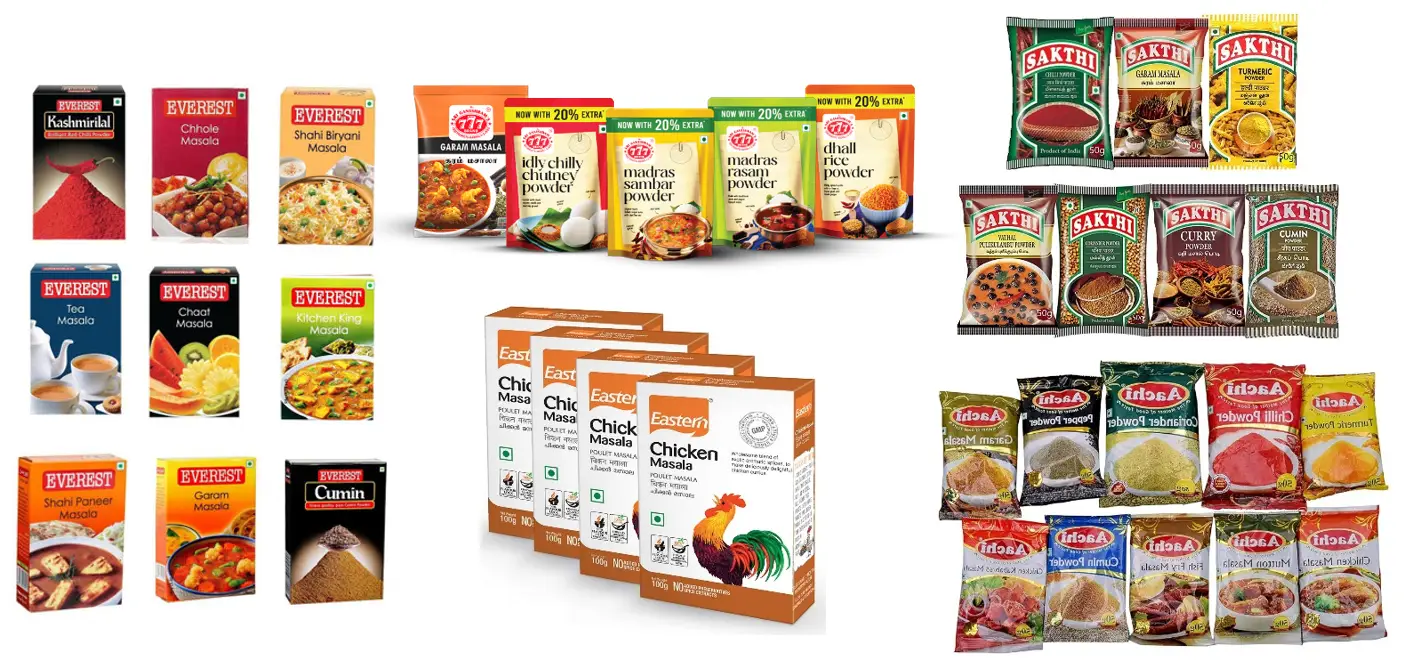
- Food photography is appetising but often competes with text and promo bands for visual prominence.[1]
- Typography is multi-weight and varied, reducing scan clarity.
Pack hierarchy and System-1 processing
Research shows shoppers spend 1–3 seconds on a pack before moving on; successful packs guide the eye to: (1) brand recognition, (2) product type, (3) key benefit, (4) variant, in that order.[6][8]
777 current hierarchy assessment
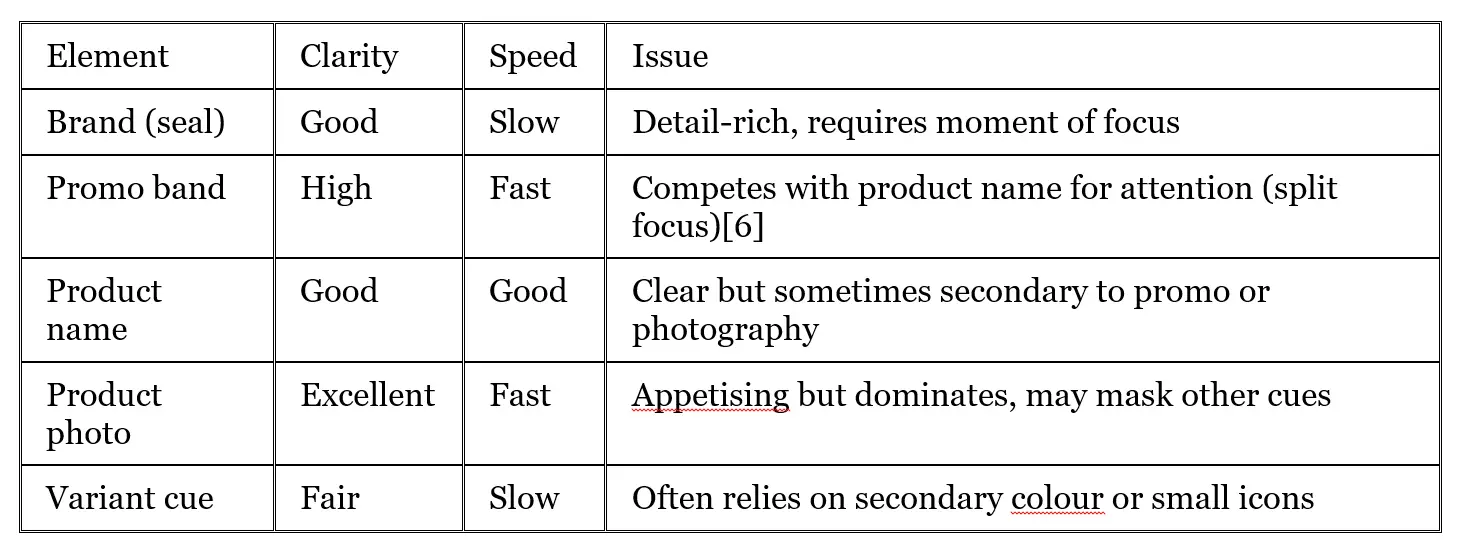
Gap: No single dominant “777 block” or masterbrand zone that shoppers instantly recognise across the shelf, unlike Everest’s red bar or Aachi’s red lozenge frame.
Comparative pack architecture
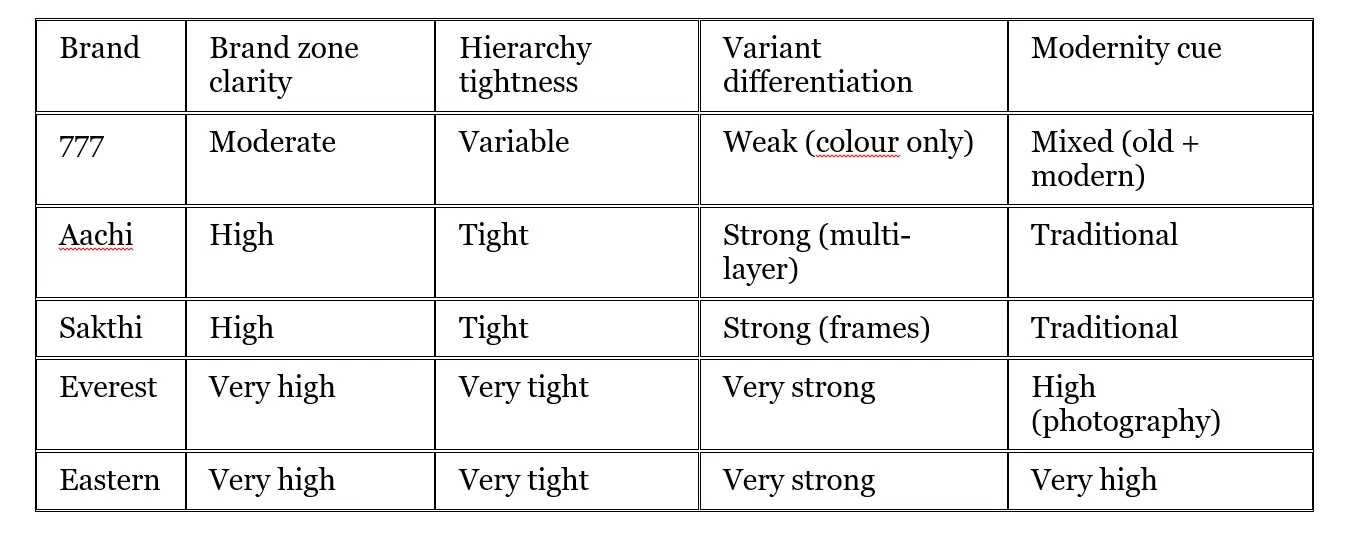
Everest and Eastern packs show eye-tracked-validated hierarchies: logo bar → product name → variant → benefit → recipe visual. This guides the eye predictably and reduces decision time.
Recommendations for 777 pack redesign
- Establish a 777-master brand zone (top 30% of pack) with simplified seal + wordmark, using consistent placement across all categories.
- Tighten hierarchy: Reduce promo-band dominance; move “20% EXTRA” to a smaller secondary band or back-of-pack, allowing product name and category to lead.
- Variant colour system: Develop a coded secondary palette (not pastels) so rava idli = warm terracotta accent, vegetable upma = herbaceous sage, besan ladoo = soft gold, etc. This reduces cognitive load and improves recall.
- Food photography: Use rich, warm-lit shots of prepared dishes or ingredients to reinforce taste and aroma cues, especially for masala-forward items.
- Typography: Standardise to 2–3 weights max; ensure product name is largest readable element after the brand zone.
Category-Specific Analysis: Instant Mixes vs. Masala Powders
The sweet-vs.-savoury colour challenge
777 currently uses:
- Masala powders: Red + white + category-specific deeper colours (appropriate)
- Instant mixes (rava idli, upma, besan ladoo, khatta poha): Soft pastels (problematic for savoury items)
Instant mixes are genuinely “light” (soft texture, quick preparation) but many contain significant spice and tempering—rava idli has mustard, cumin, curry leaves, chillies; vegetable upma has similar tempering plus turmeric and ginger.[7]
Psychology gap: Pastels signal “mild, calm, gentle”—which is accurate for texture but misleading for flavour intensity. A shopper expecting mild taste may be surprised by warmth and masala, reducing satisfaction and repeat purchase.
Solution: Use warm, saturated secondary colours for savoury instant mixes:
- Rava idli: warm terracotta or burnt orange (not light blue)
- Vegetable upma: herbaceous sage or deep olive (not soft purple)
- Khatta poha: warm golden yellow or rust (not light green)
- Besan ladoo: soft gold or cream (pastels acceptable—this item is genuinely sweet-forward)
This approach keeps a modern, light feel while aligning colour psychology with actual product character.
Benchmarking Summary Table
Holistic brand positioning
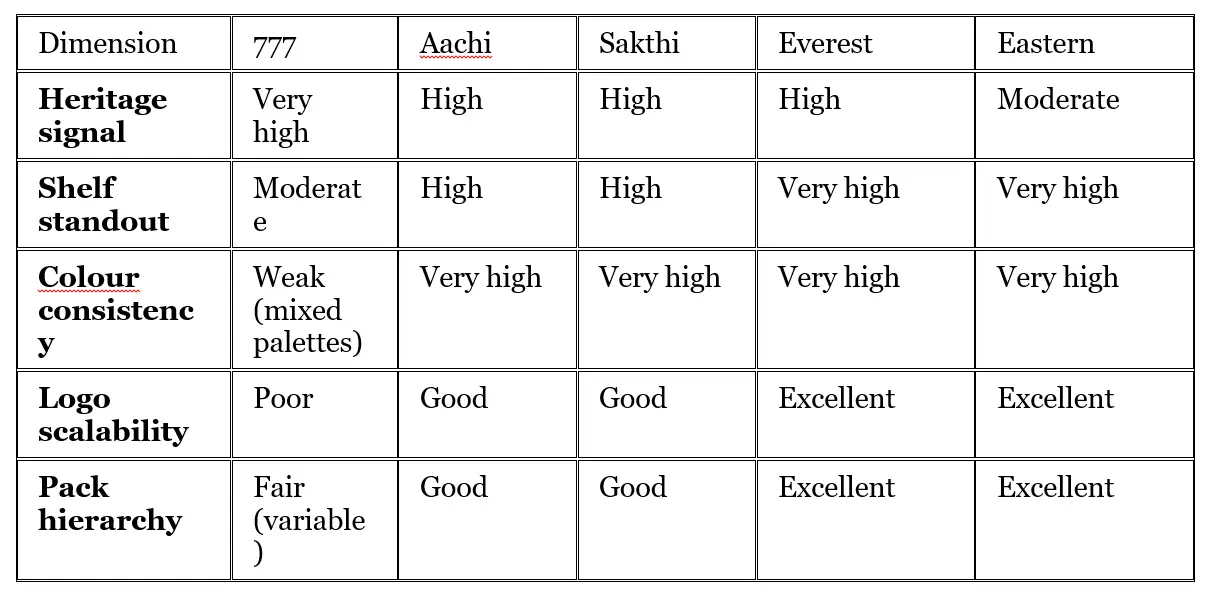
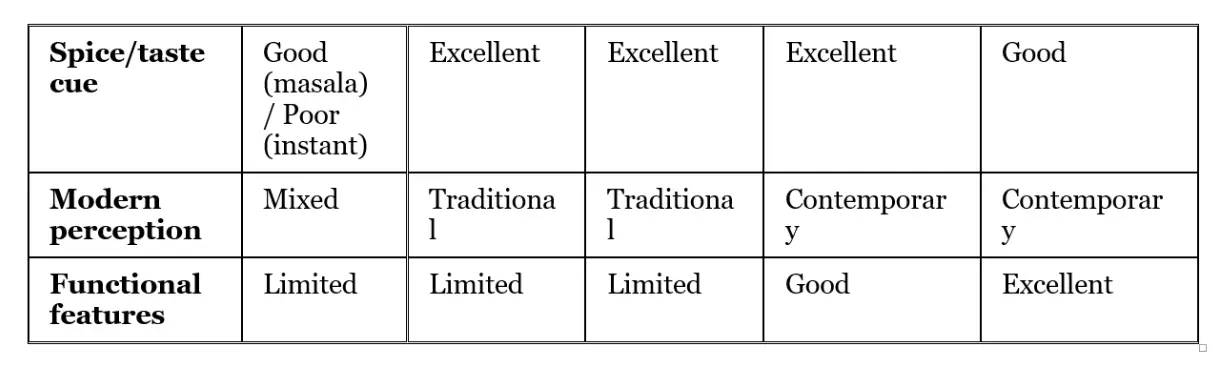
Competitor benchmarking: Scored assessment (0–10)
The following matrix provides a quantified comparison across five key visual and design dimensions relevant to FMCG shelf performance, consumer psychology, and competitive positioning in the Tamil Nadu spice and instant-mix market.
Scoring criteria and methodology
- Logo strength & recognition (0–10): Simplicity, distinctiveness, legibility at small sizes (below 40mm), ease of System-1 (fast) recognition; higher scores favour clean wordmarks over intricate seals.[1]
- Colour strategy (spice cues): Alignment of palette with product character (savoury vs. sweet); saturation levels and warmth cues that signal taste intensity and aroma; higher scores reward consistent, psychologically appropriate hue systems.[2]
- System consistency across SKUs (0–10): Repeatability of layout, colour logic, and typography across product range; visual coherence that allows shoppers to quickly identify brand family; higher scores reflect disciplined, scalable systems.[3]
- Shelf impact & readability (0–10): Ability to attract attention and be decoded in 1–3 seconds; visual hierarchy clarity; contrast and typography legibility; scores based on research showing effective packs guide eye predictably (brand → product → variant → benefit).[4]
- Modernity & premiumness (0–10): Perception of contemporary design, quality materials, and upmarket positioning; balance between heritage and newness; scores reflect design language (clean vs. cluttered, minimalist vs. decorative).[5]
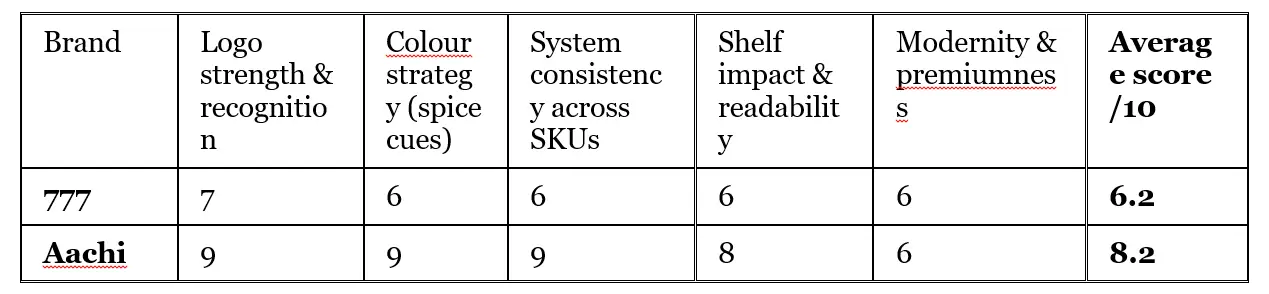
Benchmark scores by brand

Score interpretation and insights
- 777 (6.2/10): Solid heritage foundation but weak on modern visual systems and consistency. Underperforms competitors on logo scalability and colour psychology for instant mixes. Immediate opportunity to close gaps in logo simplification and palette revision.
- Aachi (8.2/10): Dominant player with excellent logo clarity, very strong colour and consistency discipline. Slightly lower modernity score reflects traditional design language (busy, heritage-forward) which may feel dated to younger shoppers but resonates deeply with core target.
- Sakthi (7.6/10): Strong competitor with excellent colour strategy and system consistency similar to Aachi. Slightly lower scores reflect similar traditional aesthetic and slightly less distinctive logo compared with Everest/Eastern.
- Everest (8.8/10): Highest overall score. Excels across all dimensions with contemporary design language, disciplined hierarchy, and strong colour psychology. Leadership position reflects investment in modern packaging design and eye-tracking validation.
- Eastern (8.4/10): Second-highest score with very high modernity and premium perception. Excellent system consistency and shelf readability. Slightly lower colour-strategy score reflects more neutral (orange + clean accents) versus intensely spice-cued palettes of traditional players.
Key observations
- 777’s largest gap is logo and system consistency (both 6/10). Simplifying the seal and codifying a visual system across categories would alone move the average to ~7.0.
- Colour strategy gap for 777 is critical (6/10 vs. 8–9 for others). The soft-pastel approach for savoury instant mixes is psychologically misaligned; revising to warm, saturated secondaries would improve this score to ~8, boosting overall average to 6.8.
- Modernity perception is 777’s structural weakness (6/10 vs. 8–9 for contemporary competitors). Heritage is an asset, but visual language must feel “heritage + modern,” not “heritage only.” This requires investment in cleaner typography, contemporary imagery, and refined colour treatment—not abandonment of tradition.
- All competitors outperform 777 on system consistency, indicating that a unified visual language across 15+ SKUs is a table-stakes requirement in this category. 777’s category-by-category variation costs recognition and shelf efficiency.
Benchmark gap summary
To reach parity with Aachi (8.2) and Sakthi (7.6), 777 should prioritize:
- Logo simplification: +1–2 points
- Colour system revision: +1–2 points
- Pack layout standardisation: +0.5–1 point
- Typography and hierarchy tightening: +0.5 point
Target state: 777 at 7.8–8.0/10 within 12–18 months, with modernity lift to 7–8 requiring longer brand evolution.
EXTERNAL AUDIT
MARKET CONTEXT
INDUSTRIAL LANDSCAPE
The Indian FMCG (Fast-Moving Consumer Goods) sector, which includes processed foods, spices, pickles, and masalas, remains one of the fastest-growing segments of the economy. In FY26, India’s FMCG market recorded strong value growth and continued momentum driven by both rural and urban consumption, reflecting resilience in consumer demand and expanding purchasing power across regions.
Within this broader FMCG context, the packaged food and spice market in India is expanding rapidly. The packaged spices segment—an important category for brands like SGR 777 Foods—constitutes a significant portion of the domestic market and has been growing at a double-digit CAGR. Demand is fuelled by rising disposable incomes, increasing health consciousness, and a shift toward convenience-oriented food products.
The Indian pickles market, where SGR 777 Foods also operates, is similarly projected to grow steadily. With deep cultural roots in Indian cuisine, pickles remain a daily staple across households, aiding market expansion for branded products, particularly as urbanisation and organised distribution increase their reach.
Consumer preferences are evolving: there is a growing emphasis on packaged, hygienic, and ready-to-use spice mixes and traditional food products as lifestyles change and time-pressed consumers seek convenience without compromising flavour. E-commerce and digital grocery platforms are increasingly pivotal in expanding access to regional and heritage brands nationwide.
The industry structure remains highly competitive and fragmented, with major national players (such as Everest, MDH, Tata Sampann) and strong regional brands vying for shelves and consumer attention. Many large FMCG firms are also pursuing acquisitions and portfolio expansions to strengthen their position in the blended spices and convenience foods space.
COMPETITOR TRENDS
COMPETITOR MATRIX
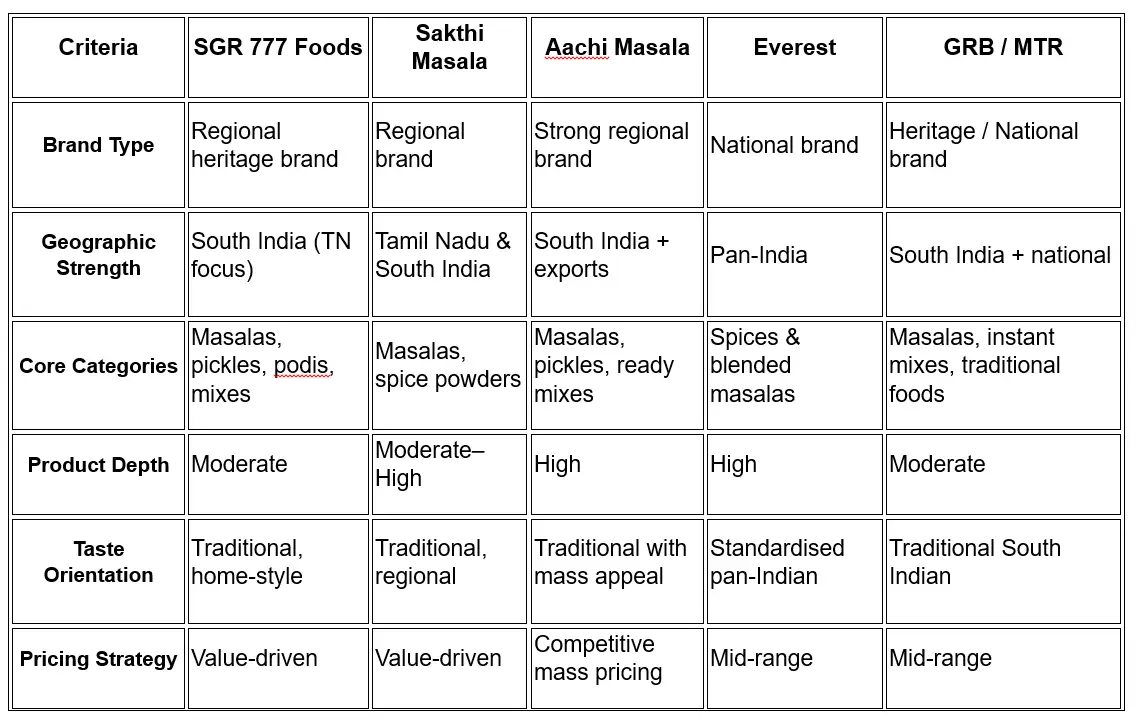
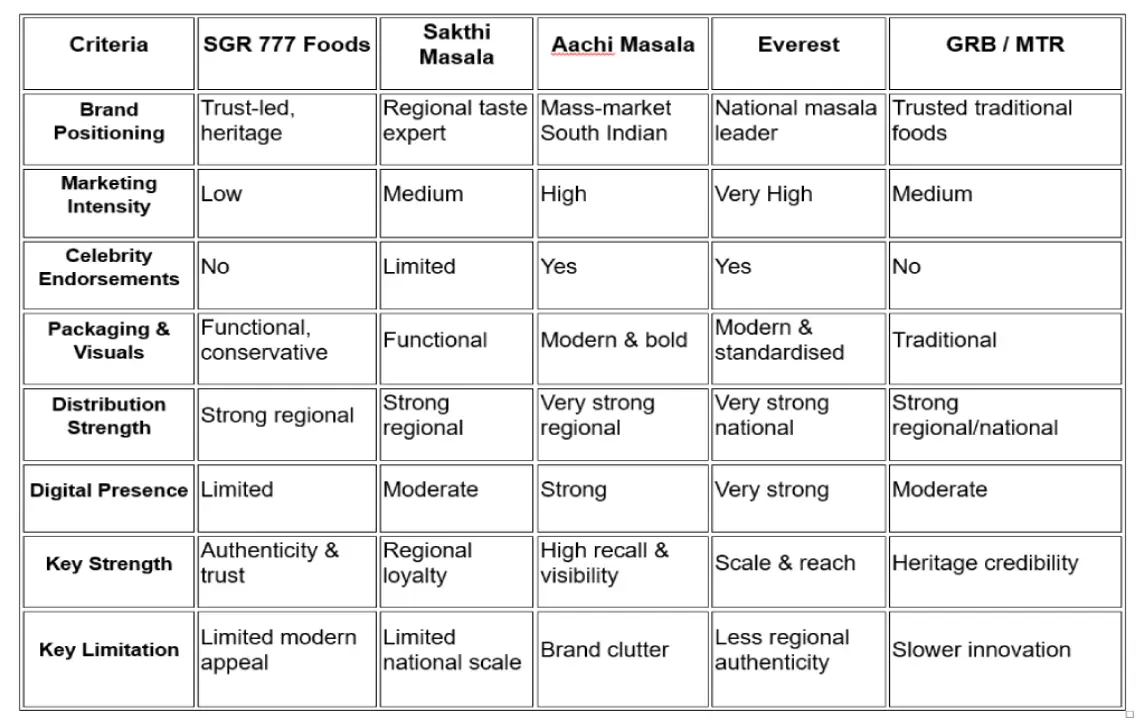
COMPETITOR BENCHMARKING
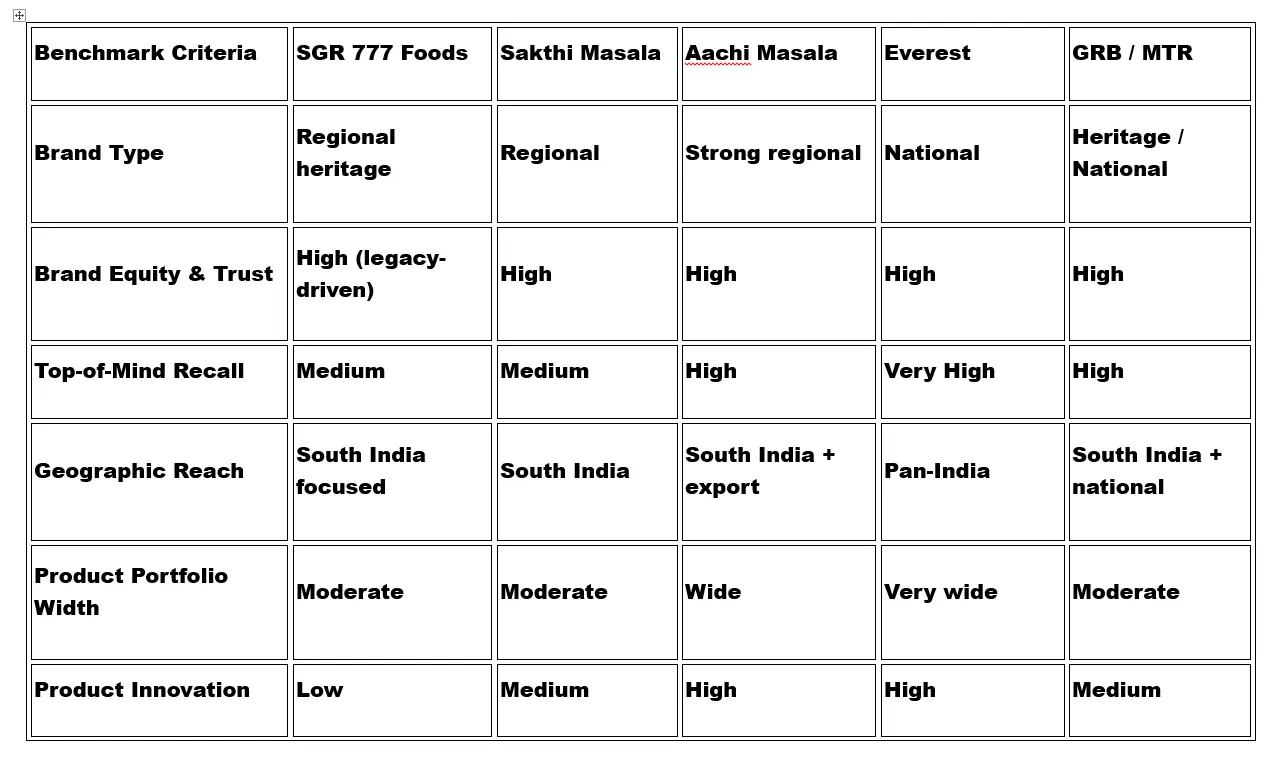
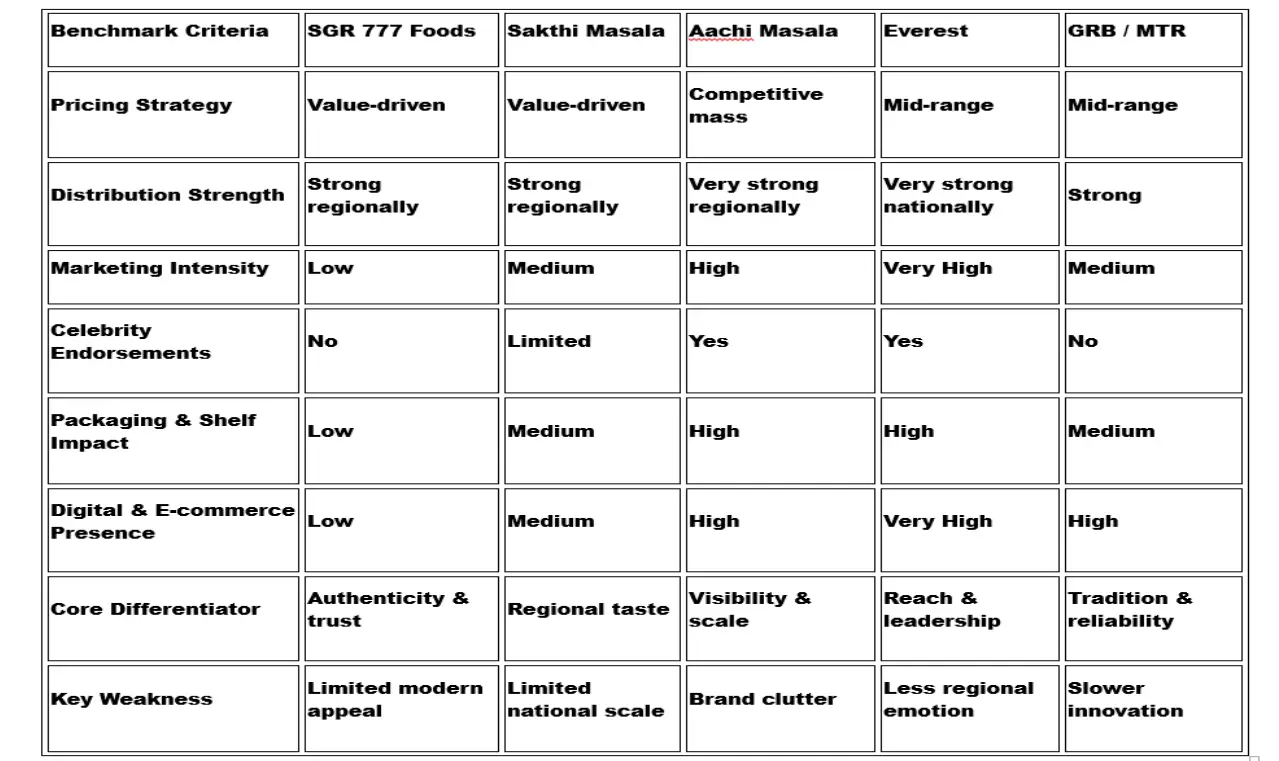
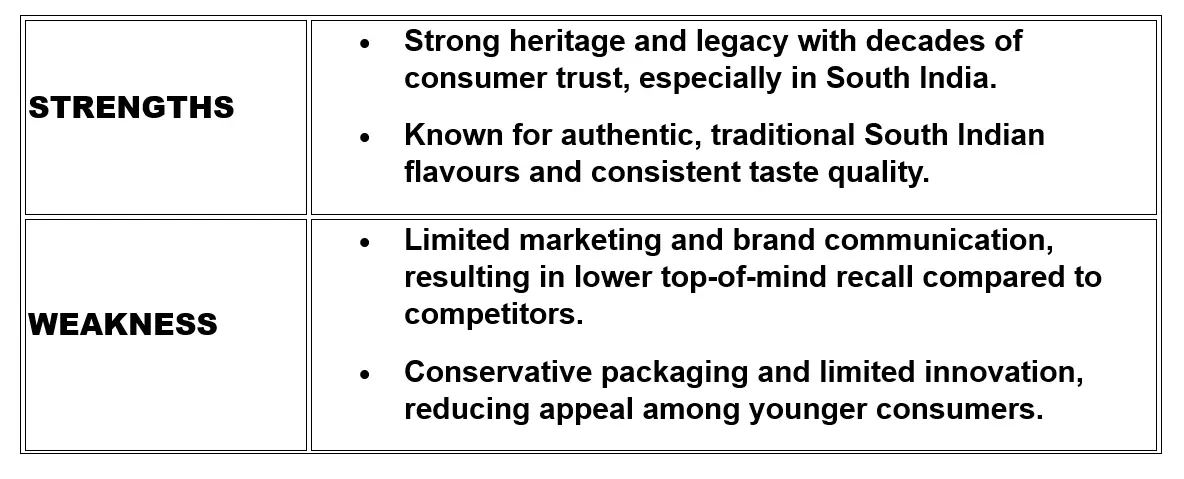
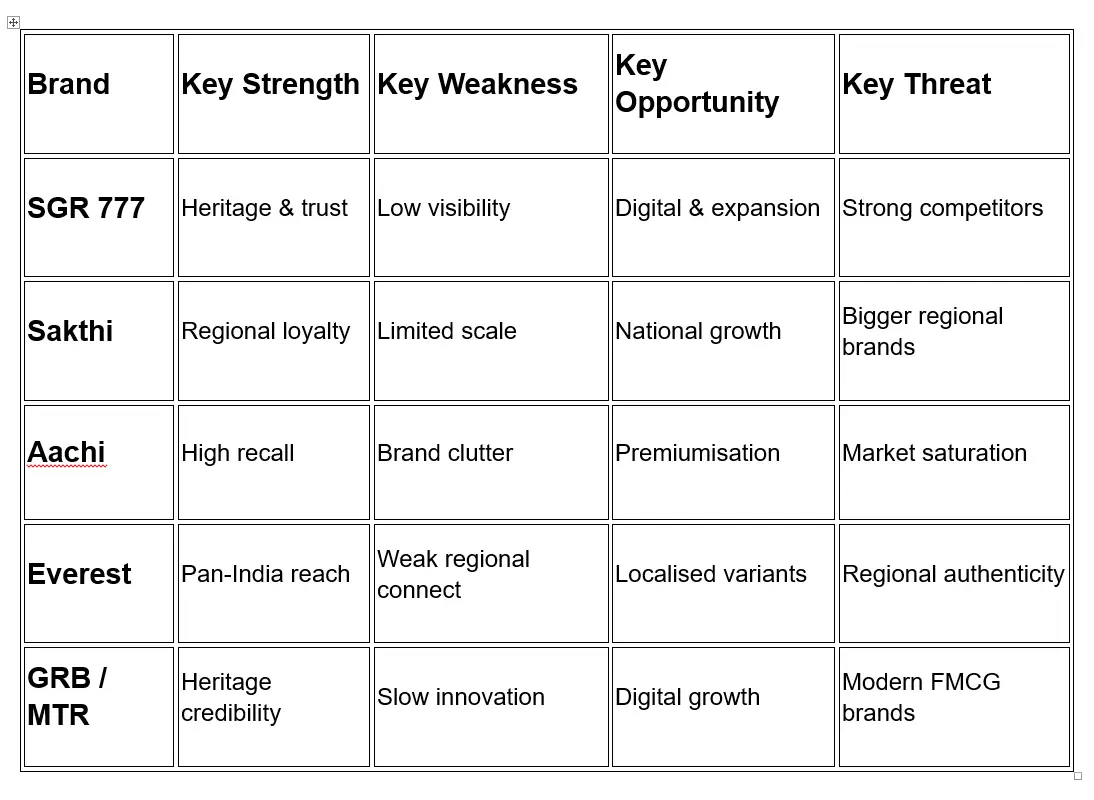
SWOT ANALYSIS
SGR 777 Brand
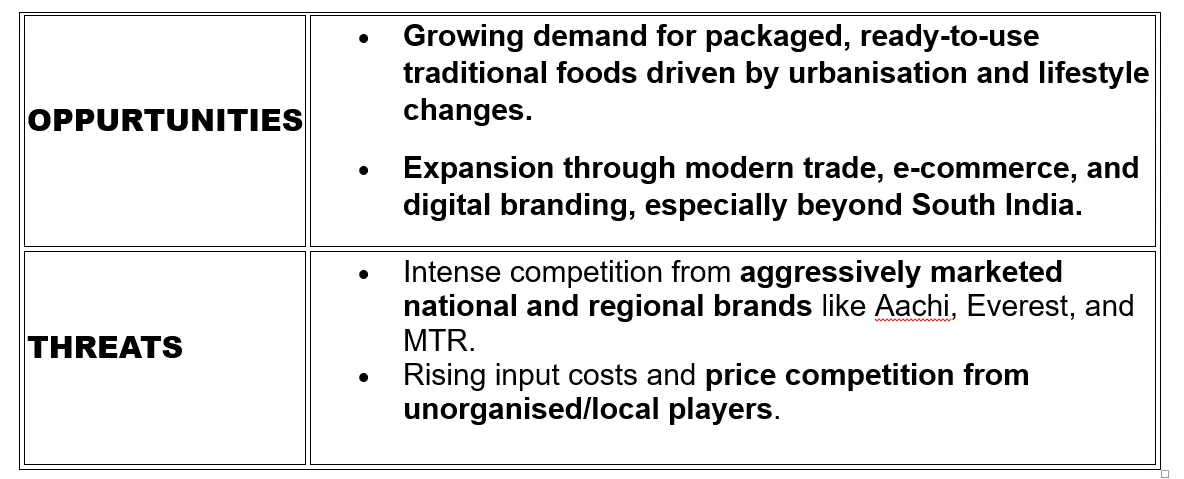
SAKTHI MASALA
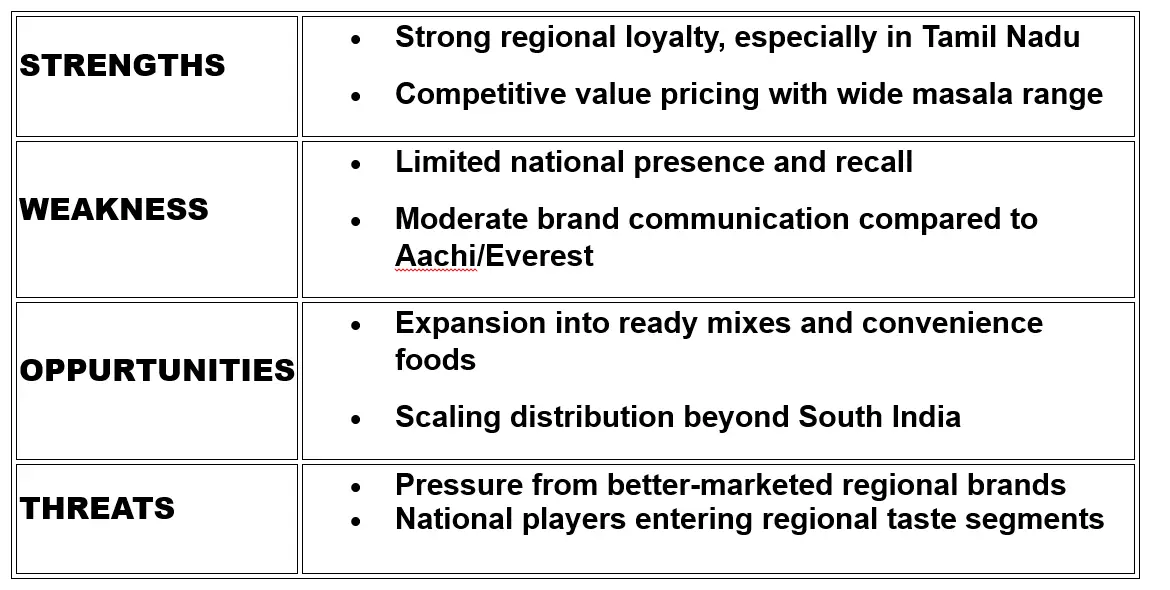
AACHI MASALA
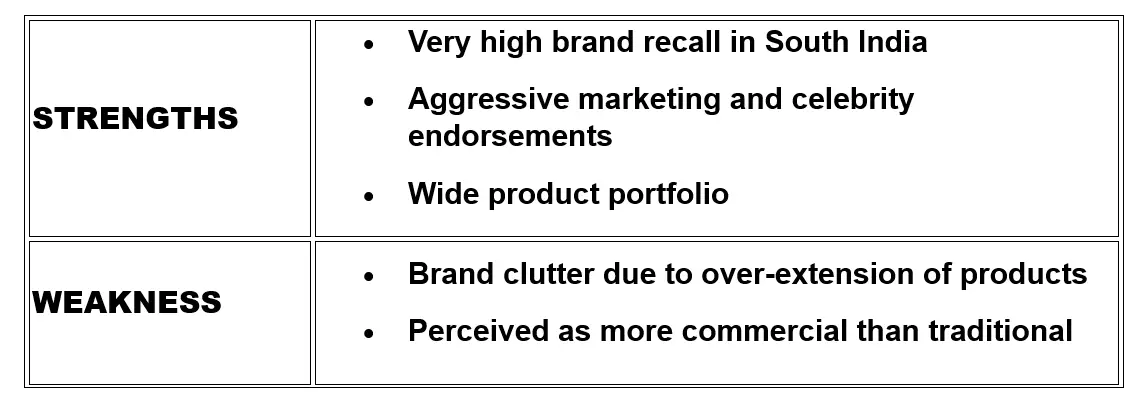
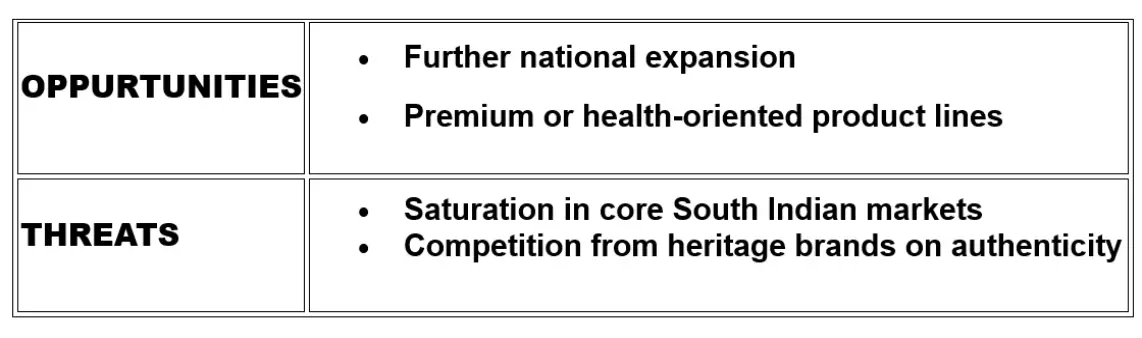
EVEREST
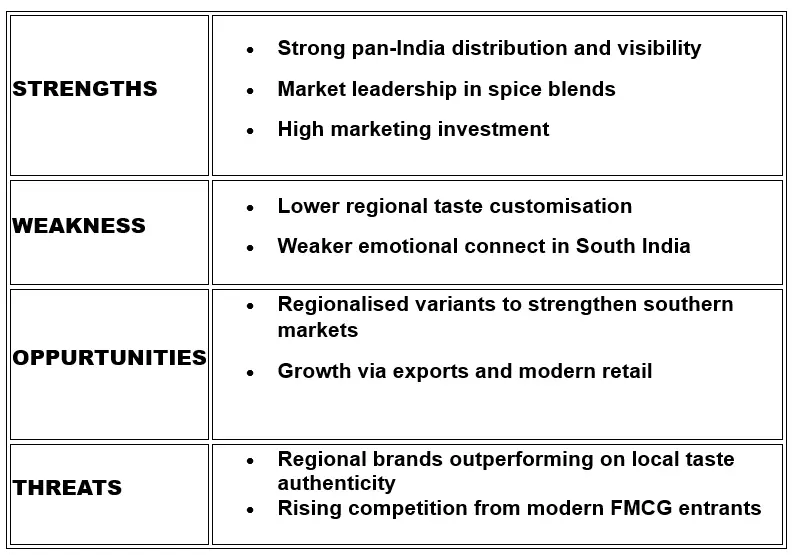
GRB / MTR
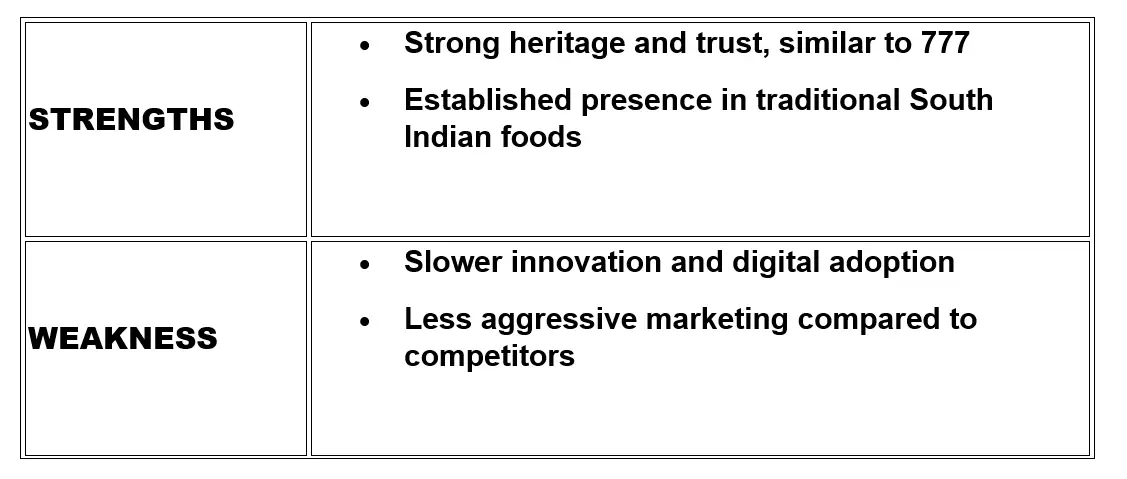
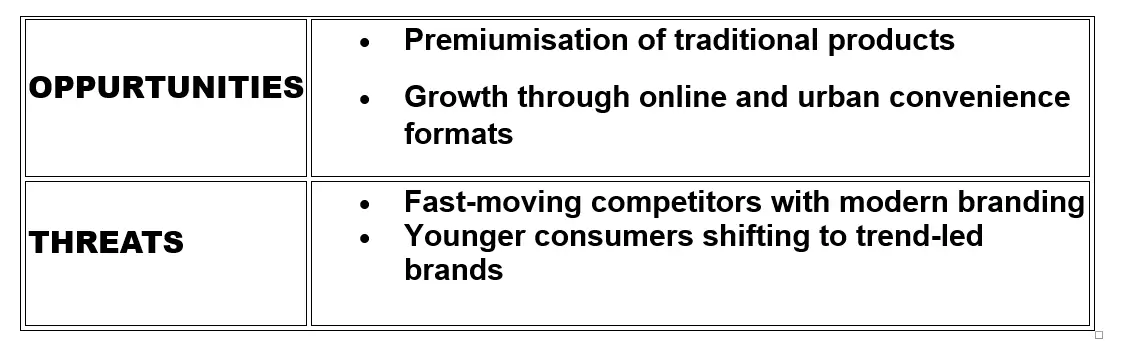
COMPARATIVE SNAPSHOT
TARGET AUDIENCE
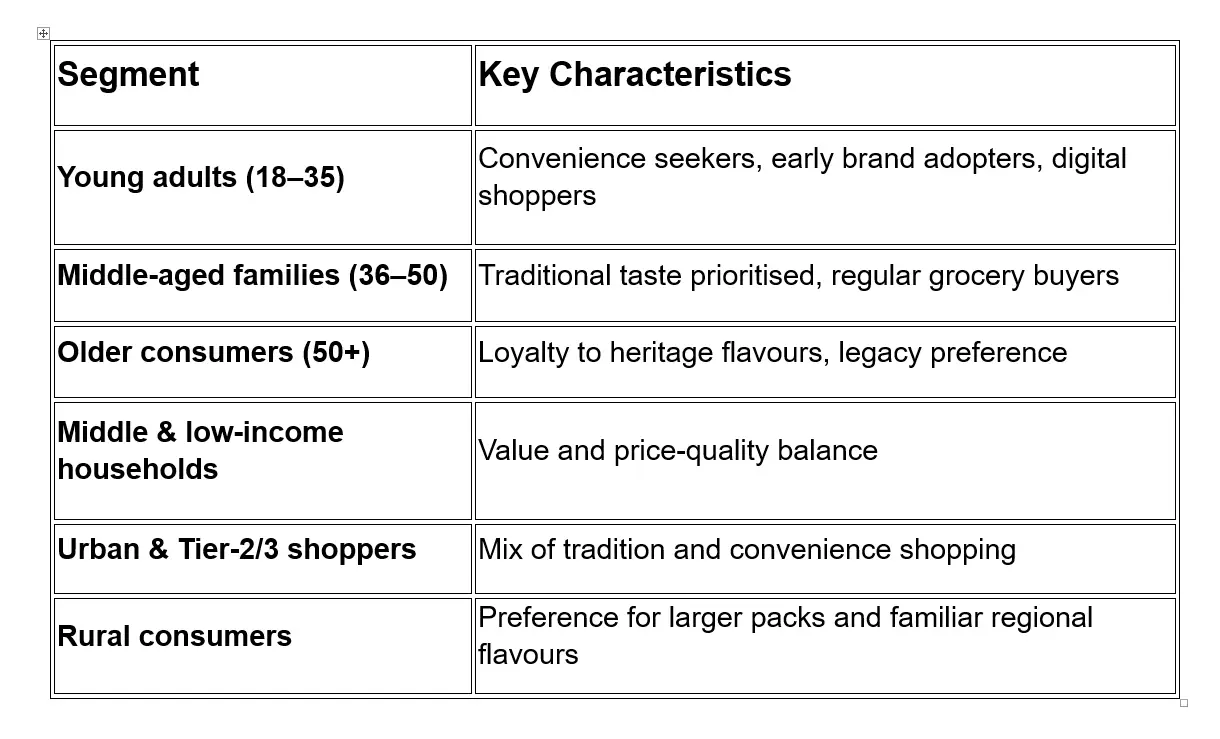
The target audience for SGR 777 Foods spans multiple demographic and psychographic segments — from traditional families valuing heritage flavours to younger consumers seeking convenience without losing authentic taste. This diversified audience base positions the brand to leverage both emotional and functional appeal across regions and shopping preferences, while highlighting the need for modern engagement strategies to increase reach beyond legacy markets.
BRAND PERFORMANCE
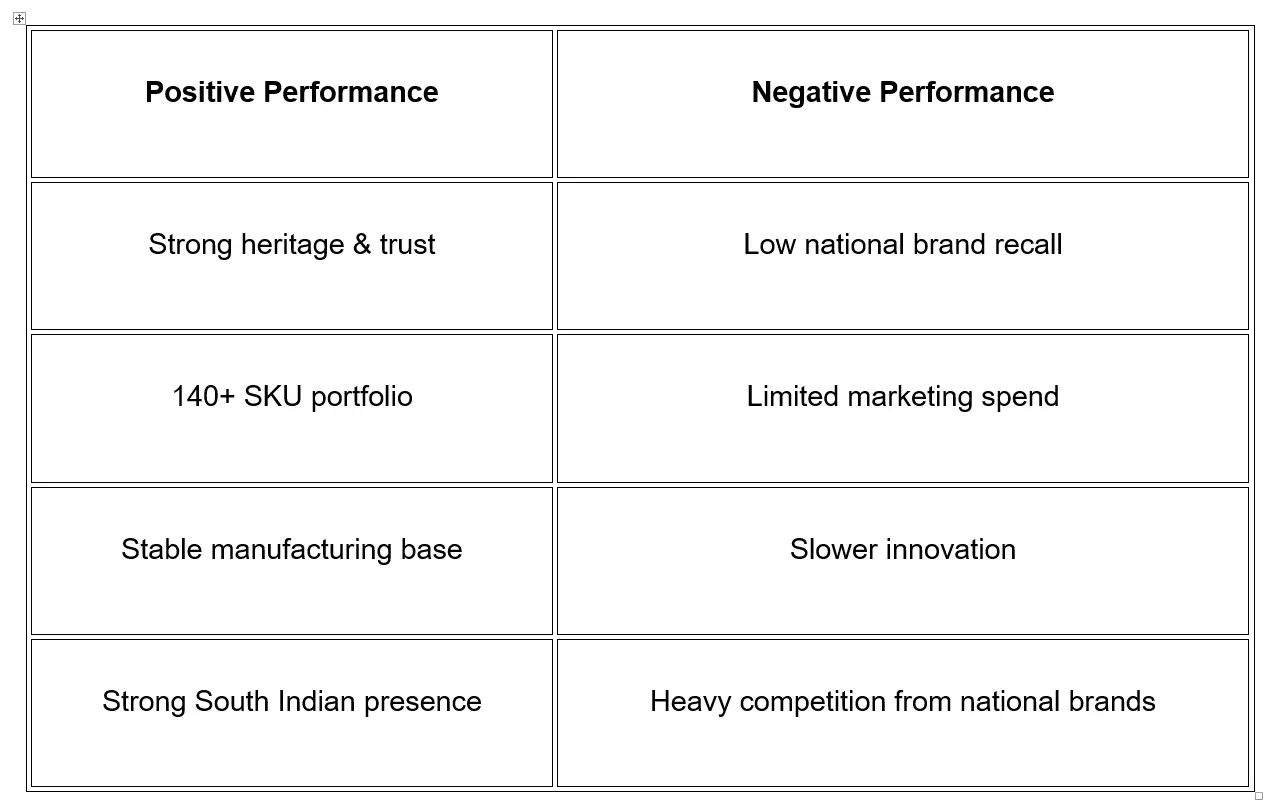
- Production & Portfolio: Offers ~142 SKUs with plans for capacity expansion and new product categories.
- Regional Strength: Strong in South India; less penetration at a national level compared with larger FMCG spice brands.
- Competitive Positioning: Operating in a fragmented market where brands like Everest (≈30% branded share) dominate.
- Brand Visibility: High trust in traditional segments but relatively low mass-marketing visibility compared to competitors.
- Growth Context: Branded spices market is growing ~10–15% annually, offering opportunities for expansion if distribution and branding improve.
BRAND AWARENESS
SGR 777 Foods enjoys strong aided awareness in its core markets, particularly in Tamil Nadu and parts of South India, where the brand is commonly recognised during purchase consideration at kirana stores.
However, unaided awareness and top-of-mind recall are relatively lower when compared to competitors like Aachi, Everest, and Sakthi, which invest heavily in mass media advertising and celebrity endorsements.
Brand awareness for 777 is largely driven by:
- Long-term household usage
- Word-of-mouth recommendations
- Retail visibility in traditional trade
Rather than:
- High-frequency advertising
- Digital or social media campaigns
This results in deep but narrow awareness—strong among existing users, but limited among younger consumers, urban audiences, and non-South Indian markets.
BRAND EVALUATION
SGR 777 Foods is evaluated as a heritage-driven regional FMCG brand with strong credibility in traditional food categories. The brand’s core equity lies in its authentic taste, consistency, and long-standing trust, rather than innovation-led or aspirational positioning.
From a functional perspective, the brand performs well on product reliability, taste consistency, and perceived authenticity, which are critical evaluation criteria in the spices and traditional foods category. However, on modern brand parameters such as visual identity, innovation, premium cues, and lifestyle relevance, SGR 777 Foods lags behind more aggressively marketed competitors.
Overall, the brand is evaluated positively by its loyal consumer base, but its perceived value remains conservative and traditional, limiting its appeal beyond core users.
EMOTIONAL APPEAL
SGR 777 Foods derives its emotional appeal primarily from heritage, nostalgia, and trust, rather than aspirational or lifestyle-driven branding. The brand is deeply associated with traditional South Indian home cooking, evoking memories of family meals, festivals, and familiar tastes passed down through generations.
A key emotional driver for 777 is intergenerational trust. Consumers often associate the brand with what their parents or grandparents used, creating a sense of reliability and emotional reassurance. This positions 777 not merely as a packaged food brand, but as a custodian of authentic culinary tradition.
The brand also appeals emotionally through its consistency. In a category where taste reliability is critical, 777’s promise of unchanged recipes and familiar flavours reinforces comfort and confidence, especially among middle-aged and older consumers.
Unlike competitors that leverage celebrity endorsements or high-decibel advertising, SGR 777 Foods’ emotional connect is quiet and organic, built through lived experience rather than storytelling campaigns. This understated approach strengthens loyalty but limits emotional resonance with younger, urban consumers who respond more strongly to visual narratives and modern brand communication.
Emotional Positioning Summary
- Evokes nostalgia and tradition
- Builds family-level trust and familiarity
- Reinforces comfort through unchanging taste
- Strong with older and family-oriented consumers
- Weaker emotional engagement among youth segments
DIFFERENTIATION
- Deep restaurant-to-retail heritage (authentic origin story)
777 began as Hotel Sri Rama Bhavan in Madras (1933) and commercialised its products later — the brand identity literally comes from its FPO licence number “777”. This restaurant origin gives the brand a genuine culinary provenance that many competitors (even heritage ones) don’t claim in the same direct way. - Longstanding legacy and generational trust
The brand has operated for decades and is perceived as a legacy, family-rooted brand in South India — an emotional and trust asset that converts into repeat household purchases. (Legacy coverage & brand story). - Large traditional product range centred on South Indian tastes
777’s portfolio emphasises pickles, podis, sambar/rasam powders and regional chutneys — offering many region-specific SKUs (pickles and podis across variants) that target South Indian palates more specifically than pan-India spice leaders. (See product categories & SKU variety). Classic “home-style” flavour positioning (not mass-market standardisation)
While national brands often standardise flavours for pan-India tastes, 777 emphasises home-style, restaurant-derived recipes and regional authenticity — a clear sensory/ taste differentiation. - Operational scale with focused regional manufacturing & export history 777 runs sizeable manufacturing operations in Tamil Nadu and has exported traditional products overseas (serving diaspora markets) — combining regional focus with selective international reach. This is different from many small local makers and also different from national brands that scale via multiple factories.
- Low-decibel marketing — growth via product & word-of-mouth (operational vs promotional focus)
Historically, 777 has not relied on high-cost advertising or celebrity endorsements; instead it has scaled through product reliability and organic demand (e.g., home-cooking surges). This contrasts with competitors like Aachi, Everest or MTR, which use aggressive marketing. - Positioning as a regional heritage specialist vs. national mass players
Competitors like Everest are built as pan-India spice leaders (large market share, standardised blends), while Aachi/Sakthi are strong regional challengers. 777’s unique place is heritage + restaurant lineage + South-centric portfolio, which is distinct from both mass national players and pure commodity regional players. - Credibility in specific traditional categories (pickles & podis)
777’s clear emphasis on pickles and podis (many regional variants) gives it category credibility where many competitors focus more on pure spice powders or blended masalas. This category focus is a point of difference.
MAJOR GAPS
Lack of Modern Storytelling
SGR 777 Foods relies heavily on its heritage and legacy but does not actively translate this history into contemporary brand narratives. The absence of structured storytelling around its origin, restaurant lineage, and culinary expertise limits emotional engagement, especially in media environments where storytelling drives brand recall.
Impact:
Heritage exists, but it is under-communicated, making the brand feel passive rather than purposeful.
Weak Digital Strategy & Online Presence
The brand shows limited investment in digital platforms, including social media, influencer collaborations, and content-led engagement. In an era where food discovery and brand affinity are increasingly shaped online, this restricts reach and relevance.
Impact:
Low visibility among digital-first consumers and reduced interaction with younger, urban audiences.
Weak Appeal to Younger Generations
Younger consumers (18–35) seek brands that align with identity, culture, and modern lifestyles. The brand’s conservative communication style and limited digital storytelling reduce resonance with this audience.
Impact:
Low brand affinity among first-time buyers and future core consumers.
CONCLUSION
SGR 777 Foods stands as a heritage-rich, trust-led regional food brand with a legacy rooted in authenticity, traditional recipes, and consistent product quality. Its long history, restaurant-origin credibility, and strong household acceptance in South India have enabled the brand to sustain steady revenue growth and deep consumer loyalty over decades.
From a brand perspective, 777’s strongest asset is trust built through generations, rather than aggressive advertising or modern brand-building tactics. This has resulted in a stable but modest business scale, with revenues under ₹100 crore—reflecting strong regional performance but limited national expansion when compared to competitors such as Aachi, Sakthi, Everest, and MTR.
However, the evaluation also reveals significant strategic gaps. The brand has limited digital presence, lack of modern storytelling, and minimal engagement with younger consumers restrict its future scalability. While competitors have successfully evolved through celebrity endorsements, digital marketing, and contemporary positioning, SGR 777 Foods has largely remained conservative in its communication approach.
Despite these gaps, the brand is not weak—it is under-leveraged. Its differentiation lies in authenticity, simplicity, and credibility, but these strengths have not yet been translated into modern brand narratives or digital ecosystems. If addressed strategically, these gaps present a strong opportunity rather than a threat.
Overall Assessment
- Brand Strength: High trust, authenticity, loyal consumer base
- Market Position: Strong regional player, limited national recall
- Performance: Stable growth, moderate scale
- Key Risk: Aging consumer base and declining youth relevance
- Key Opportunity: Modern storytelling without diluting heritage
Conclusion
777 Foods occupies a valuable heritage position in the Tamil Nadu spice and convenience-foods market, but its visual identity needs modernisation to remain competitive against increasingly sophisticated brands like Everest, Eastern, and modernised versions of Aachi and Sakthi.
The key gaps are:
- Logo: Too intricate to scale; needs simplification while retaining heritage cues.
- Colour system: Inconsistent and psychologically misaligned (pastels for savoury items).
- Pack architecture: No single “777 visual language” across categories.
- Modernity: Feels dated on shelf despite strong food photography.
By implementing the short-term recommendations (seal simplification, colour revision, layout standardisation) and progressively advancing to functional and digital-first approaches, 777 can preserve its heritage equity while signalling contemporary quality, convenience, and authentic South Indian masala to both traditional kirana shoppers and emerging e-commerce consumers.
References
[1] 777 Foods Brand Visual Audit PDF. December 2025.
[2] Aachi Foods and Sakthi Masala. Behance portfolio case studies and brand websites. Accessed December 2025.
[3] Everest Global. Packaging design case studies. https://everestglobal.in/packaging/. Accessed December 2025.
[4] Analogy Design. Packaging design for Eastern Condiments. https://www.analogydesign.co/work/packaging-eastern-condiments. Accessed December 2025.
[5] Meyers Communications. Psychology of sustainable product packaging design. February 2025.
[6] Kadence. Packaging psychology: Understanding how shoppers think and behave. September 2025.
[7] Indian Healthy Recipes. Rava idli recipe and upma recipe. March–May 2025.
[8] EyeSee Research. Looking is (halfway to) buying: The impact of pack visual hierarchy on shoppers. December 2023.
