


SEO vs SEM: Difference, Benefits and Best Marketing Strategies
Table of Contents
ToggleSearch Engine Visibility Strategy: 6 Power Secrets to Beat Rivals
SEO vs SEM: Difference, Benefits and Best Marketing Strategies
Imagine having a fantastic website, excellent products and competitive pricing, but hardly anyone visits your website.
What is the problem?
Your potential customers may simply not be finding you online without a clear search engine visibility strategy.
This is where SEO (Search Engine Optimization) and SEM (Search Engine Marketing) become important.
Both strategies help businesses gain visibility on search engines like Google through a structured search engine visibility strategy. However, they work differently, require different investments and deliver results over different timelines.
So, which search engine visibility strategy should your business choose?
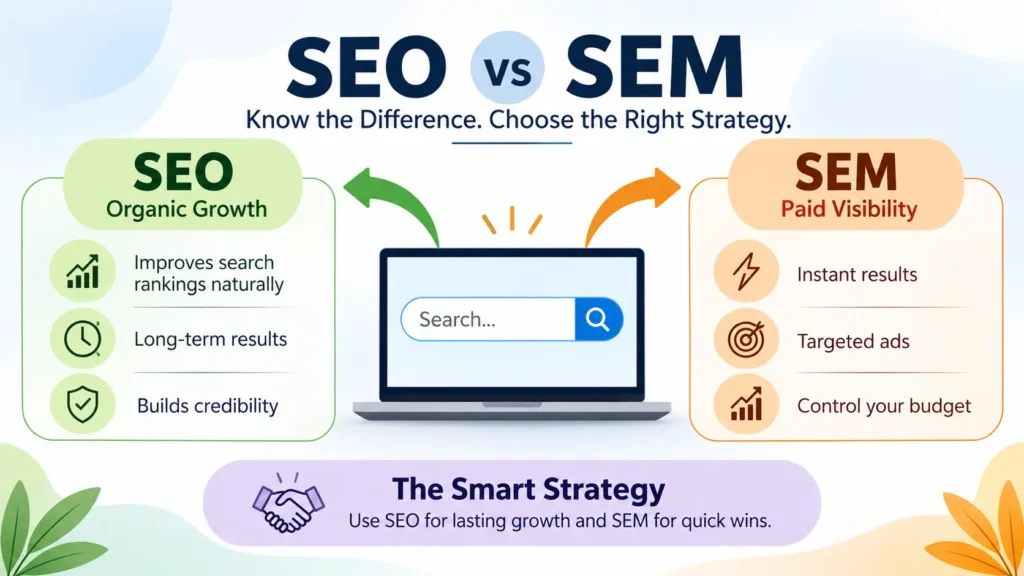
1. What Is SEO (Search Engine Optimization)?
SEO is the process of improving your website so that it appears more prominently in the organic (unpaid) search results of search engines as a foundational search engine visibility strategy.
For example, imagine someone searches Google for:Best branding agency in Chennai.
If your website has relevant content, a technically sound structure and strong authority, it has an opportunity to appear among the organic search results driven by your search engine visibility strategy.
SEO generally focuses on three important areas:
1. On-Page SEO
Optimising website content, page titles, headings, keywords, images and internal links within your search engine visibility strategy.
2. Off-Page SEO
Building your website’s reputation through relevant backlinks, brand mentions and other external signals to strengthen your overall search engine visibility strategy.
3. Technical SEO
Improving website speed, mobile usability, indexing, site structure and overall technical performance.
Benefits of SEO
Generates organic website traffic.
Builds long-term online visibility.
Improves brand credibility.
Attracts customers actively searching for your services through a sustainable search engine visibility strategy.
Can deliver sustainable results over time.
SEO is a long-term investment in your website’s visibility and overall search engine visibility strategy. To review professional design and web standards, check guidelines from the AIGA Design Association
2. What Is SEM (Search Engine Marketing)?
SEM is commonly used in digital marketing to describe paid search advertising, serving as an immediate-impact search engine visibility strategy, although the term can sometimes be used more broadly to include SEO.
In this blog, we use SEM to refer specifically to paid search campaigns within your search engine visibility strategy.
For example, when someone searches for website design company in Chennai, your business advertisement may appear in the sponsored section of Google search results.
Businesses commonly use platforms such as Google Ads to run these campaigns.
You can target customers based on factors such as:
Search keywords.
Location.
Language.
Audience signals.
Campaign objectives inside your search engine visibility strategy.
Many search campaigns use a pay-per-click (PPC) model, where advertisers pay when someone clicks their advertisement.
Benefits of SEM
Can generate visibility quickly after campaign approval and launch.
Reaches customers searching for specific services through a targeted search engine visibility strategy.
Allows location and keyword targeting.
Provides measurable campaign data.
Offers control over advertising budgets.
Helps generate enquiries and sales opportunities.
SEM helps businesses compete for attention when customers are actively searching.
3. Key Differences Between SEO and SEM
Understanding how each channel fits into your broader search engine visibility strategy is essential:
One important point: SEO is not completely free. Businesses still invest in content creation, technical improvements, tools and professional expertise to support their search engine visibility strategy.
Similarly, paid advertising does not guarantee conversions. Results depend on targeting, competition, landing pages and the quality of the offer in your search engine visibility strategy.
4. When Should Your Business Choose SEO?
SEO is particularly useful when your business wants to establish a strong online presence over time with an organic search engine visibility strategy.
Consider SEO if:
You want consistent organic website traffic.
Your customers regularly search for your products or services.
You publish blogs and educational content.
You want to build authority in your industry through a long-term search engine visibility strategy.
You are planning long-term digital growth.
Example: A skincare brand publishing helpful blogs about skincare routines, skin concerns and product ingredients can attract people searching for those topics.
Over time, relevant content embedded in a solid search engine visibility strategy may bring visitors who discover the brand through Google.
5. When Should Your Business Choose SEM?
SEM is useful when your business needs faster search visibility or wants to promote a specific product, service or campaign using a paid search engine visibility strategy.
Consider paid search when:
You are launching a new product.
You want to promote a limited-time offer.
You need enquiries within a defined campaign period.
You want to target customers in a specific location using a localized search engine visibility strategy.
You want to test which search terms generate leads.
Example: A Chennai-based branding agency running a Google Ads campaign for “branding agency in Chennai” can reach people actively looking for branding services.
However, the campaign must have relevant advertisements, a strong landing page and a clear enquiry process to turn clicks into customers under your search engine visibility strategy.
6. The Smartest Strategy: Combine SEO and SEM
Here is something successful businesses understand: SEO and SEM do not have to compete with each other.
They can work together as a unified search engine visibility strategy.
Imagine your business is launching a new website.
You can use SEM to generate immediate search visibility while building SEO through quality website content, keyword optimisation and technical improvements as part of your dual search engine visibility strategy.
A combined search engine visibility strategy offers several advantages:
Paid campaigns can generate early traffic.
SEO can gradually strengthen organic visibility.
Search data from advertisements can reveal valuable keywords for your search engine visibility strategy.
Both channels can increase brand exposure.
Businesses can reach customers at different stages of their buying journey.
For many businesses, combining both approaches creates a more balanced digital marketing and search engine visibility strategy.
The Cholanadu Perspective: Visibility Is Good, But Business Growth Is Better
SEO and SEM are two powerful approaches to improving your business’s online presence through a tailored search engine visibility strategy.
SEO helps establish long-term organic visibility, while SEM allows businesses to gain targeted paid search exposure more quickly inside their search engine visibility strategy.
Neither strategy is automatically better than the other. The right choice depends on your business goals, competition, available budget and customer behaviour.
If you want sustainable growth, invest in an organic search engine visibility strategy. If you need faster visibility for specific campaigns, consider SEM. If your budget and resources allow, combine both for a more comprehensive search engine visibility strategy.
At Cholanadu, we believe successful digital marketing is not simply about appearing on Google. It is about attracting the right audience, building trust and converting online visibility into meaningful business opportunities through a strategic search engine visibility strategy. To learn more about our strategic growth frameworks, explore our guide on Cholanadu Brand Strategy Services.
Because being visible gets attention. Being relevant earns customers.
8. Launching the New Brand: More Than a Logo Reveal
Once the strategy, identity and communication systems are ready, the brand strategy overhaul moves towards launch.
A successful rebranding launch requires careful coordination as the final step of the brand strategy overhaul.
It may include:
- Introducing the new brand identity.
- Updating the website and social media platforms.
- Releasing an announcement or advertising film.
- Updating packaging and marketing materials.
- Communicating the changes to existing customers.
- Launching campaigns to attract new audiences.
A well-planned launch helps customers understand the transformation brought by the brand strategy overhaul rather than leaving them confused by sudden changes.
The Cholanadu Perspective: A Brand Overhaul Is a Business Transformation
A complete brand strategy overhaul involves much more than refreshing the appearance of a business.
It requires research, positioning, creativity, communication, customer understanding and consistent execution.
When all these elements work together in a brand strategy overhaul, a business can build a stronger identity, improve customer perception and create a more meaningful market presence.
The biggest mistake is treating branding as a one-time design project. Strong brands evolve with their customers, markets and business ambitions through ongoing brand management and periodic brand strategy overhaul initiatives.
At Cholanadu, we believe that successful branding begins with strategy and grows through consistency. To learn more about how strategic consulting transforms business growth, view our internal guide on Cholanadu Brand Strategy Services.
Because a powerful brand built through a brand strategy overhaul is not simply designed to look different. It is built to be remembered, trusted and chosen.
