


How to Measure the ROI of Branding and Marketing Campaigns ?
Table of Contents
ToggleROI of Branding and Marketing: 7 Proven Ways to Measure Success
When evaluating the ROI of branding and marketing, every investment in business is expected to create real, tangible value. Whether you are launching a new product, running social media ads, redesigning your brand identity, or investing in content marketing, one question eventually comes up:
“Is this actually working?”
That is where calculating the ROI of branding and marketing becomes one of the most important metrics in modern business growth.
The challenge is that marketing results are often visible immediately, while branding creates value gradually. A performance campaign may generate leads this week, but a strong brand can influence customer decisions for years. Understanding the difference and measuring both correctly helps businesses make smarter decisions, allocate budgets effectively, and grow with confidence.
Branding vs. Marketing: Why ROI Is Measured Differently
Before calculating the overall return, it is important to understand that branding and marketing do not operate in the exact same way.
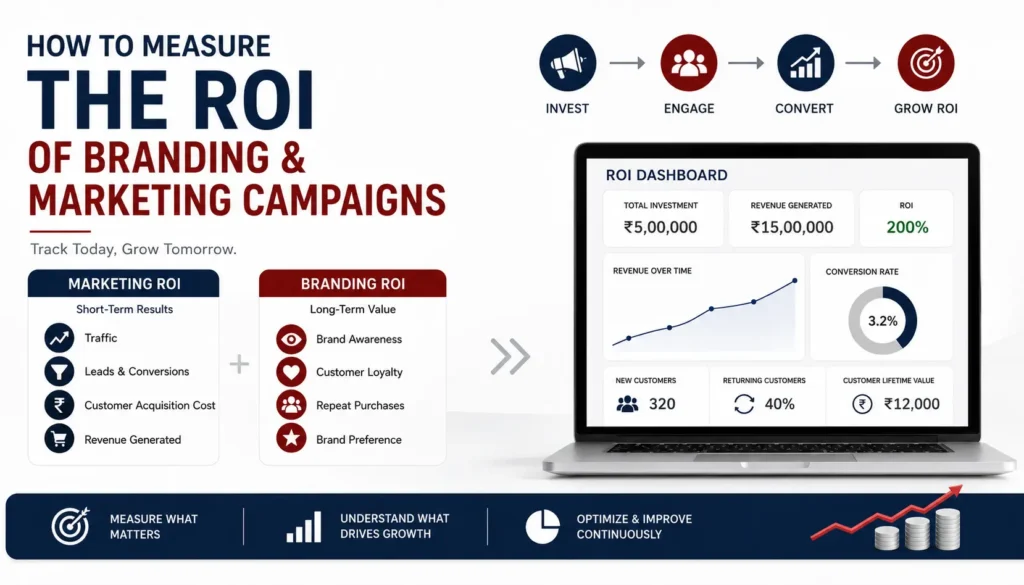
Marketing campaigns focus on immediate outcomes such as leads, sales, website traffic, inquiries, downloads, or conversions.
Branding initiatives focus on long-term value such as trust, recognition, customer loyalty, pricing power, reputation, and repeat business.
A common mistake is judging a branding campaign only by short-term sales. Branding often influences future purchasing behavior, referrals, customer retention, and even how much customers are willing to pay.
The smartest businesses measure both short-term marketing ROI and long-term brand ROI together.
The Basic ROI Formula
The standard calculation for tracking marketing campaigns is simple:

For example, if you spend ₹1,00,000 on a campaign and generate ₹3,00,000 in revenue:
- Revenue: ₹3,00,000
- Cost: ₹1,00,000
- Profit: ₹2,00,000

This formula works exceptionally well for direct response campaigns, but measuring the full ROI of branding and marketing requires additional performance indicators.
Metrics That Measure Marketing ROI
1. Website Traffic :
Track how many visitors came from each campaign source.
Monitor:
- Organic traffic
- Paid advertising traffic
- Social media traffic
- Referral traffic
- Email campaign traffic
Tools such as Google Analytics can reveal which digital channels generate the highest-value visitors to your storefront.
2. Lead Generation :
If your campaign aims to generate inquiries, calculate:
- Number of leads
- Cost per lead (CPL)
- Lead-to-customer conversion rate
- Revenue generated from those leads
A campaign producing fewer but higher-quality leads may outperform one generating a large number of unqualified inquiries.
3. Customer Acquisition Cost (CAC) :
CAC tells you how much it costs to acquire one customer.

For example:
- Marketing Spend: ₹2,00,000
- New Customers: 100
- CAC: ₹2,000 per customer
Lower CAC combined with strong customer value usually indicates healthy marketing performance.+
4. Conversion Rate :
Traffic alone is not enough. Measure how many visitors become paying customers.

A campaign attracting 10,000 visitors with a 5% conversion rate usually delivers more value than one attracting 20,000 visitors with a 1% conversion rate.
Metrics That Measure Branding ROI
Branding is less about immediate transactions and more about increasing the probability that customers choose you over competitors.
1. Brand Awareness :
Ask:
- Are more people searching for your brand name?
- Has direct website traffic increased?
- Are social media mentions growing?
- Are more customers recognizing your logo or brand identity?
Increasing branded search volume is often a strong indicator that branding efforts are working.
2. Customer Retention :
Acquiring customers is expensive. Retaining them is usually far more profitable.
Measure:
- Repeat purchase rate
- Subscription renewals
- Returning customer percentage
- Customer lifetime value (CLV)
Strong branding often increases customer retention dramatically.
3. Customer Lifetime Value (CLV) :
CLV estimates the total revenue a customer generates during their relationship with your business.
For example:
- Average Purchase: ₹2,000
- Purchases per Year: 4
- Customer Lifespan: 5 years
- CLV: ₹40,000
If branding increases customer loyalty, CLV rises—even if acquisition costs remain similar.
4. Brand Preference :
Ask existing and potential customers:
- Which brands come to mind first?
- Which brand do they trust most?
- Which brand feels premium?
- Which brand would they recommend?
Survey-based brand preference studies reveal the hidden impact of branding investments.
A Practical ROI Dashboard
Instead of relying on a single number, create a balanced dashboard to monitor the ROI of branding and marketing side-by-side:
| Performance Metric | Category | Primary Measurement Focus |
| Branded Search Volume | Brand ROI | Awareness & Intent |
| Customer Retention Rate | Brand ROI | Loyalty & Experience |
| Customer Lifetime Value (CLV) | Brand ROI | Long-Term Equity |
| Customer Acquisition Cost (CAC) | Marketing ROI | Short-Term Efficiency |
| Click-Through & Conversion Rate | Marketing ROI | Direct Action |
| Return on Ad Spend (ROAS) | Marketing ROI | Instant Revenue |
This approach gives a complete picture of both immediate performance and long-term brand growth.
Attribution: The Missing Piece
One customer may:
- See your Instagram reel
- Read your blog
- Watch a YouTube video
- Visit your website
- Click a Google ad
- Purchase two weeks later
Which channel deserves credit? The answer is attribution.
Common attribution models include:
- First-touch attribution: Credits the first interaction.
- Last-touch attribution: Credits the final interaction.
- Linear attribution: Distributes credit across all interactions.
- Data-driven attribution: Uses analytics to estimate contribution.
For most growing businesses, multi-touch attribution provides a more realistic view when assessing the true ROI of branding and marketing.
How Branding Improves Marketing ROI ?
This is where many businesses underestimate branding. A stronger brand can:
- Increase ad click-through rates
- Improve conversion rates
- Reduce customer acquisition cost
- Increase average order value
- Improve customer retention
- Generate more referrals
In other words, branding makes every marketing rupee work harder.
For example, two companies may run identical ads. The better-known brand usually receives more clicks, more trust, higher conversions, and lower acquisition costs. Brand equity compounds over time.
For additional strategies on optimizing your digital presence, explore our guide on building a high-converting brand design for e-commerce stores.
A Simple Example :
Imagine a company spends:
- ₹3,00,000 on branding
- ₹2,00,000 on performance marketing
After six months:
- Website traffic increases 60%
- Branded searches increase 80%
- Customer retention rises from 25% to 40%
- Marketing conversion rate improves from 2% to 3.5%
- Revenue grows from ₹10 lakh to ₹16 lakh
The branding investment may not be directly responsible for every sale, but it has clearly improved the efficiency of all marketing activities. That is real ROI.
The Most Important Question
Instead of asking:
“Did this branding campaign generate sales today?”
Ask:
“Did this branding campaign make future sales easier, cheaper, and more likely?”
That question captures the true value when analyzing the ROI of branding and marketing.
Cholanadu Takeaway
Measuring the ROI of branding and marketing campaigns is not about choosing one metric—it is about combining financial results with customer perception.
Track revenue, leads, conversions, and acquisition costs. But also monitor awareness, loyalty, retention, and customer lifetime value.
Marketing creates transactions. Branding creates preference.
When measured together, they reveal the real engine behind sustainable business growth. Because the strongest brands are not the ones that spend the most—they are the ones that know exactly what every marketing and branding investment is returning over time.
