


Why 90% of Rebrands Fail (And the $1M Mistake Most Founders Make)
Table of Contents
ToggleRebranding Strategy Mistakes: 5 Proven Ways to Avoid $1M Failures
Why 90% of Rebrands Fail (And the $1M Mistake Most Founders Make)
A New Logo Cannot Fix a Broken Brand Strategy
Imagine spending $1 million on a complete rebrand. Your business gets a sophisticated new logo, a modern website, premium packaging, and a fresh marketing campaign. Everything looks impressive. Yet, months later, customers are confused, sales are struggling, and your brand is losing the recognition it spent years building.
What went wrong? The problem may not be the design. It may be the thinking behind it. Making critical rebranding strategy mistakes can derail even the best intentions.
Rebranding can help businesses reposition themselves, attract new audiences, and prepare for growth. However, when founders focus exclusively on visual changes without addressing the underlying business strategy, even an expensive rebrand can become a costly mistake due to common rebranding strategy mistakes.
A rebrand should change how people understand your business, not simply how your business looks. Let’s explore why rebrands fail, what founders often overlook, and how businesses can approach brand transformation more strategically by avoiding rebranding strategy mistakes.
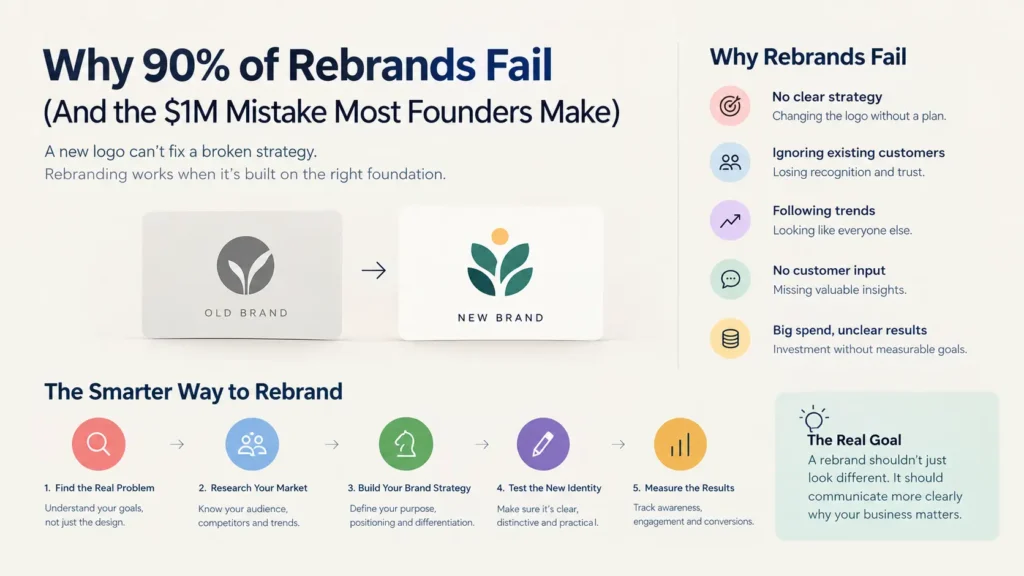
1. The Biggest Mistake: Changing the Logo Before Defining the Strategy
One of the most common rebranding strategy mistakes is treating a rebrand as a design project rather than a business decision. A founder may decide that the existing logo looks outdated and immediately commission a new identity. But an important question remains unanswered:
What business problem is the rebrand supposed to solve? Is the company targeting a new audience? Has its market position changed? Is it expanding into new product categories? Does its existing identity no longer reflect its value?
Without clear answers, committing rebranding strategy mistakes can result in a new logo creating visual change without delivering meaningful business improvement.
Before redesigning anything, businesses should establish their objectives, understand their customers, and define what makes them different from competitors. Design should communicate that strategy—not replace it. To explore foundational professional design standards, review guidelines from the AIGA Design Association
2. Why Customer Recognition Is More Valuable Than Founders Realise
Your existing brand may have years of recognition behind it. Customers recognise your colours, packaging, logo, and communication style. These familiar elements can help them identify your products quickly and distinguish you from competitors.
A sudden, unnecessary redesign can weaken those associations if it stems from avoidable rebranding strategy mistakes.
Consider a familiar consumer brand that changes its packaging, visual identity, and messaging simultaneously. Loyal customers may struggle to recognise the product, while new customers may not understand what has changed or why.
This doesn’t mean businesses should avoid redesigns. It means they should understand which elements are valuable and which need improvement. A successful rebrand preserves meaningful brand assets while making necessary changes.
The objective is not to erase recognition. It is to strengthen it.
3. The $1 Million Mistake: Spending Big Without Understanding the Problem
Why would a company invest heavily in a rebrand and still fail to achieve its objectives? Because expenditure does not guarantee strategic clarity, and ignoring core principles leads straight to rebranding strategy mistakes.
Imagine a company investing $1 million in a rebranding exercise that includes research, design, website development, packaging, advertising, and launch activities. If the business has not identified the real problem, the entire investment could be directed towards the wrong solution due to classic rebranding strategy mistakes.
For example:
If customers consider the product overpriced, a new logo may not solve the problem.
If customer service is poor, a premium visual identity will not repair the experience.
If the business lacks differentiation, modern design alone will not create a compelling reason to buy.
If customers do not understand the product, a clearer positioning strategy may be more valuable than a complete redesign.
The actual mistake is not spending $1 million. It is spending a large amount without establishing what success should look like.
A rebrand should have measurable objectives, such as improving brand recognition, increasing consideration among a target audience, clarifying market positioning, or supporting entry into a new category. Before approving the budget, define the problem, the proposed solution, and the evidence that will demonstrate success.
4. Copying Trends Instead of Building a Distinctive Identity
Minimalist logos, neutral colour palettes, geometric typography, and simplified visual systems have become popular across many industries. These styles can work beautifully when they reflect a brand’s personality and positioning.
Problems arise when businesses fall into rebranding strategy mistakes by adopting trends simply because competitors are using them.
Imagine five companies in the same industry choosing nearly identical logos, colours, and website layouts. Their branding may look contemporary, but customers have fewer visual cues to distinguish one company from another.
A distinctive brand requires more than following design conventions. It needs a clear point of view, an understanding of its audience, and a visual identity that reflects its individual character.
Before adopting a trend, founders should avoid rebranding strategy mistakes by asking:
Does this design reflect our brand positioning?
Will our customers recognise us?
Does it distinguish us from competitors?
Will it remain useful as our business evolves?
Good design makes a brand look professional. Strategic design helps make it recognisable.
5. Ignoring Customers During the Rebranding Process
A rebrand may begin with the founder’s vision, but its success depends partly on how customers respond. Founders often become emotionally attached to their existing identity or excited about a new creative direction, which fuels further rebranding strategy mistakes. That enthusiasm can make it difficult to evaluate the change objectively.
Customer research provides an important counterbalance. Before launching a major rebrand, businesses should investigate how customers currently perceive the brand, what they value, and what they expect from it to sidestep typical rebranding strategy mistakes.
They can then test proposed messaging, visual concepts, and positioning with relevant audience groups. This does not mean every customer preference should determine the final design. Customer feedback must be interpreted alongside business objectives and long-term strategy.
The purpose is to identify potential problems before they become expensive mistakes. A rebrand should be informed by customer understanding, not driven entirely by internal opinion.
6. Changing Everything at Once Can Create Confusion
A major rebrand may involve a new logo, website, packaging, tone of voice, product naming system, and marketing strategy. Changing all these elements simultaneously without a roadmap invites severe rebranding strategy mistakes, making it difficult for customers to understand the transition.
A more structured approach can help. Businesses should plan how the new identity will appear across their website, social media, advertising, packaging, sales materials, and customer communications.
They should also explain important changes when necessary, particularly when the company name, product range, ownership, or market positioning has changed. Consistency is essential.
If customers see one identity on Instagram, another on the website, and outdated packaging in stores, the rebrand may appear incomplete. A carefully managed rollout helps ensure that every customer touchpoint communicates the same brand story.
7. How to Rebrand Without Wasting Your Investment
A successful rebrand requires a process that connects business objectives with creative execution, ensuring you bypass costly rebranding strategy mistakes.
Here are five practical steps founders should consider:
Step 1: Identify the Real Business Problem: Determine why the current brand needs to change. Establish whether the challenge involves positioning, customer perception, recognition, expansion, or visual relevance.
Step 2: Research Your Market: Study your competitors, target audience, customer feedback, and changing market expectations.
Step 3: Define Your Brand Strategy: Clarify your purpose, positioning, audience, differentiation, and communication style before finalising the visual identity.
Step 4: Develop and Test the New Identity: Create design concepts that reflect the strategy. Evaluate their clarity, distinctiveness, practicality, and suitability across different platforms.
Step 5: Measure the Results: Track relevant indicators before and after launch, such as brand recognition, customer consideration, website conversions, and audience response.
Not every rebrand will produce immediate sales growth, and external factors can influence results. However, clearly defined objectives make it easier to assess whether the investment is delivering value. To align your overall brand roadmap with expert growth frameworks, explore our guide on Cholanadu Brand Strategy Services.
The Cholanadu Perspective: Rebrand With Purpose, Not Pressure
Rebranding can be a powerful opportunity to reposition a business, communicate its evolving value, and build stronger connections with customers. But changing your identity simply because it looks outdated, competitors are redesigning, or a new trend has become popular can lead to unnecessary expense.
The most important work happens before the first design concept is created. It begins with understanding the business, identifying the problem, listening to customers, and establishing a clear direction for the future while actively avoiding rebranding strategy mistakes.
At Cholanadu, we believe that effective branding combines strategic thinking, distinctive design, and consistent communication. A brand should not merely look different after a rebrand. It should communicate more clearly why it matters.
Because the most expensive branding mistake is not choosing the wrong colour or logo. It is investing in a new identity without knowing what your business needs to become.
A Question for Business Owners
If you invested $1 million in your next rebrand, would you be able to explain exactly what business problem that investment is intended to solve?
If the answer is unclear, the first step is not to redesign your logo. It is to rethink your strategy.
