


Why Playing It “Safe” with Your Branding Is Killing Your Growth
Table of Contents
ToggleDistinctive Brand Identity: 7 Proven Ways to Avoid Growth Traps
Why Playing It “Safe” with Your Branding Is Killing Your Growth
The Hidden Cost of Looking Like Everyone Else in a Competitive Market
Imagine launching a business with an excellent product, competitive pricing, and a dedicated team. Your logo looks professional, your website follows the latest design trends, and your marketing materials appear polished.
Yet, customers struggle to remember your brand. Why?
Because your competitors look almost identical. The same colours, familiar slogans, predictable advertisements, and generic messaging make it difficult for customers to recognise what makes your business different.
This is the hidden danger of playing it safe with your branding and failing to establish a distinctive brand identity. Many businesses believe that avoiding creative risks protects their reputation. In reality, excessive caution can make a brand invisible in a crowded marketplace without a truly distinctive brand identity.
Your brand doesn’t have to be louder than everyone else. It needs to give people a reason to remember you through a distinctive brand identity.
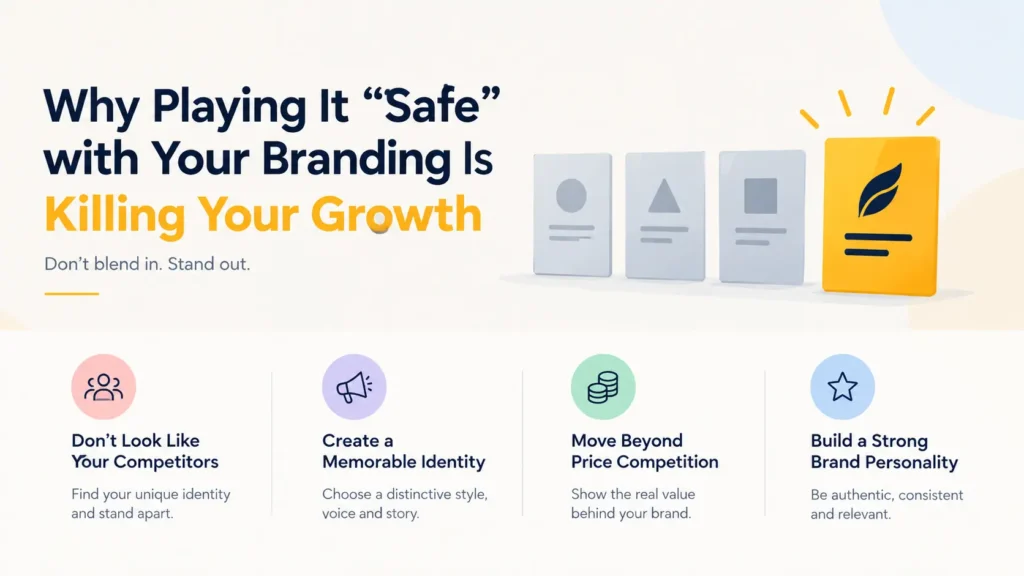
1. The Problem With Looking Like Your Competitors
When businesses enter competitive markets, they often study successful competitors and imitate their visual styles.
A technology company chooses a familiar blue colour palette. A skincare brand adopts minimalist packaging. A consulting firm uses corporate typography and generic promises about excellence.
These choices are not inherently wrong. The problem arises when businesses copy industry conventions without considering whether those conventions help establish a distinctive brand identity.
If every competitor communicates in the same way, customers have fewer reasons to remember one company over another. Building a distinctive brand identity requires a clear understanding of its identity, audience, and competitive advantage.
Before approving your next design, ask yourself:
Does this look genuinely connected to our business?
Can customers distinguish us from our competitors?
Does our messaging communicate a specific advantage?
Would someone recognise our brand without immediately seeing our name?
If your branding could belong to almost any business in your industry, it may be time to rethink your approach and focus on a distinctive brand identity. To review professional graphic standards, check guidelines from the AIGA Design Association.
2. Safe Branding Often Leads to Forgettable Marketing
Customers encounter countless advertisements, social media posts, websites, and promotional messages every day. In this environment, simply looking professional may not be enough to attract attention without a distinctive brand identity.
Consider two brands selling similar products.
Brand A uses generic promotional messages, conventional product photographs, and familiar advertising formats.
Brand B communicates a clear point of view, uses distinctive visual storytelling, and presents its products in ways that reflect its personality.
Both brands may offer excellent products, but Brand B has more opportunities to create memorable associations through its distinctive brand identity. This doesn’t mean every business needs provocative advertisements or unconventional designs.
It means that creative decisions should communicate something meaningful about the brand. A memorable identity can emerge from distinctive colours, a recognisable visual style, an unusual but relevant brand voice, or a compelling story.
Professionalism earns credibility. A distinctive brand identity helps customers remember you.
3. Playing Safe Can Turn Your Business Into a Price Competition
When customers struggle to identify meaningful differences between competing brands, price can become a major deciding factor.
Imagine two companies offering similar services. Their websites look alike, their messaging promises similar benefits, and neither communicates a compelling reason to choose it over the other.
Customers may naturally compare prices. This can put pressure on profit margins and encourage businesses to compete through discounts rather than building a distinctive brand identity.
Strong branding helps businesses communicate the value behind their offerings. For example, a premium skincare company might differentiate itself through transparent product information, a carefully defined customer experience, and a consistent, distinctive brand identity.
A design agency might communicate its value through a distinctive creative philosophy, specialist expertise, and a clear approach to solving client problems. These qualities do not automatically justify higher prices, but they can help customers understand why an offering is different.
When your brand communicates its value clearly through a distinctive brand identity, the conversation can move beyond price alone.
4. Your Brand Personality Is a Business Asset
A brand is more than its logo, colours, and typography. It also has a personality expressed through its language, behaviour, customer experience, and visual communication. Some brands are bold and energetic. Others are refined, reassuring, playful, or authoritative.
Problems arise when businesses choose a personality simply because it appears fashionable or acceptable within their industry instead of forming a distinctive brand identity.
A financial services company does not need to sound identical to every other financial services company. A traditional food brand does not have to abandon its heritage to appeal to younger customers.
The key is to develop a personality that reflects the business while remaining relevant to its audience. Ask these questions:
If our brand were a person, how would it communicate?
What should customers feel when they interact with us?
Which qualities make our business genuinely different?
Does our current distinctive brand identity reflect those qualities?
A clearly defined personality makes it easier to maintain consistency across advertising, websites, packaging, and social media, cementing a distinctive brand identity. It also gives creative teams a stronger foundation for producing meaningful content.
5. Taking Creative Risks Doesn't Mean Ignoring Strategy
There is an important difference between a distinctive brand identity and unnecessary experimentation. Changing your logo to an unusual shape, adopting an unfamiliar colour, or creating a controversial campaign does not automatically make your business memorable in a positive way.
Creative decisions must serve a purpose. A successful brand should balance three essential elements:
Distinctiveness: Give customers recognisable reasons to remember you via a distinctive brand identity.
Relevance: Ensure your identity connects with the needs and expectations of your audience.
Consistency: Reinforce the same core brand associations across different customer touchpoints.
For example, a premium hospitality brand might use sophisticated photography and elegant typography to communicate exclusivity. A youth-focused lifestyle brand might use expressive visuals and conversational messaging to create a more energetic personality.
Neither approach is universally better. Their effectiveness depends on how well the creative direction reflects the brand’s positioning. The objective is not to be different for the sake of being different, but to build a distinctive brand identity that matters to your customers.
6. How to Make Your Branding More Distinctive
You don’t necessarily need a complete rebrand to stand out. Sometimes, focused improvements can help shape a distinctive brand identity.
Step 1: Identify What Makes You Different: Define the qualities that genuinely separate your business from competitors. These might include specialist expertise, product design, customer service, a unique process, or a distinctive brand philosophy.
Step 2: Review Your Competitors: Study their visual identities, messaging, website experiences, and marketing campaigns to carve out a distinctive brand identity.
Step 3: Strengthen Your Visual Identity: Develop a consistent system of colours, typography, imagery, and design elements that helps customers recognise your distinctive brand identity.
Step 4: Develop a Recognisable Brand Voice: Decide how your business should communicate to support your distinctive brand identity.
Step 5: Test Your Creative Direction: Gather feedback from relevant customers and evaluate how effectively your branding communicates.
Step 6: Measure What Matters: Track relevant indicators such as brand recognition, customer enquiries, conversion rates, and repeat purchases.
Not every creative risk will succeed. Testing allows you to learn, refine, and improve without relying entirely on assumptions.
7. When Should Your Business Rethink Its Branding?
Your existing brand may need attention if:
Customers frequently confuse your business with competitors due to a weak distinctive brand identity.
Your marketing looks similar to other brands in your industry.
You rely heavily on discounts to attract customers.
Your visual identity no longer reflects the quality of your products or services.
Your business has evolved, but your branding has remained unchanged.
Your messaging describes what you sell but fails to establish a distinctive brand identity.
These signs do not automatically mean you need a complete redesign. Sometimes, the solution is clearer positioning, stronger messaging, more distinctive photography, or a consistent visual system. The first step is to identify the underlying problem before deciding what needs to change.
The Cholanadu Perspective: Don't Let the Fear of Being Different Make Your Brand Invisible
Playing it safe may feel comfortable, especially when your business has invested considerable time and money in its existing identity. But branding that relies entirely on familiar conventions can make differentiation difficult without a distinctive brand identity.
In a competitive market, businesses need more than attractive logos and polished websites. They need a clear identity, a compelling reason for customers to choose them, and a consistent way of communicating their value through a distinctive brand identity.
At Cholanadu, we believe effective branding combines strategic clarity with creative distinction. Your identity should reflect who you are, what makes your business valuable, and why customers should remember your distinctive brand identity. To align your overall visual growth framework, explore our guide on Cholanadu Brand Strategy Services.
Because growth doesn’t always come from following what everyone else is doing. Sometimes, it begins with having the confidence to communicate what makes your business different through a distinctive brand identity.
