


Website Redesign vs. Complete Rebrand: Which One Does Your Business Need?
Table of Contents
Toggle5 Best Ways to Rebrand or Redesign Your Website in 2026
When planning to rebrand, your website looks outdated. Your brand feels inconsistent. Your customers are changing. The immediate question is often: “Should we redesign our website or should we rebrand the entire business?”
Although these two decisions may appear similar, they solve very different problems.
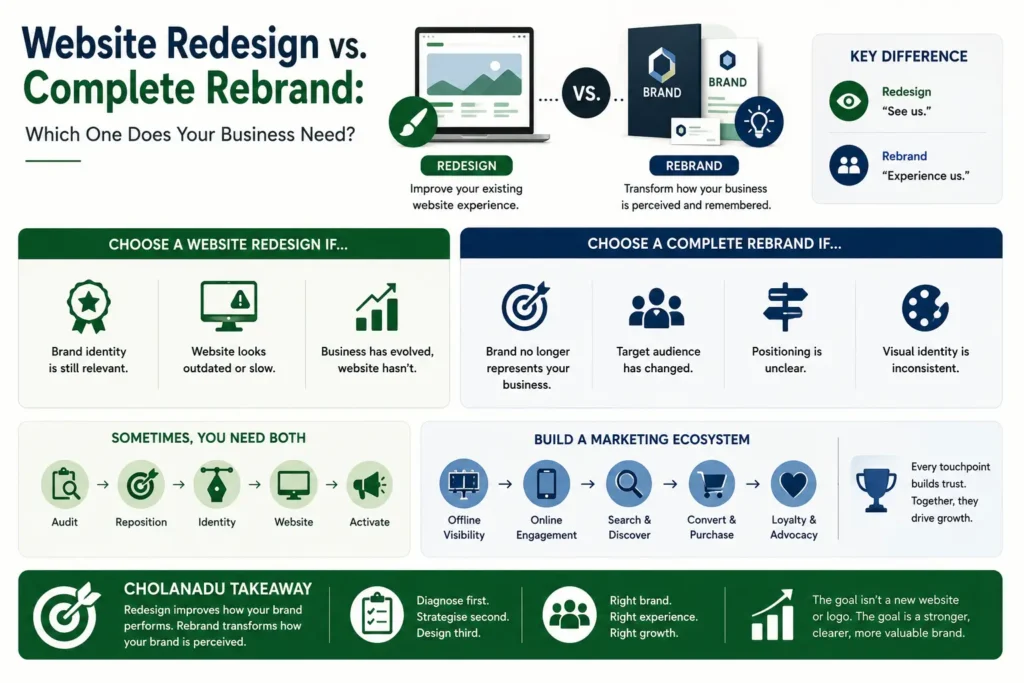
A website redesign improves how your existing brand is presented digitally. A complete rebrand changes how your business is perceived, positioned, and remembered.
Choosing the wrong approach can result in wasted investment, inconsistent communication, and a brand that still doesn’t connect with its audience.
So, how do you know which one your business actually needs for a successful rebrand strategy?
First, Understand the Difference
Think of your business as a premium physical store.
The brand is everything customers associate with the store:
The name
Logo
Colours
Personality
Positioning
Values
Messaging
Customer experience
Reputation
The website is the digital storefront. A website redesign improves the storefront. A rebrand can change the identity of the entire store. That’s the fundamental difference when you rebrand.
A website redesign focuses primarily on improving your existing website while keeping the core brand identity intact.
It may involve:
Modernising the website interface
Improving mobile responsiveness
Improving navigation
Reorganising content
Enhancing page speed
Improving SEO structure
Adding stronger calls-to-action
Improving user experience
Updating imagery
Improving conversion pathways
Integrating modern technologies
The objective? Make your existing brand perform better online without a full rebrand.
Your logo, brand name, colours, positioning and overall identity may remain largely unchanged.
Example
Imagine a company that has been operating successfully for 10 years.
Its logo is recognised. Its customers trust the brand. Its market positioning is clear. But its website still looks like it was designed in 2016. In this situation, a website redesign may be the smarter investment rather than a rebrand.
You don’t necessarily need a new identity. You need a better digital experience.
A complete rebrand goes much deeper. It involves reconsidering the strategic identity of the business itself.
A rebrand may include:
Brand Strategy → Positioning → Identity → Messaging → Digital Experience
It can involve:
Brand positioning
Brand purpose
Target audience definition
Brand personality
Logo redesign
Colour palette
Typography
Visual identity
Brand voice
Messaging
Tagline
Marketing communication
Website
Social media identity
Packaging and collateral
The objective to rebrand is not simply to make the business look newer. It is to make the business mean something different or stronger in the minds of its audience.
The Most Important Question
Before deciding between the two, ask yourself:
“Is the problem with our website or with our brand?” This single question can save your business considerable time and money during a rebrand.
Choose a Website Redesign If…
01. Your Brand Identity Still Feels Relevant
If customers recognise your brand and your positioning remains strong, there may be no reason to start from zero with a rebrand. Your brand may simply need a modern digital environment. Keep the identity. Upgrade the experience.
02. Your Website Looks Outdated
Technology and digital design evolve rapidly. A website that looked premium five years ago may appear ordinary today. Warning signs include:
Poor mobile experience
Outdated layouts
Slow loading
Confusing navigation
Low-quality visuals
Weak calls-to-action
Difficult checkout or enquiry process
In this situation, redesigning the website can create a significant improvement without an immediate rebrand. Check Google’s official Search Console Documentation to audit digital site performance.
03. Your Business Has Evolved but Your Website Hasn’t
Perhaps your company has introduced new services. Maybe you have expanded into new markets. Perhaps your customer base has grown. Your brand may still be relevant, but your website may not communicate the full scale of the business anymore. That’s a classic redesign situation instead of a total rebrand.
Choose a Complete Rebrand If…
01. Your Brand No Longer Represents Your Business
Businesses evolve.
A company that started as a small local service provider may eventually become a premium regional or national brand.
If the identity still communicates:
“small and traditional”
while the business has evolved into:
“modern and premium”
there is a disconnect.
A rebrand can bridge that gap. Explore our dedicated Cholanadu Strategy Hub for growth execution.
02. Your Target Audience Has Changed
Your original audience may not be your future audience.
For example:
Then: Price-conscious local customers
Now: Premium urban customers
If your visual identity, messaging and communication were designed for the old audience, simply redesigning the website may not solve the problem. The need to rebrand becomes essential.
03. Your Positioning Is Unclear
Can you clearly answer: “Why should customers choose you instead of your competitors?”
If the answer is complicated, generic, or inconsistent, the issue may not be your website.
It may be your brand strategy. A decision to rebrand gives you an opportunity to clarify:
Who you are.
Who you serve.
What makes you different.
Why customers should care.
04. Your Visual Identity Is Inconsistent
Look across your:
Website
Instagram
LinkedIn
Brochures
Advertisements
Presentations
Packaging
Business cards
Do they all look like they belong to the same company? If every platform uses different colours, fonts, messaging and visual styles, you don’t simply have a design problem. You need a unified rebrand strategy.
The simple rule:
If your brand is right but your website is wrong → Redesign.
If your brand itself is wrong, outdated or unclear → Rebrand.
What About Doing Both?
Sometimes the answer isn’t either/or. It is both. A rebrand without a modern website can leave your new identity trapped in an outdated digital experience. And a website redesign without addressing a fundamentally outdated brand can simply create a beautiful website for the wrong positioning.
The strongest transformation can therefore follow this sequence:
01. Brand Audit
Understand where the brand currently stands before a rebrand.
↓
02. Strategic Repositioning
Define where the brand needs to go.
↓
03. Visual Identity
Develop the appropriate identity system to rebrand.
↓
04. Website Strategy
Translate the brand into a digital experience.
↓
05. Website Development
Build the new digital presence.
↓
06. Digital Activation
Carry the identity consistently across marketing channels.
This creates one connected brand experience rather than disconnected design projects.
Don't Make the Decision Based on Design Alone
One of the biggest mistakes businesses make is treating a rebrand as a visual exercise.
A new logo may look impressive.
A beautiful website may generate compliments.
But neither automatically creates a stronger brand.
Before changing anything, evaluate five areas:
Strategy: Is your business positioning still relevant for a rebrand?
Audience: Are you communicating with the right customers?
Identity: Does your visual identity represent your current ambition?
Experience: Does your website make it easy for customers to understand and engage with you?
Perception: How do customers actually perceive your brand?
Only after answering these questions should you decide between redesigning and a rebrand.
Think Beyond the Logo
A successful rebrand transformation isn’t about changing what customers see alone. It’s about changing what customers understand, feel and remember. A powerful brand should create consistency across every touchpoint:
Advertisement → Website → Social Media → Sales Conversation → Product/Service → Customer Experience
When these elements work together, a rebrand becomes more than decoration.
It becomes a business asset.
The Strategic Decision
Before approving a redesign or rebrand project, ask three questions:
What is broken? Is it the website experience?
What has changed? Has the business, audience or market evolved to require a rebrand?
What needs to become different? Does the business need a better website—or a completely different market perception?
The answers will usually reveal the right direction.
Cholanadu Takeaway
A website redesign says:
“We are improving how our existing brand appears and performs.”
A rebrand says:
“We are evolving how the market sees and understands us.”
Neither is automatically better.
The right choice depends on what your business needs to change.
If your brand still has strong equity, don’t destroy it unnecessarily with an unwanted rebrand.
If your brand no longer represents your ambition, don’t simply give it a prettier website. Execute a strategic rebrand.
Diagnose first. Strategise second. Design third.
Because the objective isn’t to have a newer website or a newer logo.
The objective is to build a stronger, clearer and more valuable brand through a targeted rebrand.
Cholanadu Perspective
At Cholanadu, we believe every branding decision should begin with a strategic question: “What business problem are we trying to solve?” Because sometimes, your business doesn’t need a new brand. It needs a better website. Sometimes, it doesn’t need a new website. It needs a stronger identity through a rebrand.
And sometimes, it needs both built around one clear brand strategy.
The smartest transformation isn’t the one that changes the most.
It’s the one that changes what matters.
Your brand is the promise.
Your website is the experience.
Your marketing is the conversation.
Your customer is the judge.
Make sure all four tell the same story.
