


Kodak’s Digital Failure: What Happens When You Skip Regular Brand Audits
Table of Contents
ToggleKodak Brand Audit Secrets: 5 Power Lessons From Digital Failure
The technology wasn’t the problem. The brand failed to evolve with it because it skipped regular Kodak brand audit evaluations.
For decades, Kodak was almost synonymous with photography. You took a picture, you thought of Kodak. The company had technology, distribution, customer trust, and one of the strongest brand names in the world. Yet when digital photography transformed the industry, Kodak struggled to transform itself with it.
The result? A powerful reminder that a successful brand today can become irrelevant tomorrow if it stops performing a Kodak brand audit, questioning, and evolving itself.
The Kodak Paradox
Here is what makes Kodak’s story particularly fascinating: Kodak actually had a connection to digital photography. An early digital camera prototype was developed by Kodak engineer Steven Sasson in 1975.
The technology existed. The opportunity existed. But the business model surrounding traditional film photography was deeply embedded in Kodak’s success. And this created a dangerous situation: the company was looking at the future through the lens of its past.
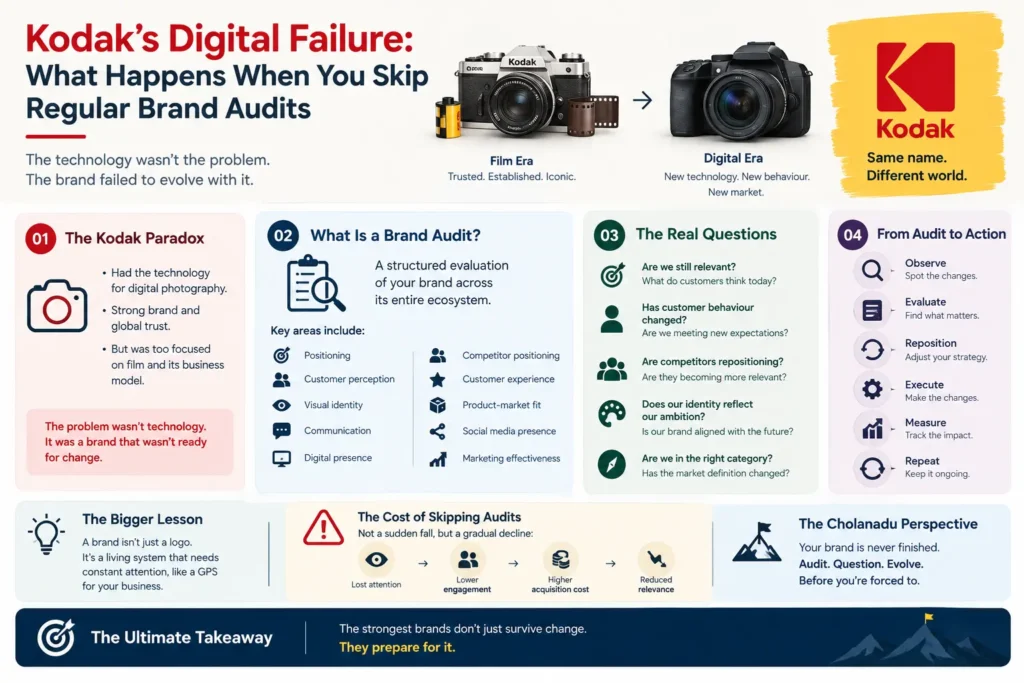
This is where regular Kodak brand audit processes become essential. A Kodak brand audit isn’t simply about checking whether your logo looks modern. It asks a much bigger question: Is our brand still relevant to where the market is going?
01 What Is a Kodak Brand Audit?
A Kodak brand audit is a structured evaluation of how your brand is performing across its entire ecosystem. It examines critical strategic areas such as:
Brand positioning & Customer perception
Visual identity & Communication
Digital presence & Social media presence
Competitor positioning & Marketing effectiveness
Customer experience & Product-market relevance
Think of a Kodak brand audit as a health check for your brand. You may feel your brand is performing well, but your customers, competitors, and market may be telling a completely different story.
02 The Danger of "We’ve Always Done It This Way"
One of the biggest risks for established brands is familiarity. Success creates routines. Routines create comfort. And comfort can create resistance to change.
Kodak had spent decades building an extraordinarily successful film business. But the photography industry was changing rapidly:
Film → Digital
Physical prints → Screens
Camera ownership → Smartphone photography
Film processing → Instant sharing
The consumer wasn’t simply changing products; the consumer was changing behaviour. And brands that fail to conduct a routine Kodak brand audit may fail to notice that the customer has already moved somewhere else.
03 A Kodak Brand Audit Forces the Right Questions
Regular Kodak brand audit reviews create a moment to step outside the business and examine the brand objectively.
Are we still relevant? What does your brand mean to customers today? Not five years ago—today.
Has customer behaviour changed? Customers may now discover, compare, purchase, review, and recommend products completely differently. Your brand strategy must reflect that journey.
Are competitors repositioning? Sometimes the biggest warning isn’t declining sales; it’s a competitor becoming more relevant. A Kodak brand audit helps identify how competitors are changing their positioning, communication, technology, and customer experience.
Does our identity reflect our ambition? Your logo, colours, website, packaging, photography, tone of voice, and content should communicate the brand you are building, not simply the company you started with.
Are we competing in the right category? This is perhaps the most important question. Kodak thought deeply about photography, but the market was moving toward digital imaging and information sharing.
Sometimes the problem isn’t that your brand is losing; it’s that the definition of your market has changed. Explore classic business case studies at Harvard Business Review or review marketing insights on Adweek.
04 Kodak Brand Audit Exercises Are Not Rebranding
This distinction matters. A Kodak brand audit does not automatically mean “change the logo.” Instead, it asks: What needs to change and what should remain?
Sometimes the answer may be a complete repositioning. Other times it may simply be:
A sharper message & A refreshed visual identity
Better digital experiences & New audience targeting
Improved content strategy & Updated brand positioning
The objective of a Kodak brand audit isn’t to change everything. The objective is to change what is no longer working.
05 The Real Cost of Skipping a Kodak Brand Audit
A brand rarely becomes irrelevant overnight. It usually happens gradually:
First, competitors become more interesting.
Then customer attention shifts.
Then engagement declines.
Then acquisition becomes more expensive.
Then the brand starts spending more money simply to maintain visibility.
Eventually, management asks: “What happened?” The answer may be that nothing happened suddenly—the brand simply stopped conducting a Kodak brand audit while the market kept moving. Read more about maintaining identity in our guide on Cholanadu Brand Architecture and our insights on Cholanadu Strategy.
06 Think of a Kodak Brand Audit Like a GPS Recalculation
Imagine driving toward a destination while refusing to check the GPS. You may continue driving efficiently, and you may even be moving quickly. But if the road changes, your original route may no longer make sense.
A Kodak brand audit performs the exact same function:
Observe → Evaluate → Reposition → Execute → Measure → Repeat
It doesn’t interrupt growth; a Kodak brand audit helps ensure you’re growing in the right direction.
07 The Kodak Lesson for Modern Businesses
The Kodak story isn’t simply about digital cameras. It’s about organizational thinking, market awareness, and brand adaptability. Today, disruption may come from:
Artificial Intelligence (AI)
Short-form video & Social commerce
Changing search behaviour
New consumer expectations & New platforms
New competitors & New technology
The next disruption may already be developing while your current strategy is still producing results. That is why successful brands cannot rely solely on historical performance. Yesterday’s success is not proof of tomorrow’s relevance.
08 The Premium Brand Advantage
Strong brands don’t wait for a crisis to evaluate themselves. They use a Kodak brand audit to continuously ask:
What are customers expecting now?
What will they expect next?
What are competitors doing differently?
What does our brand stand for today?
And most importantly—what should it stand for tomorrow?
This mindset turns a Kodak brand audit from an annual checklist into a strategic growth discipline.
Cholanadu Takeaway
Kodak’s story offers a powerful lesson for every business, from established corporations to ambitious startups. Your brand is never finished. Markets evolve, customers evolve, technology evolves, and culture evolves—your brand must evolve with them through a consistent Kodak brand audit.
A regular Kodak brand audit gives you the opportunity to identify those changes before they become problems. Because the biggest branding mistake isn’t always making the wrong decision. Sometimes, it’s failing to realize that a decision needs to change.
Audit your brand. Question your relevance. Understand your market. Evolve before you’re forced to. Because the strongest brands don’t simply survive change—they prepare for it.
