


Red Bull Stratos Space Jump: The Blueprint for High-Stakes Event Marketing
Table of Contents
ToggleEvent Marketing Secrets: 7 Power Lessons From Red Bull Stratos
What happens when a brand stops advertising and creates something the world cannot ignore through high-stakes event marketing? In 2012, Red Bull did exactly that.
On October 14, Felix Baumgartner stepped out of a capsule nearly 39 kilometres above Earth, becoming the first person to break the sound barrier during a freefall. Millions watched. Newsrooms covered it. Social media exploded. And Red Bull turned a single moment into a masterclass in event marketing.
This was not simply a sponsorship. It was brand storytelling at extreme scale through tactical event marketing.
The Big Idea: Don't Promote the Event. Become the Event.
Traditional advertising says: “Look at our brand.”
Red Bull Stratos event marketing said: “Look at what humans can achieve.”
That distinction changed everything. Instead of placing its logo around an existing sporting event, Red Bull created an entirely new cultural moment around adventure, courage, innovation, and human potential—values closely associated with its brand. The event became the advertisement, and the advertisement became a global story.
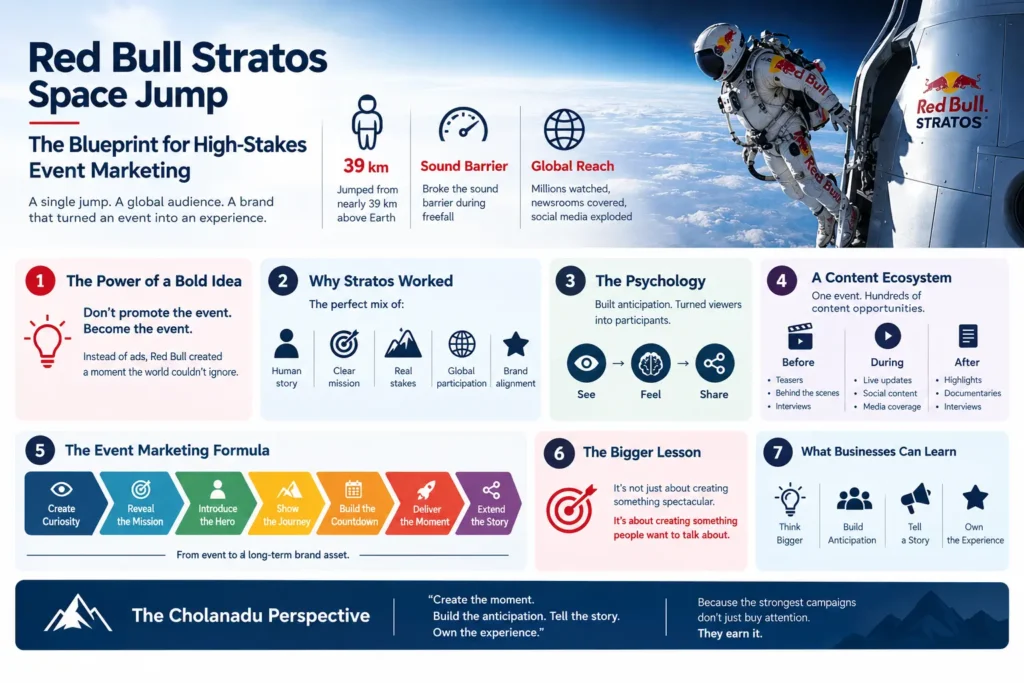
01 Why Stratos Event Marketing Was Different
The Stratos event marketing project combined several powerful ingredients:
A Human Story: Felix Baumgartner wasn’t just an athlete. He was the face of a seemingly impossible challenge.
A Clear Mission: The objective was simple enough for anyone to understand: jump from the edge of space and break records.
Real Stakes: There was genuine uncertainty. The outcome wasn’t scripted like a conventional advertisement.
Global Participation: People across the world could watch the same moment unfold simultaneously.
Brand Alignment: The project naturally reinforced Red Bull’s association with pushing boundaries through intentional event marketing.
The result? Marketing became entertainment. Entertainment became news. And news became long-term brand awareness.
02 The Psychology Behind the Event Marketing Campaign
High-stakes event marketing creates something ordinary advertisements struggle to generate: anticipation.
The Stratos jump wasn’t promoted for just a few seconds. The audience followed the preparation, the training, the technology, the weather, the mission, and the countdown. Every stage created another reason to pay attention. This transformed the audience from passive viewers into active participants in the story. They weren’t simply watching an advertisement; they were waiting to discover: “Will he actually do it?”
03 Build the Story Before the Event Marketing Moment
One of the most valuable lessons from Stratos is that the biggest moment wasn’t created on the day of the jump. It was built months and years beforehand. A high-impact event marketing strategy can follow this exact structure:
Create Curiosity: Give people a reason to ask questions (What is happening?).
Reveal the Mission: Make the objective simple and memorable (What are we trying to achieve?).
Introduce the Hero: Give the audience someone to emotionally follow (Who is taking the challenge?).
Show the Journey: Training, preparation, setbacks, and behind-the-scenes moments make the story human (How are we getting there?).
Create the Countdown: Turn the occasion into something people don’t want to miss (When is it happening?).
Deliver the Moment: The climax should reward the attention you’ve built (This is the moment).
Extend the Story: The initiative shouldn’t disappear after the jump ends. Turn the achievement into interviews, documentaries, social content, PR stories, case studies, and future campaigns (The moment becomes an asset).
04 From Event Marketing to Content Engine
This is where modern brands can learn something especially valuable. Major event marketing shouldn’t produce one piece of content; it should produce an entire content ecosystem.
Before the Event: Teasers, countdown posts, behind-the-scenes content, interviews, preparation videos, founder/athlete stories.
During the Event: Live updates, short-form videos, reactions, real-time social content, media coverage.
After the Event: Highlights, reels, documentaries, interviews, statistics, lessons, emotional storytelling.
One execution leads to hundreds of content opportunities. Check out more details on Red Bull Stratos Project or explore marketing principles at Adweek Insights.
05 The Red Bull Event Marketing Principle
The deeper lesson isn’t simply “create something spectacular.” It is: create something your audience genuinely wants to watch and make your brand inseparable from the experience.
That’s powerful brand integration. The audience doesn’t feel interrupted by advertising. The experience itself is the event marketing.
06 Why High-Stakes Event Marketing Creates Stronger Brands
A conventional advertisement might communicate: “Red Bull supports extreme sports.”
Stratos demonstrated: “Red Bull pushes the limits of human possibility.”
The second message is not merely communicated; it is experienced. That difference is the foundation of memorable event marketing and branding.
07 What Businesses Can Learn About Event Marketing
You don’t need a space jump to create a Stratos-level event marketing strategy. The principle can work at different scales:
A startup could launch a bold challenge.
A fashion brand could create an immersive fashion experience.
A technology company could attempt a world-first demonstration.
A local business could create a community gathering with a powerful human story.
The scale can change, but the core event marketing thinking doesn’t have to. Ask yourself: “What can we create that people would willingly talk about?” That question is often far more valuable than “What advertisement should we run?” Read more about our thoughts on Cholanadu Brand Architecture and Cholanadu Marketing Strategy.
08 The Ultimate Event Marketing Shift
The best event marketing doesn’t begin with “How do we promote our event?” It begins with “How do we make this event impossible to ignore?”
That shift changes everything. Because when the idea is powerful enough:
People share it.
Media covers it.
Communities discuss it.
Content creators react to it.
And most importantly, the brand becomes part of a memorable story.
The Cholanadu Perspective
Red Bull Stratos demonstrates a fundamental truth about modern branding and event marketing: don’t compete for attention; create a reason for attention. In a world filled with advertisements, audiences have learned to scroll past ordinary marketing.
But they stop for:
A story.
A challenge.
A mystery.
A human achievement.
A moment they don’t want to miss.
That is the real blueprint behind high-stakes event marketing. Create the moment. Build the anticipation. Tell the story. Own the experience. And let the audience carry the message forward. Because the strongest campaigns don’t simply buy attention—they earn it.
