


Avis vs. Hertz (1962): How the “We Try Harder” Campaign Captured Market Share
Table of Contents
ToggleBrand Strategy Masterclass: 5 Genius Lessons From Avis vs Hertz 1962
Executing a brilliant brand strategy can turn being No. 2 into a dominant market advantage, as demonstrated by one of the greatest campaigns in advertising history.
In the world of branding, businesses are often obsessed with being No. 1.
The biggest. The most popular. The market leader.
But what happens when you are No. 2? You could try to imitate the leader. Or you could turn your position into your greatest competitive advantage using a bold brand strategy.
That is exactly what Avis did in 1962.
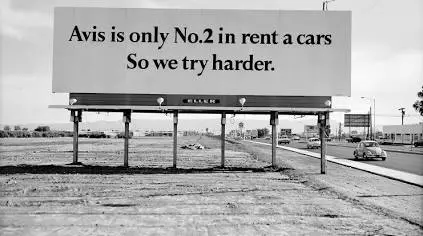
Facing a dominant competitor in the American car-rental market, Avis launched one of the most memorable positioning campaigns in advertising history:
“We Try Harder.” It was more than a slogan.
It was a strategic transformation of weakness into personality, competition into differentiation, and market position into a compelling brand story.
The Market: When Hertz Was the Giant
During the early 1960s, Hertz was the dominant name in the U.S. car-rental industry.
Avis, meanwhile, was struggling to compete. The conventional marketing approach would have been straightforward:
“Avis is just as good as Hertz.” But that would create a problem for their overall brand strategy.
If consumers already believed Hertz was the leader, why should they switch? Avis needed something more powerful than a claim of equality.
It needed a reason to be chosen. The answer was simple: A No. 2 company could try harder than No. 1. That insight became the foundation of the campaign.
The Strategic Breakthrough
Instead of hiding its position behind vague advertising language, Avis openly acknowledged it.
“Avis is only No. 2 in rent-a-cars.” Then came the powerful conclusion: “So why go with us? We try harder.”
This changed the competitive conversation.
Avis was no longer trying to convince customers that it was bigger than Hertz.
It was telling them: We may not be the biggest. But because we have more to prove, we work harder for you.
That was an extraordinarily human proposition and a masterclass in positioning brand strategy.
Why “We Try Harder” Worked
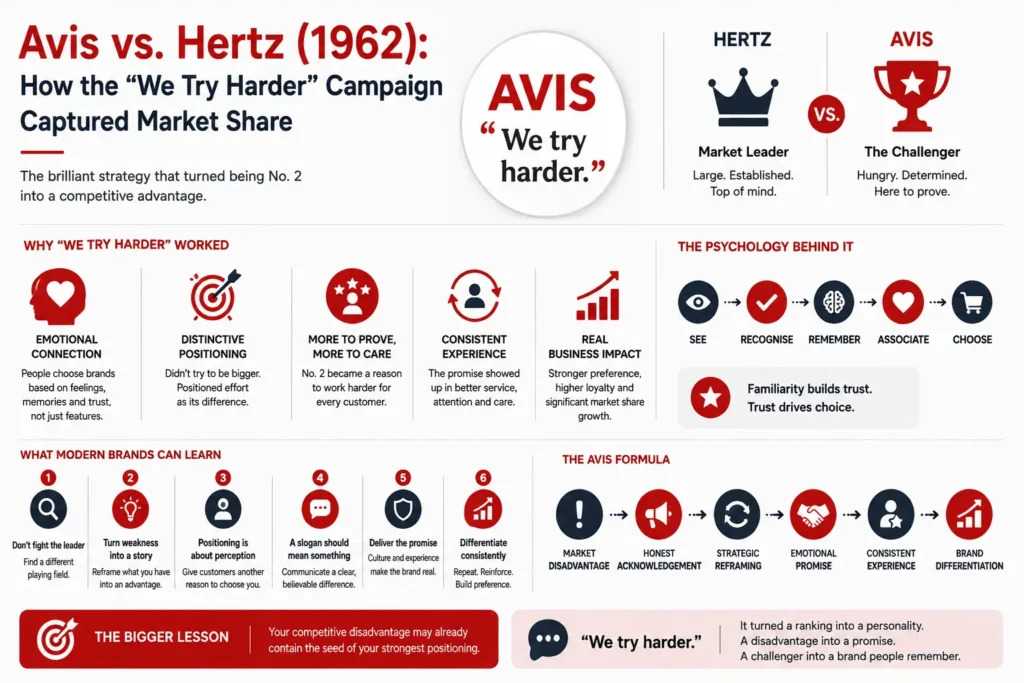
The campaign succeeded because it transformed a business fact into an emotional benefit. Hertz represented leadership. Avis represented effort. Hertz had scale. Avis had something to prove. Hertz was the established leader. Avis positioned itself as the hungry challenger.
This created a distinctive personality that consumers could understand immediately.
And that is one of the most important principles of positioning brand strategy:
You don’t always need to be better at everything. You need to be meaningfully different.
The Psychology Behind the Campaign
The brilliance of “We Try Harder” was not simply the wording. It was the psychology behind it. People naturally respond to stories of determination.
A challenger who works harder feels more relatable than a powerful leader who appears comfortable at the top.
Avis essentially transformed its disadvantage into a narrative:
“We need your business therefore, we will work harder to earn it.” That creates a powerful psychological effect.
The customer is no longer simply renting a car. They are choosing the company that cares more about earning their business.
From Weakness to Brand Personality
Before the campaign, being No. 2 was a disadvantage. After the campaign, it became part of Avis’s identity. This is an important branding lesson. A weakness does not always need to be hidden. Sometimes, it can be reframed through a clever brand strategy.
The campaign effectively said: “Yes, we’re No. 2. And that’s exactly why we care more.”
The Power of Competitive Positioning
Avis did something many brands struggle to do: It defined itself in relation to the market leader without becoming a copy of the leader.
This distinction matters. Competitive brand strategy is not about saying:
“We are better than them.” It can be much more sophisticated:
“Because of who we are in this market, we behave differently.” That creates a position competitors cannot easily replicate.
If Hertz suddenly said: “We try harder too,”
the statement would lose some of its natural credibility. Why? Because the original strategic logic belonged to the challenger.
The Campaign Was Bigger Than Advertising
“We Try Harder” eventually became more than an advertising line.
It became an internal philosophy.
The promise implied that Avis should actually deliver better service.
Cleaner cars.
Better attention to customers.
More effort.
Better experiences.
More responsiveness.
This is where a great brand strategy becomes powerful.
A slogan creates awareness.
A brand promise creates expectations.
A company culture delivers the promise.
The strongest campaigns connect all three.
The Business Impact
The campaign is widely regarded as a landmark example of effective positioning, helping Avis dramatically improve its competitive standing during the 1960s. To analyze how historic advertising shifts shaped corporate market valuation, review documented studies on Adweek Advertising History.
The important lesson, however, is not simply that a clever slogan increased market share.
The deeper lesson is this: Avis changed the basis on which customers compared the two brands.
Instead of asking: “Who is bigger?”
The campaign encouraged customers to ask:
“Who will work harder for me?” That is a completely different competitive battlefield. And Avis had created it using a brilliant brand strategy.
The “No. 2” Advantage
There is a fascinating strategic lesson here for modern businesses. Being smaller can sometimes provide a powerful narrative.
A startup can say:
“We are small enough to care.” A boutique agency can say: “You won’t be just another account.” A challenger brand can say: “We have something to prove.”
A new e-commerce company can say: “We listen because every customer matters.”
The formula is simple:
Limitation → Reframe → Promise → Experience
Avis had a limitation:
It wasn’t No. 1.
It reframed it: That’s why we try harder. It created a promise: We will work harder for your business.
And the promise could be expressed through the customer experience.
What Modern Brands Can Learn From Avis
01. Don’t Fight the Leader on the Leader’s Territory
If your competitor has more money, more stores, more customers or greater recognition, don’t automatically attempt to beat them at their own game.
Find another dimension. Differentiate before you compete.
02. Turn Your Weakness Into a Story
Every business has disadvantages.
Limited budget.
Smaller team.
Lower awareness.
Newer brand.
Fewer locations.
Instead of asking: “How do we hide this?” Ask: “Can this become part of our story?”
03. Positioning Is About Perception
Avis did not need to convince consumers that Hertz was a bad company. It simply gave consumers another reason to choose Avis.
That is sophisticated brand strategy.
You don’t always destroy the competitor’s advantage. You create a different advantage.
04. A Slogan Should Mean Something
“We Try Harder” worked because it wasn’t an empty collection of attractive words. It communicated a clear philosophy. A powerful slogan should answer:
“Why should I believe this brand is different?”
If the answer is unclear, the slogan is probably not doing enough work.
The Avis Formula
The campaign can be reduced to a simple branding framework:
MARKET DISADVANTAGE
↓
HONEST ACKNOWLEDGEMENT
↓
STRATEGIC REFRAMING
↓
EMOTIONAL PROMISE
↓
CONSISTENT EXPERIENCE
↓
BRAND DIFFERENTIATION
This is why the campaign remains relevant decades later as a core case study in brand strategy.
The Bigger Branding Lesson
The most fascinating part of the Avis story is that the company didn’t pretend to be something it wasn’t.
It embraced its position.
And then it gave that position meaning.
That is the essence of a powerful brand strategy.
Branding isn’t always about appearing bigger.
Sometimes it is about making your difference more valuable.
Avis couldn’t immediately change the fact that Hertz was the market leader.
So it changed what being No. 2 meant.
And that is the genius of:
“WE TRY HARDER.”
It turned a ranking into a personality.
A disadvantage into a promise.
And a challenger into a brand people could remember.
CHOLANADU BRANDING TAKEAWAY
The Avis story teaches one timeless principle: Your competitive disadvantage may already contain the seed of your strongest positioning.
Before spending more on advertising, ask: What is our real position in the market?
What can we uniquely own? What does our competitor’s strength allow us to become? And what promise can we make that customers genuinely value? Discover how our team builds custom market positioning by visiting Cholanadu.
Because sometimes, the most powerful brand strategy isn’t saying:
“We are the biggest.” It is simply saying: “We have more to prove.”
