


Zomato & Swiggy Social Banter: Building an Unforgettable Brand Voice
Table of Contents
Toggle5 Powerful Social Banter Examples: How Zomato & Swiggy Win
Social banter has changed modern marketing completely. In a digital world where consumers scroll past hundreds of advertisements every day, brands are no longer competing only on products and prices. They are competing for attention, personality and cultural relevance through strategic social banter.
Few Indian brands demonstrate this better than Zomato and Swiggy. Their social banter, witty responses and playful communication have transformed food delivery from a functional service into an entertaining digital experience.
Sometimes, the way a brand talks through social banter can become as memorable as what it sells.
The Rise of the “Brand Personality” Through Social Banter
Traditional advertising often follows a familiar formula:
Product → Benefit → Offer → Call to Action
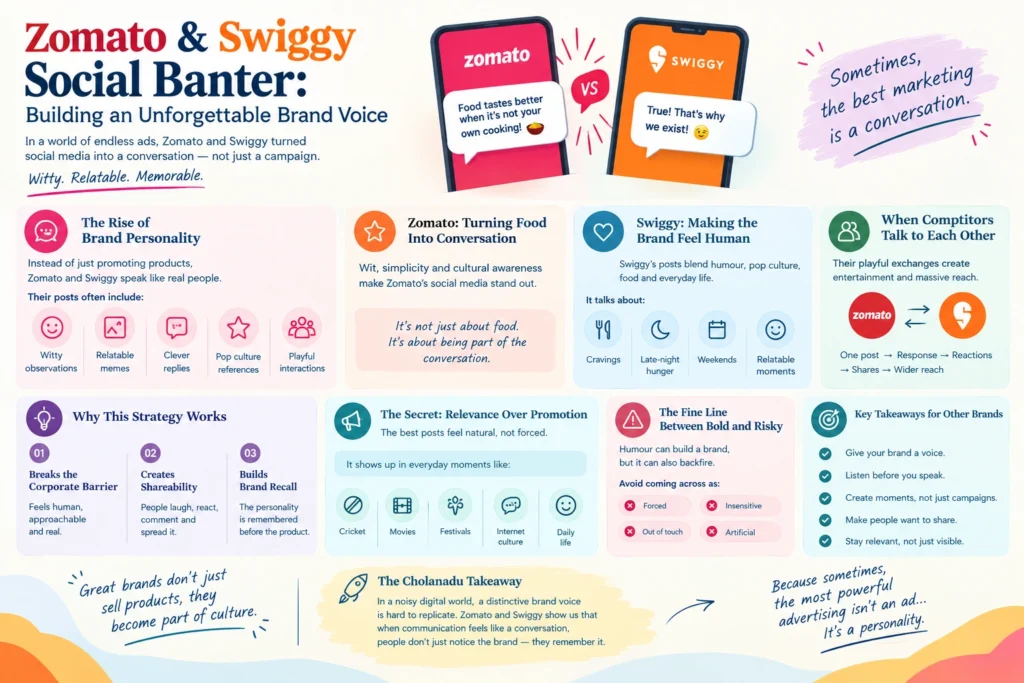
Zomato and Swiggy frequently approach communication differently using social banter. Their social-media presence feels less like a corporate announcement and more like a conversation between people.
A simple food-related moment can become:
A witty observation
A relatable meme
A clever reply
A cultural reference
A playful social banter interaction with another brand
This creates something incredibly valuable in modern branding: A recognisable personality. Consumers begin to understand not just what the brand does, but how the brand behaves during social banter.
For insights on viral trends, check out coverage on digital media from The Hindu or Times of India. You can also explore our internal guide on Cholanadu Brand Strategy to learn more.
Zomato: Turning Food Into Social Banter & Conversation
Zomato has built a distinctive communication style around wit, simplicity, cultural awareness, and continuous social banter. Whether it is a trending topic, a food-related conversation or a competitor’s social post, the brand often communicates in a way that feels quick and conversational. The objective isn’t necessarily to make every post a direct sales pitch.
Instead, through social banter, the brand frequently aims to become part of the conversation. That distinction is powerful. When people share a brand’s post because it is funny or relatable, the brand earns organic attention through social banter rather than simply purchasing it through advertising.
Swiggy: Making the Brand Feel Human via Social Banter
Swiggy has similarly embraced a conversational identity across digital platforms using social banter. Its communication often combines:
Humour + Pop Culture + Food + Everyday Life
This social banter approach makes the brand easier to relate to. Instead of saying:
“Our food delivery service is convenient.”
The brand can communicate around the situations consumers already experience through social banter: hunger at midnight, cravings during work, weekend food decisions or the eternal question:
“What should we eat?”
The product remains in the background while the consumer’s experience becomes the story driving the social banter. Read more on our Cholanadu for similar brand stories.
When Competitors Start Talking: The Power of Social Banter
One of the most fascinating aspects of the Zomato–Swiggy rivalry is that competition occasionally becomes entertainment through social banter. Their social-media interactions demonstrate an important principle of modern marketing:
A competitor does not always have to be treated as an enemy. Sometimes, a competitor can become part of your social banter content.
A clever exchange can generate:
Brand A posts → Brand B responds → Audience reacts → Screenshots spread → Other platforms amplify the conversation
Suddenly, two brands have created a piece of social banter that audiences voluntarily distribute. This is where social banter becomes a marketing asset. Read more about viral engagement dynamics on Economic Times Brand Equity.
Why This Social Banter Strategy Works
01. It Breaks the Corporate Barrier
People generally don’t connect emotionally with corporate language. They connect with personality. A witty social banter response makes a company appear more approachable and human.
02. It Creates Shareability
People share social banter content that makes them:
Laugh
React
Agree
Disagree
Tag friends
Join a conversation
A clever social banter interaction can therefore generate significantly more cultural visibility than a conventional promotional post.
03. It Builds Brand Recall
Consider the difference between:
“Order your favourite food with us.”
and
A brand that consistently makes you smile through social banter when you see its posts.
The second experience can create stronger mental associations. The consumer may remember the social banter personality before remembering the advertisement.
The Secret: Social Banter Relevance Over Promotion
The most interesting brand conversations don’t always begin with:
“Buy now.”
They begin with:
“Did you see what happened?”
This is an important shift in social-media marketing and social banter. Modern brands can participate in:
Cricket
Movies
Festivals
Internet culture
Workplace humour
Dating culture
Food trends
Viral moments
Everyday frustrations
But the connection in social banter must feel natural. The brand shouldn’t force itself into every trend. Social banter relevance is more powerful than visibility.
The Fine Line Between Bold and Risky Social Banter
There is, however, an important lesson hidden inside this social banter strategy.
Humour can strengthen a brand, but poorly executed social banter can damage it. A brand attempting to imitate internet culture through social banter without understanding its audience may appear:
Forced
Desperate
Insensitive
Out of touch
Artificial
The strongest brand voices don’t simply copy internet slang for social banter. They develop a consistent personality that audiences recognise. Check our Cholanadu to safeguard your digital voice.
What Other Brands Can Learn From Social Banter
The Zomato and Swiggy social banter approach offers several broader branding lessons:
Give Your Brand a Voice: Don’t communicate like every other company. Define how your brand speaks through social banter. Is it Witty? Warm? Bold? Minimal? Playful? Sophisticated? Consistency turns social banter into identity.
Listen Before You Speak: Social media isn’t simply a publishing platform. It is a listening platform. Brands should understand what people are discussing before entering the conversation with social banter.
Create Moments, Not Just Campaigns: A campaign may run for a few weeks. A memorable social banter personality can remain with consumers for years.
Make People Want to Share: The strongest social banter content often doesn’t say: “Please share this.” It gives people a reason to share it.
Zomato and Swiggy demonstrate how competition can exist alongside cultural conversation and social banter. Their social-media strategies highlight an important transformation in modern marketing: Brands are no longer simply broadcasting messages. They are participating in conversations through social banter.
And when those social banter conversations are entertaining, relevant and authentic, consumers don’t feel like they are watching an advertisement. They feel like they are watching a personality.
Cholanadu Takeaway on Social Banter
In the crowded digital marketplace, products can be copied, offers can be matched and advertisements can be outspent. But a distinctive brand voice built on social banter is much harder to replicate.
Zomato and Swiggy’s social banter demonstrates the power of turning everyday digital communication into brand entertainment.
The ultimate objective of social banter isn’t merely to make people notice your brand. It’s to make them recognise your voice before they even see your name.
That is when communication becomes branding. And that is when a brand stops merely appearing on social media and starts becoming part of culture through social banter.
