


Guerrilla Marketing Lessons: How Small Brands Beat Giant Budgets
Table of Contents
Toggle10 Powerful Guerrilla Marketing Tactics: How Small Brands Beat Giant Budgets
Guerrilla Marketing proves that in modern business, money can buy visibility, but it cannot always buy attention. Large corporations can spend millions on television campaigns, celebrity endorsements, billboards, and digital advertising. Yet, some of the most memorable campaigns come from small brands operating with modest budgets through Guerrilla Marketing.
Their advantage? Creativity over capital. Strategy over scale. And surprise over spending.
This is the power of Guerrilla Marketing—a marketing approach that uses unconventional, memorable, and often low-cost ideas to generate massive attention.
For small brands, Guerrilla Marketing is not simply a budget-saving technique. It can become a powerful way to challenge established competitors and create a distinctive identity.
What is Guerrilla Marketing?
Guerrilla Marketing refers to unconventional promotional strategies designed to create maximum attention with relatively limited resources.
Instead of asking: “How much can we spend?”
Guerrilla Marketing strategists often ask: “How can we make people stop, look, talk, and share?”
The objective of Guerrilla Marketing is not necessarily to reach everyone. It is to create an experience that people remember and voluntarily spread.
A cleverly designed street installation, an unexpected social media post, a surprising product demonstration, or a creative public interaction can sometimes generate more conversation than an expensive traditional advertisement. Read news coverage on creative ad strategies in The Hindu or explore industry updates on Times of India.
You can also explore our internal guide on Cholanadu Brand Strategy to strengthen your overall position.
1. Creativity Can Compensate for Budget Limitations in Guerrilla Marketing
A major lesson from Guerrilla Marketing is simple: A smaller budget does not automatically mean a smaller idea. Large brands often have the advantage of scale. Small brands can compensate through originality using Guerrilla Marketing.
Imagine two companies launching similar products. One spends ₹50 lakh on conventional advertising. The other spends ₹2 lakh creating an unexpected public experience using Guerrilla Marketing that attracts thousands of people and gets organically shared online.
The second brand may not have purchased the largest amount of media, but through Guerrilla Marketing, it created something people actually remember.
The lesson for small brands using Guerrilla Marketing:
Don’t compete with large companies on their strongest battlefield. If they have enormous advertising budgets, execute Guerrilla Marketing through:
Creativity
Speed
Local relevance
Personalisation
Surprise
Community engagement
Cultural understanding
The goal of Guerrilla Marketing is not to shout louder. It is to become more interesting.
2. Turn Ordinary Spaces Into Guerrilla Marketing Opportunities
Guerrilla Marketing often transforms everyday environments into communication platforms.
A staircase can become a Guerrilla Marketing advertisement.
A pavement can become a product demonstration.
A bus stop can become an interactive experience.
A shop window can become a social-media moment.
This Guerrilla Marketing approach works because consumers encounter the message in an environment where they are not necessarily expecting advertising.
Think beyond traditional ad space:
Instead of asking: “Where can we place our advertisement?”
Ask: “Where can our brand create a Guerrilla Marketing experience?”
That small shift in thinking can completely change a campaign.
3. Surprise Creates Attention in Guerrilla Marketing
People naturally notice things that break patterns in Guerrilla Marketing.
A normal poster may disappear into a crowded street.
A surprising Guerrilla Marketing installation may make people stop.
A conventional social media post may receive limited attention.
An unexpected brand interaction can trigger comments, shares, and conversations.
This is why surprise is one of Guerrilla Marketing‘s strongest tools.
The key, however, is relevance. A Guerrilla Marketing campaign should not be unusual simply for the sake of being unusual. The surprise should strengthen the brand message.
4. Make the Audience Part of Your Guerrilla Marketing Campaign
Traditional advertising often places the audience in the role of a viewer. Guerrilla Marketing can turn the audience into a participant.
Consider Guerrilla Marketing campaigns where people:
Interact with an installation
Take photographs
Solve a challenge
Create their own content
Participate in an event
Share their experience online
Now the customer is no longer simply consuming the campaign. They are helping distribute your Guerrilla Marketing message.
This is particularly powerful in the social-media era. One creative physical experience can generate dozens or even hundreds of pieces of user-generated content. Learn more about engaging audiences on Economic Times Brand Equity and check our Cholanadu for workflow ideas.
5. Build Guerrilla Marketing Campaigns That People Want to Share
A Guerrilla Marketing campaign should ideally answer one important question: “Why would someone tell another person about this?”
People share Guerrilla Marketing content for many reasons. It may be:
Funny
Unexpected
Beautiful
Useful
Emotional
Clever
Relatable
Small brands should design Guerrilla Marketing campaigns around these human motivations rather than simply focusing on product features. A Guerrilla Marketing campaign that naturally creates conversation can extend its reach far beyond the original marketing budget.
6. Local Culture as a Guerrilla Marketing Advantage
Small brands often possess something multinational companies cannot easily replicate: Deep local understanding.
A neighbourhood reference, regional language, cultural tradition, local humour, or community insight can make a Guerrilla Marketing campaign feel extremely personal.
For example, a small South Indian brand could create Guerrilla Marketing around a familiar local situation using Tamil language and cultural references. The Guerrilla Marketing campaign does not need to appeal to everyone. It needs to feel authentic to the people it is trying to reach.
That authenticity in Guerrilla Marketing can become a powerful competitive advantage.
7. Speed Is Another Small-Brand Guerrilla Marketing Superpower
Large organisations often have multiple approval layers. A small business can execute Guerrilla Marketing decisions in hours.
That flexibility allows smaller brands to respond quickly with Guerrilla Marketing to:
Trending conversations
Cultural moments
Local events
Viral topics
Customer reactions
Competitor campaigns
This doesn’t mean every trend should be exploited. Instead, small brands should build the ability to execute Guerrilla Marketing on relevant opportunities quickly without sacrificing brand consistency or good judgment.
8. Guerrilla Marketing Is Not Just About Being Cheap
There is an important misconception: Guerrilla Marketing ≠ Cheap Marketing.
A poorly executed low-budget campaign is simply a poorly executed campaign. Successful Guerrilla Marketing depends on:
A Guerrilla Marketing campaign may require very little money but considerable strategic thinking. The real resource being optimised in Guerrilla Marketing is not just money—it is attention.
9. Design Your Guerrilla Marketing for the Digital Second Life
A modern Guerrilla Marketing campaign should be designed for both physical and digital audiences. Imagine a creative Guerrilla Marketing installation placed in a busy location.
The people who see it physically are only the first audience. If the Guerrilla Marketing installation is visually compelling, photographs and videos can travel through:
Suddenly, a small physical Guerrilla Marketing campaign becomes a global digital conversation.
Ask these Guerrilla Marketing questions before launching:
Will people photograph it?
Will they record it?
Is there a strong visual?
Is the message immediately understandable?
Can the Guerrilla Marketing campaign work without a lengthy explanation?
If the answer is yes, your Guerrilla Marketing campaign has greater potential to travel. Check our Cholanadu Risk Management Framework to safeguard public campaigns.
10. Don't Copy Tactics: Understand Guerrilla Marketing Thinking
One of the biggest mistakes small businesses make is copying a successful Guerrilla Marketing campaign. What worked for one brand may not work for another.
Instead of copying the execution, study the Guerrilla Marketing principle behind it. Was the campaign successful because it:
Created surprise?
Used humour?
Leveraged a cultural insight?
Encouraged participation?
Generated user content?
Challenged an existing category convention?
Once the underlying Guerrilla Marketing principle is understood, it can be adapted to the brand’s own identity. Copying a campaign creates imitation; understanding Guerrilla Marketing strategy creates innovation.
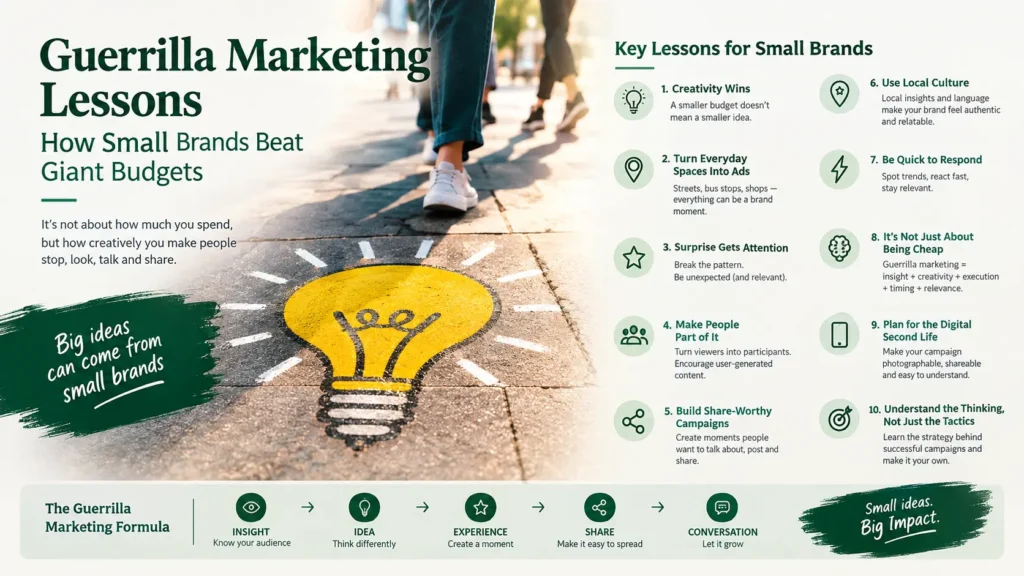
The Guerrilla Marketing Formula
A useful framework for small brands executing Guerrilla Marketing is:
Insight: Find something meaningful about your audience.
Idea: Turn that insight into an unexpected Guerrilla Marketing concept.
Experience: Give people a Guerrilla Marketing moment worth experiencing.
Share: Make the experience naturally photographable, recordable, or discussable.
Conversation: Allow the audience to amplify the Guerrilla Marketing campaign.
This is where a small Guerrilla Marketing investment can potentially create disproportionate attention. The difference is not simply financial—it is strategic thinking.
The Biggest Lesson: Don't Try to Look Big
Small brands sometimes make the mistake of trying to imitate large corporations. They use expensive-looking advertisements, generic corporate language, and predictable campaigns.
But being small is actually an advantage in Guerrilla Marketing.
A small brand using Guerrilla Marketing can be:
More personal
More experimental
More local
More human
More responsive
Instead of hiding its size, a smart brand can turn its agility into part of its Guerrilla Marketing identity.
Cholanadu Takeaway
Guerrilla Marketing teaches one of the most important lessons in modern branding: Attention does not always belong to the brand with the biggest budget. It often belongs to the brand with the most interesting Guerrilla Marketing idea.
For small businesses, the objective of Guerrilla Marketing should not be to outspend giant competitors. It should be to outthink them in the moments that matter.
A clever Guerrilla Marketing idea can start on one street corner. A memorable experience can become a photograph. A photograph can become a social post. A social post can become a conversation. And a conversation can become a brand.
That is the real power of Guerrilla Marketing.
