


Old Spice Campaign: Repositioning a Legacy Brand for a Younger Audience
Table of Contents
Toggle5 Brand Repositioning Secrets: Best Lessons From Old Spice
How a Traditional Men’s Grooming Brand Became a Digital-Age Icon.
In branding, longevity can be both an advantage and a challenge.
A brand with decades of recognition carries trust, familiarity, and heritage. But if its image becomes associated with an older generation, younger consumers may simply stop paying attention.
Old Spice faced exactly this challenge. Once strongly associated with traditional men’s grooming, the brand needed a strategic brand repositioning to become relevant to a younger, digitally connected audience without completely abandoning its heritage. Its transformation became one of the most memorable examples of how creative storytelling, humour, cultural relevance, and digital-first marketing can reshape brand perception.
The Challenge: When Heritage Starts Feeling Old
Old Spice had strong brand recognition, but recognition alone does not guarantee relevance. Younger consumers were entering a grooming market filled with modern competitors, stylish packaging, celebrity endorsements, and increasingly sophisticated digital advertising.
The challenge was therefore not simply: “How do we sell more body wash?”
It was: “How do we make a legacy brand feel culturally relevant again?” This required a fundamental shift in communication and a clear brand repositioning framework.
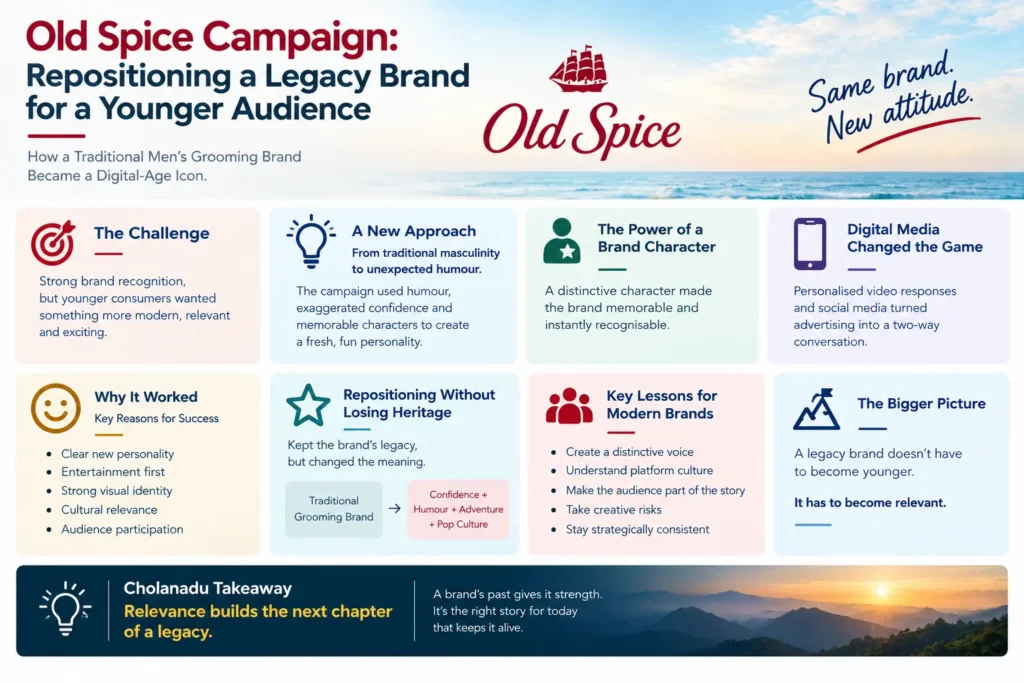
From Traditional Masculinity to Unexpected Humour
The breakthrough came with a radically different creative direction.
Instead of presenting the conventional image of masculinity, Old Spice embraced absurd humour, exaggerated confidence, rapid visual transitions, and memorable characters.
The famous “The Man Your Man Could Smell Like” campaign featured actor Isaiah Mustafa delivering an intentionally over-the-top performance that moved through surreal scenarios at remarkable speed.
The advertisement was not simply demonstrating a product. It was creating a dynamic personality for the brand. That distinction was crucial.
The Power of a Memorable Brand Character
Old Spice understood something fundamental about modern advertising. People may forget product specifications, but they remember personalities and stories.
The campaign created a recognisable character who became closely associated with the brand. His confident delivery, unusual settings, humour, and visual unpredictability gave Old Spice a distinctive identity.
Instead of saying: “Our product is better.” The brand effectively communicated:
“Our brand is unlike anything else.” That difference made the campaign highly shareable and anchored its brand repositioning.
Digital Media Changed the Conversation
Old Spice did not stop with television advertising. The campaign expanded into the digital world, where the brand could interact directly with consumers.
One of its most notable strategies involved producing personalised video responses to people across social media platforms.
This transformed advertising from a one-way broadcast into a form of entertainment and conversation.
Consumers were no longer simply watching an advertisement. They were participating in the campaign.
Why this mattered ?
Digital audiences increasingly expect brands to:
Respond quickly
Understand internet culture
Entertain rather than interrupt
Encourage participation
Create content worth sharing
Old Spice embraced these behaviours instead of treating digital platforms as merely another advertising channel.
Humour Became a Strategic Branding Asset
Humour was not used simply to make advertisements funny.
It became part of Old Spice’s core identity. The exaggerated performances, unexpected situations, rapid storytelling, and deliberately ridiculous scenarios created a consistent emotional experience.
This consistency helped consumers recognise the brand even before seeing its name. That is one of the strongest forms of branding: When the style itself becomes identifiable.
Repositioning Without Erasing Heritage
One of the most interesting lessons from Old Spice is that brand repositioning does not necessarily mean abandoning the past. The brand retained important elements of its heritage while changing how that heritage was interpreted.
Instead of presenting itself as a traditional grooming product for an older demographic, Old Spice became a brand associated with: Confidence + Humour + Adventure + Pop Culture
The product category remained familiar. The emotional meaning changed.
Why the Campaign Worked
Several strategic principles contributed to the campaign’s impact:
A Clear New Personality: Old Spice developed a distinctive voice rather than attempting to appeal to everyone.
Entertainment First: The advertisements were designed to be entertaining enough that people would voluntarily watch and share them.
Strong Visual Identity: Surreal environments, fast transitions, and memorable characters created instantly recognisable content.
Cultural Relevance: The campaign understood the humour and communication style of the digital generation.
Audience Participation: Social media allowed consumers to become part of the campaign rather than remaining passive viewers.
Old Spice demonstrates that brand age and brand relevance are not the same thing. A company can have decades of history and still reinvent the way consumers experience it.
The important question is not: “How old is our brand?”
It is: “How does our audience perceive our brand today?” That distinction can completely change a marketing strategy.
What Modern Brands Can Learn From Old Spice
For legacy brands considering a brand repositioning strategy, several lessons stand out:
Don’t simply modernise the logo. Modernisation should extend into communication, personality, content, and customer experience.
Create a recognisable voice. A distinctive personality can make a brand easier to remember.
Understand the culture of the platform. Digital audiences respond differently from traditional advertising audiences.
Make the audience part of the story. Participation can create stronger engagement than passive exposure.
Take creative risks but stay strategically consistent. Unexpected ideas work best when they reinforce a clear brand identity.
Cholanadu Takeaway
Old Spice’s transformation is a powerful reminder that brand repositioning is not about pretending the past never existed. It is about taking the equity a brand has built over generations and presenting it through a language that today’s audience understands.
The result can be more than a successful campaign. It can be a completely new cultural perception of the brand.
For businesses facing the challenge of becoming relevant to younger consumers, the Old Spice story offers one enduring lesson: A legacy brand does not have to become younger. It has to become relevant.
Cholanadu – Where Branding Meets Strategic Thinking.
