


Tesla’s “Zero-Dollar” Advertising Budget: The Power of Founder-Led Personal Branding
Table of Contents
Toggle7 Personal Branding Secrets: Best Lessons From Tesla
In a world where global brands spend millions on advertising, Personal Branding helped Tesla build extraordinary visibility through a very different playbook: attention driven by its founder, innovation, controversy, product launches, and community.
The phrase “zero-dollar advertising budget” is often associated with Tesla’s unconventional marketing philosophy based around Personal Branding. While Tesla’s marketing approach has evolved over time, its core lesson remains powerful:
Sometimes, the strongest brand advertisement is the person who represents the brand through effective Personal Branding.
This is where founder-led Personal Branding becomes a serious business strategy.
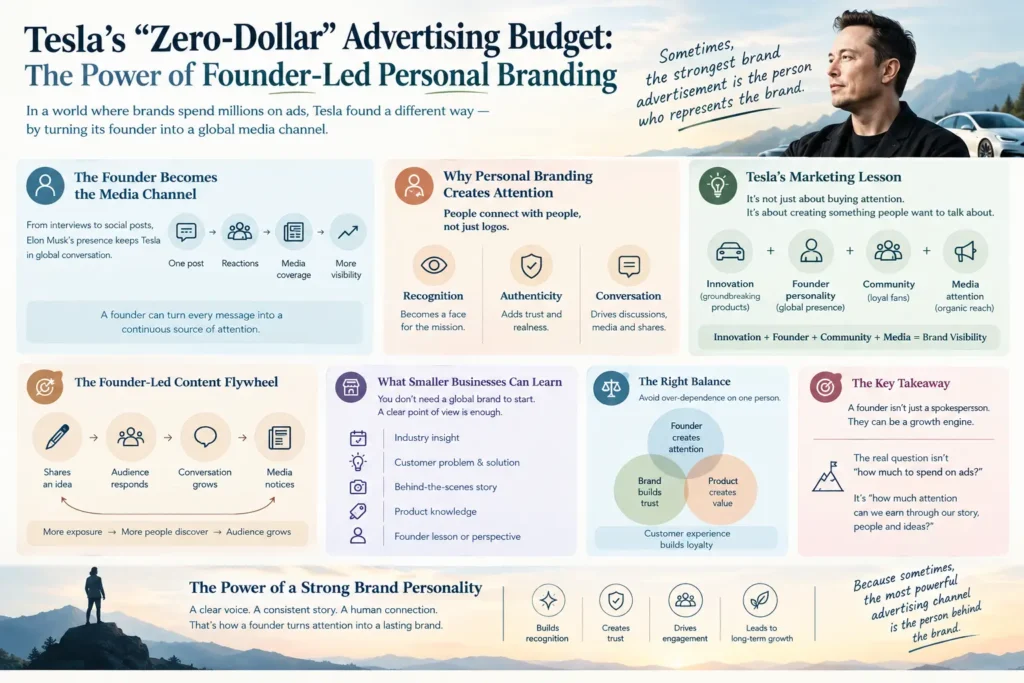
The Founder Becomes the Media Channel
Traditional brands depend heavily on advertising campaigns to communicate their message, whereas strategic Personal Branding builds direct resonance.
Founder-led Personal Branding can create a direct connection between the company and its audience.
Tesla’s public identity has been closely associated with Elon Musk, whose posts, interviews, product announcements, and public appearances show how Personal Branding generates global attention.
Instead of every message passing through a conventional advertising campaign, executive Personal Branding turns the founder into a continuous source of conversation.
One post → thousands of reactions → media coverage → social discussions → increased brand visibility.
That creates an extraordinary amplification effect for Personal Branding.
Why Personal Branding Creates Attention
People connect with people more easily than corporate logos, which is the exact premise of Personal Branding.
A company can say: “We are changing the future of transportation.”
But when a recognizable founder uses Personal Branding to communicate a vision, challenge an industry, or discuss a new product, the message can feel more personal and immediate.
Founder-led Personal Branding can create three powerful assets:
1. Recognition
The founder becomes strongly associated with the company’s mission through authentic Personal Branding.
2. Authenticity
Audiences can hear directly from the person behind the business through Personal Branding rather than only through polished advertisements.
3. Conversation
Strong personalities naturally create discussions, reactions, interviews, and media coverage around their Personal Branding.
The result is earned attention—visibility generated by public interest in Personal Branding rather than simply purchased advertising space.
Tesla’s Marketing Lesson
Tesla demonstrates an important principle of Personal Branding for modern businesses: Marketing is not always about buying attention. It can also be about Personal Branding that creates something people want to talk about.
Product innovation plays a major role alongside Personal Branding. Electric vehicles, autonomous-driving technology, futuristic product announcements, charging infrastructure, and ambitious company goals have all contributed to Tesla’s public conversation.
The founder’s public presence and Personal Branding can then amplify that conversation.
This creates a powerful combination:
Innovation + Personal Branding + Community + Media Attention = Brand Visibility
The Power of a Strong Brand Personality
A founder-led brand doesn’t necessarily need to imitate Tesla or Elon Musk to succeed at Personal Branding. The broader lesson of Personal Branding is to build a distinctive brand personality.
Consider a founder who uses Personal Branding to consistently communicate:
What the company believes
Why the product exists
What problem it solves
Where the industry is heading
What the company is building next
Over time, these Personal Branding messages become associated with the founder and consequently with the company.
This creates something traditional advertising cannot easily purchase:
Long-term familiarity through Personal Branding.
From Advertising Budget to Attention Budget
The idea isn’t that advertising has become unnecessary or that Personal Branding replaces all traditional outreach.
Advertising remains valuable for product launches, customer acquisition, retargeting, market expansion, and many other objectives.
The strategic opportunity of Personal Branding is different:
Can your company generate attention through Personal Branding before paying for it?
A founder can leverage Personal Branding to build an audience through:
LinkedIn posts → YouTube videos → Interviews → Podcasts → Industry insights → Behind-the-scenes content → Product stories
Every piece of Personal Branding content can become a small distribution channel for the brand.
Explore our insights on Cholanadu Strategy and review framework guides at Cholanadu Brand Architecture. Learn more about executive communications on Harvard Business Review and digital PR strategy on Adweek.
The Founder-Led Content Flywheel
A successful Personal Branding strategy can work like a continuous cycle:
Founder shares an idea through Personal Branding
Audience responds
Conversation grows
Media notices the Personal Branding story
Brand receives additional exposure
More people discover the company
The audience grows
The cycle then starts again.
This is why Personal Branding can become more than a social-media activity. It can become a business growth engine.
What Smaller Businesses Can Learn
You don’t need to run a global technology company to apply Personal Branding strategies. A small business founder can start Personal Branding with a smartphone and a clear point of view.
For example, a founder could use Personal Branding to regularly share:
Monday: Industry insight
Tuesday: Customer problem and solution
Wednesday: Behind-the-scenes story
Thursday: Product knowledge
Friday: Founder lesson or Personal Branding perspective
The objective of Personal Branding isn’t to become an internet celebrity. The objective is to become recognizable and trusted within a specific market through Personal Branding.
The Risk of Founder-Dependent Branding
Founder-led Personal Branding also comes with challenges.
When too much attention is concentrated around one individual’s Personal Branding, the company can become overly dependent on that personality. A strong brand should therefore gradually build its own identity alongside founder Personal Branding.
The ideal balance is:
Founder creates attention through Personal Branding.
Brand creates trust.
Product creates value.
Customer experience creates loyalty.
That is the foundation of sustainable Personal Branding.
Tesla’s approach challenges a traditional assumption about marketing and Personal Branding. A company doesn’t always need to begin with:
“How much should we spend on advertising?”
A better strategic question for Personal Branding can be: “How much attention can we earn through our story, product, people, and Personal Branding ideas?”
Founder-led Personal Branding provides an opportunity to turn leadership into communication, communication into conversation, and conversation into brand awareness.
Cholanadu Takeaway
Tesla’s famous “zero-dollar advertising” narrative is less about literally spending nothing and more about understanding the economics of attention and Personal Branding.
In the digital era, founders have something previous generations of business leaders rarely possessed: a direct publishing platform to millions of people through Personal Branding.
The brands that understand how to use that platform strategically can transform founder Personal Branding from a simple company representative into a powerful brand-building asset.
Because sometimes, the most valuable advertising channel isn’t a billboard, a television commercial, or a social-media ad.
It is the story and the Personal Branding behind the brand.
Cholanadu – Where Branding Meets Strategic Thinking.
