


Nike’s “Just Do It” Strategy: Emotional Storytelling as a Market Leadership Tool
Table of Contents
Toggle10 Top Ultimate Secrets Behind Nike’s “Just Do It” Strategy: Emotional Storytelling as a Market Leadership Tool
Some brands sell products. Great brands sell a feeling.
A pair of running shoes can be measured by cushioning, weight, grip, and durability. But what if the brand could make you feel that you are capable of running farther, pushing harder, and becoming more than you were yesterday?
That is where the Nike Just Do It strategy transformed advertising into something much bigger: emotional storytelling.
Nike didn’t simply tell people what its products could do. It told people what they could do. And that distinction became one of the most powerful lessons in modern brand building.
The Strategy Was Never Just About Shoes
Nike operates in a highly competitive category. Sportswear brands compete on:
Product technology
Performance
Design
Price
Athlete partnerships
Innovation
Distribution
Yet consumers rarely develop deep emotional relationships with technical specifications alone. The Nike Just Do It mindset understood a fundamental branding principle: people may buy a product because of its features, but they remember a brand because of how it makes them feel.
The Nike Just Do It campaign transformed Nike’s communication from product-focused advertising into human-focused storytelling. The hero was no longer the shoe. The hero was the person wearing it.
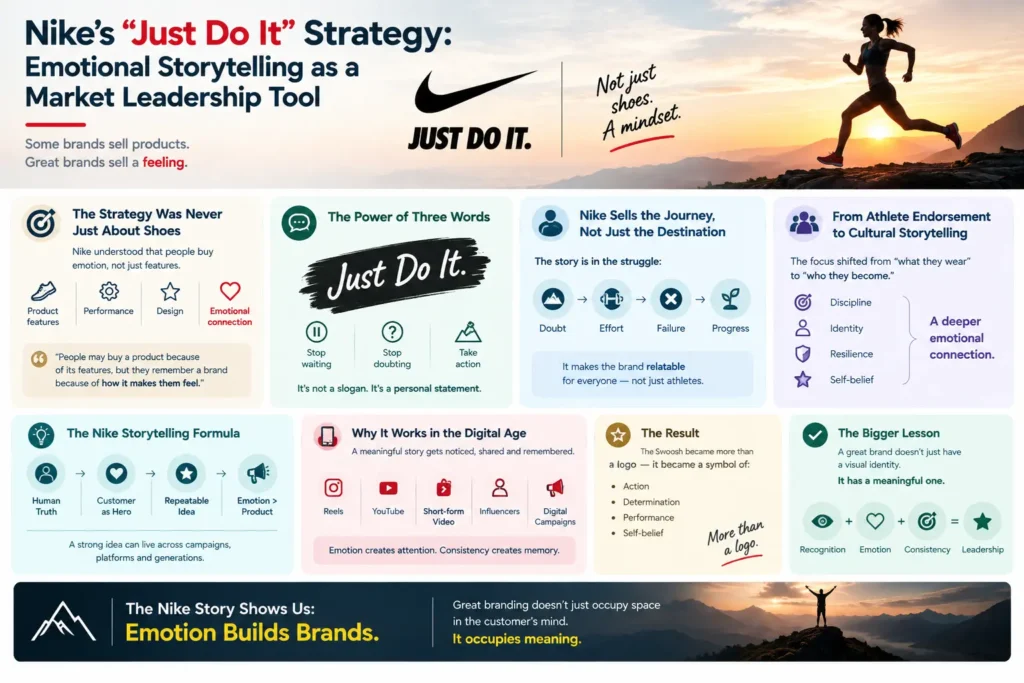
The Power of Three Words
The Nike Just Do It slogan is remarkably simple.
It doesn’t explain a product. It doesn’t describe a technology. It doesn’t mention price. Instead, it creates an internal reaction:
Stop waiting.
Stop doubting.
Take action.
That makes the Nike Just Do It motto more than a tagline. It becomes a personal statement that consumers can apply to their own lives.
For an athlete, it could mean training harder. For a beginner, it could mean taking the first step. For someone returning after failure, it could mean trying again. The same three words can therefore carry different meanings for different people. That is the strength of emotionally flexible branding.
Nike Sells the Journey, Not Just the Destination
One of Nike’s most effective storytelling approaches is its focus on the struggle behind achievement.
Instead of showing only perfect athletes crossing finish lines, Nike’s Nike Just Do It storytelling often explores:
This makes the story relatable because most consumers aren’t Olympic athletes. They are ordinary people trying to improve themselves:
A student preparing for a difficult exam.
A beginner entering a gym.
A runner completing their first kilometre.
A professional trying to overcome failure.
The emotional connection happens when the audience thinks: “That story is about me.”
From Athlete Endorsement to Cultural Storytelling
Celebrity endorsements are common in sports marketing. But Nike’s Nike Just Do It approach has frequently gone beyond simply putting a famous athlete in front of a camera.
The athlete becomes part of a larger narrative about discipline, identity, resilience, ambition, equality, self-belief, and personal transformation. This shifts the communication from “Buy what this athlete wears” to “Become the person you want to be.” That is a much deeper psychological proposition. You can check official updates on the Nike Official Site or read breaking news on Google News.
Emotional Storytelling Creates Brand Memory
Think about how people remember advertisements. Most product advertisements are forgotten because they communicate information without creating emotional significance.
A strong story works differently. It creates:
When consumers repeatedly experience the same emotional territory, the brand begins to own that territory in their minds. For Nike, that territory is strongly associated with action, determination, performance, and self-belief. This is one reason consistent brand storytelling matters. A brand doesn’t become memorable because it says something once; it becomes memorable because the Nike Just Do It vision communicates something meaningful consistently.
The Nike Storytelling Formula
The Nike Just Do It strategy offers an amazing 4-step framework for modern brands:
1. Start With a Human Truth
Don’t begin with “What are we selling?” Begin with “What does our customer struggle with?” Fear of failure? Lack of confidence? Time pressure? Social expectations? The desire to belong? Human truths create stronger storytelling opportunities than product specifications.
2. Turn the Customer Into the Hero
Your brand doesn’t always need to be the hero of the story. Your customer can be the hero. Instead of saying “Our product is powerful,” show “Here is what you can achieve with the right support.”
3. Create a Repeatable Brand Idea
Nike has the iconic Nike Just Do It foundation. A strong brand needs an idea that can survive multiple campaigns, platforms, products, and generations. The question is: “What should our brand consistently stand for?”
4. Make the Emotion Bigger Than the Product
A running shoe can represent movement. A skincare product can represent confidence. A financial service can represent freedom. The product is tangible, but the emotional meaning is what makes it memorable.
Why This Strategy Works in the Digital Age
Today, consumers encounter thousands of pieces of content every day. Brands compete not only for money but for attention. A simple product promotion can disappear within seconds. A meaningful Nike Just Do It story has a better chance of making someone stop across:
Instagram Reels
YouTube
Short-form video
Digital campaigns
Influencer content
Brand films
Social media storytelling
Emotional storytelling is not simply making an emotional video; it requires a consistent brand idea behind the emotion. Without strategy, emotional content becomes temporary entertainment. With strategy, it becomes brand memory.
Cholanadu Perspective
Great branding doesn’t merely occupy space in the customer’s mind. It occupies meaning. The brands that lead tomorrow will not necessarily be the brands that speak the loudest. They will be the brands that tell stories people see themselves inside. For more insights, visit Cholanadu Home Page.
