


The $20 Million Tropicana Packaging Mistake: How a Simple Design Tweak Tanked Sales
Table of Contents
Toggle5 Packaging Redesign Secrets: Best Tropicana Lessons
The Packaging Redesign mistake by Tropicana remains one of the most famous case studies in modern marketing.
Sometimes, a brand doesn’t need a new product to lose customers. It only needs a new look. In 2009, Tropicana learned this Packaging Redesign lesson the hard way.
The iconic orange juice brand introduced a redesigned packaging system intended to make its products look cleaner, more modern, and premium. Instead, the Packaging Redesign created confusion, weakened brand recognition, and triggered a rapid consumer backlash.
Within weeks, Tropicana reversed the Packaging Redesign. The episode became one of the most frequently cited examples of how a Packaging Redesign is not merely decoration—it is a powerful part of brand identity.
When "Modern" Becomes "Unrecognizable"
Tropicana’s original packaging had a distinctive visual language prior to its Packaging Redesign. The familiar orange with a straw, the bold typography, and the recognizable orange-and-blue color combination helped consumers identify the product almost instantly on supermarket shelves.
The Packaging Redesign simplified the package dramatically. The orange imagery was replaced with a more minimal visual approach, while typography and other elements were changed. On paper, the new Packaging Redesign appeared cleaner and more contemporary.
But consumers don’t experience a Packaging Redesign on paper. They experience it from several feet away, among dozens of competing products.
And that difference mattered for the Packaging Redesign.
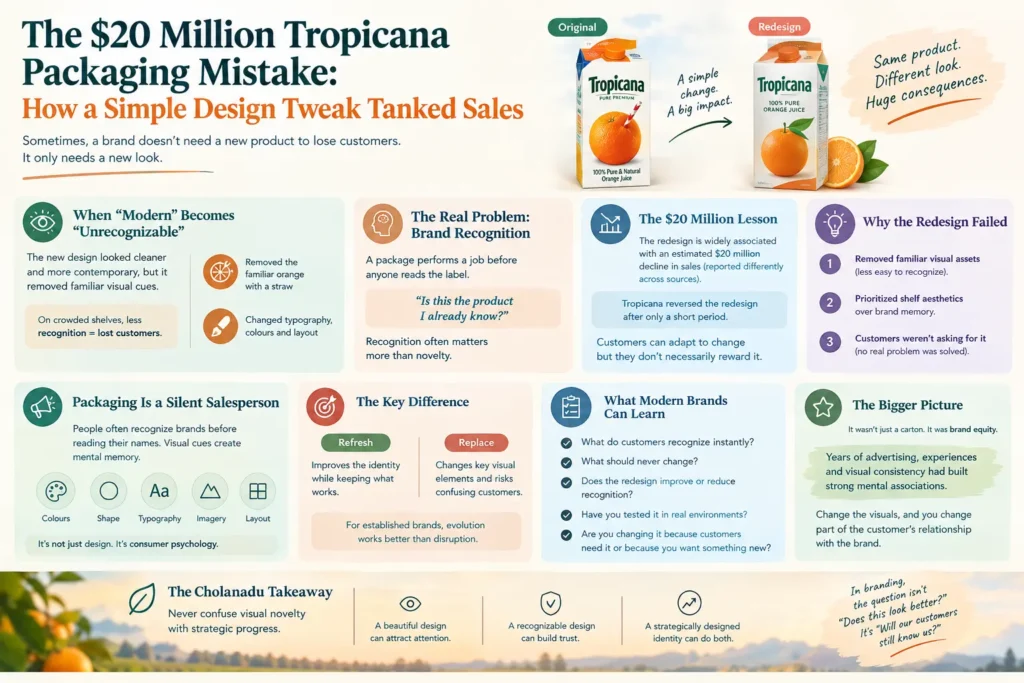
The Real Problem: Brand Recognition
A successful Packaging Redesign performs a job before anyone reads a single word.
It answers: “Is this the product I already know?”
When familiar visual cues disappear in a Packaging Redesign, consumers can hesitate. For an established brand, that hesitation during a Packaging Redesign can be expensive.
Tropicana’s Packaging Redesign demonstrated a critical branding principle: Recognition often matters more than novelty in a Packaging Redesign.
A Packaging Redesign can be aesthetically sophisticated while still being commercially ineffective.
The $20 Million Lesson
The Packaging Redesign is widely associated with an estimated $20 million decline in sales during the short period it was on shelves, although the precise financial impact is often reported differently depending on the source and measurement period.
The important Packaging Redesign lesson isn’t simply the dollar figure. It is what happened next.
Tropicana restored its previous packaging after only a short period following the failed Packaging Redesign. That reversal showed something many brands discover too late:
Customers can adapt to change, but they don’t necessarily reward a Packaging Redesign.
Why the Redesign Failed
1. It Removed Familiar Visual Assets
The old packaging had recognizable elements that had become strongly associated with Tropicana before the Packaging Redesign. The Packaging Redesign reduced or changed those signals.
As a result of the Packaging Redesign, the product became harder to recognize quickly.
2. It Prioritized Shelf Aesthetics Over Brand Memory
A Packaging Redesign may look beautiful in a presentation deck. But supermarket shelves are competitive environments.
A Packaging Redesign needs to communicate identity, category, quality, and familiarity within seconds.
3. Customers Were Not Asking for the Change
One of the biggest strategic questions before any Packaging Redesign or rebrand should be: What problem are we solving?
If customers already understand, trust, and recognize the existing packaging, executing a Packaging Redesign requires a compelling reason.
Design evolution and any Packaging Redesign should solve a genuine business problem—not simply satisfy an internal desire to “refresh” the brand.
Packaging Is a Silent Salesperson
Think about your favorite brands and how a Packaging Redesign might affect your perception.
You may recognize them before consciously reading their names. That happens because brands build visual memory before executing a Packaging Redesign.
Colors, shapes, typography, symbols, imagery, and layouts work together to create a recognizable identity in any Packaging Redesign.
This is why a Packaging Redesign is more than graphic design.
It is consumer psychology translated into a physical experience through a Packaging Redesign.
A successful Packaging Redesign should ideally achieve three things:
Recognition → Understanding → Desire
If recognition disappears during a Packaging Redesign, the other two become much harder to achieve.
Explore our insights on Cholanadu Strategy and review framework guides at Cholanadu Brand Architecture. Learn more about global product marketing on Harvard Business Review and retail branding strategy on Adweek.
The Difference Between Refreshing and Replacing
There is an important distinction between a Packaging Redesign refresh and a complete brand replacement.
A refresh improves an existing identity during a Packaging Redesign while preserving its strongest assets. A replacement can dramatically change those assets during a Packaging Redesign.
For established brands, the first approach to a Packaging Redesign is often less disruptive. The goal of a Packaging Redesign isn’t necessarily to make a package look completely different.
The goal of a Packaging Redesign is to make it look better without making it unfamiliar. That is the art of strategic Packaging Redesign.
What Modern Brands Can Learn From Tropicana
Before initiating a Packaging Redesign, brands should ask:
What do customers recognize instantly?
Identify the visual assets that carry brand memory before your Packaging Redesign.What should never disappear in a Packaging Redesign?
Not every design element has equal value. Some are strategically essential for a Packaging Redesign.Does the Packaging Redesign improve recognition or reduce it?
A modern Packaging Redesign is only useful if consumers can still identify the product.Has the Packaging Redesign been tested in the real environment?
A Packaging Redesign should be evaluated on actual shelves, mobile screens, shopping environments, and competitive displays—not just on a designer’s presentation board.Are we changing something in our Packaging Redesign because customers need it or because we want something new?
This single question can prevent an enormous Packaging Redesign mistake.
Tropicana’s Packaging Redesign episode wasn’t really a story about an orange juice carton. It was a story about brand equity and Packaging Redesign strategy.
Years of advertising, customer experiences, and visual consistency had created mental associations around the original packaging prior to the Packaging Redesign.
Changing those visual cues in the Packaging Redesign meant changing part of the customer’s relationship with the brand.
And that is why one seemingly simple Packaging Redesign decision can have consequences far beyond aesthetics.
Design Should Evolve But Memory Should Survive
Great branding doesn’t mean keeping everything unchanged forever without a Packaging Redesign. Brands must evolve. But a Packaging Redesign evolution should have direction.
The strongest Packaging Redesign initiatives understand what can change, what should remain, and why each decision matters. The objective of a Packaging Redesign isn’t to make customers notice the change. The objective of a Packaging Redesign is to make customers recognize the brand and feel that it has become even better.
Cholanadu Takeaway
The Tropicana Packaging Redesign episode offers a timeless lesson for every business: Never confuse visual novelty with strategic progress in a Packaging Redesign.
A beautiful Packaging Redesign can attract attention. A recognizable Packaging Redesign can build trust. But a strategically designed Packaging Redesign identity can do both.
In branding, the most powerful question regarding a Packaging Redesign isn’t: “Does this look better?”
It is: “Will our customers still know us when they see our Packaging Redesign?”
Because sometimes, the smallest visual change in a Packaging Redesign can create the biggest business consequence.
Cholanadu – Where Branding Meets Strategic Thinking.
