


Google Doodles Design Strategy: Engaging Audiences Through Daily Visual Variations
Table of Contents
Toggle10 Google Doodles Secrets: Best Visual Lessons
What if your brand could change its visual identity every day without losing its identity?
That is the fascinating idea behind Google Doodles.
From celebrating artists and scientists to marking cultural festivals, historical moments, and global events, Google regularly transforms its familiar homepage logo into something unexpected using Google Doodles.
The logo changes. The experience changes. But Google remains instantly recognisable.
That is the real branding lesson behind Google Doodles.
Great visual variation doesn’t weaken a brand when the core identity remains strong. It makes the brand more memorable.
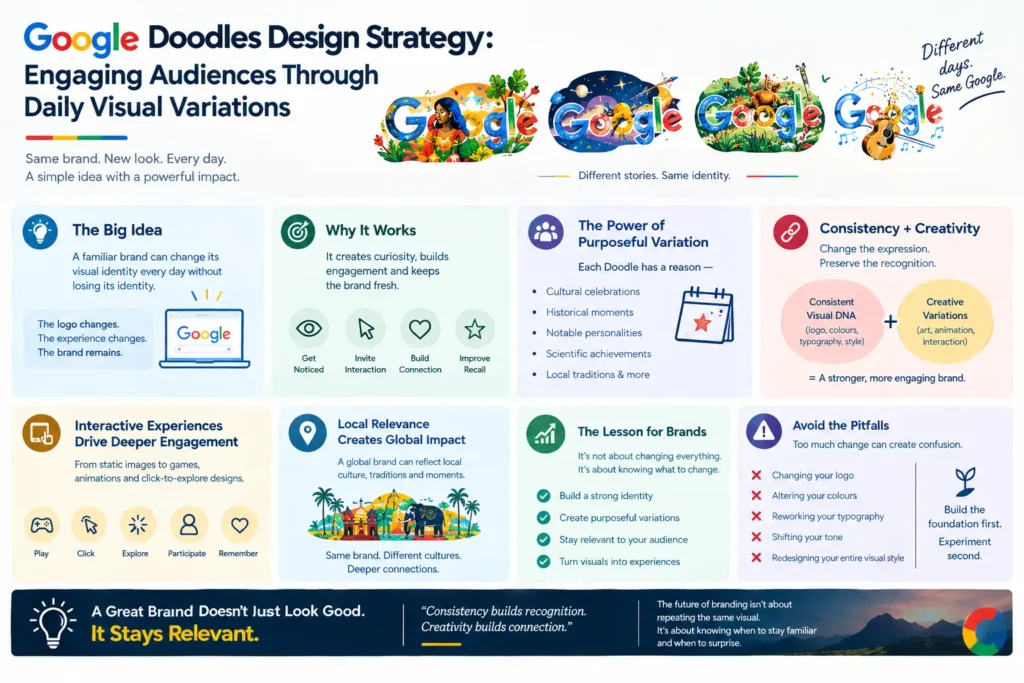
The Google Doodle: More Than a Logo
At first glance, Google Doodles may look like a simple creative treatment of the Google logo. But strategically, Google Doodles do something much bigger.
It turns a routine digital interaction into a moment of discovery.
Imagine opening Google expecting the same familiar homepage and suddenly seeing Google Doodles:
An illustrated artwork An animated musical experience An interactive scientific concept A celebration of a cultural event A tribute to an influential personality
The user doesn’t simply see the logo. They notice Google Doodles. And in a world where brands compete for attention every second, that distinction matters.
01. Familiarity Creates the Foundation
Google Doodles work because users already know what Google looks like. The basic brand identity is deeply established:
Google → Search → Familiar Logo
The Doodle temporarily changes the visual expression without destroying that association.
This creates an important branding principle behind Google Doodles:
Change the expression. Preserve the recognition.
For businesses, this is a powerful lesson from Google Doodles.
A brand does not necessarily need the exact same visual treatment every day.
Instead, it needs a consistent visual DNA.
That DNA could include:
Logo structure
Typography
Brand colours
Design language
Tone of communication
Graphic elements
Photography style
Illustration style
Once these foundations are strong, creative variations like Google Doodles become easier.
02. Why Daily Variation Gets Attention
Let’s think about two websites.
Website A
Same banner. Same graphics. Same communication style. Same visual treatment.
Website B
The brand identity remains consistent, but the homepage regularly introduces fresh visual ideas similar to Google Doodles.
Which one creates more curiosity?
The second approach has an important psychological advantage:
Anticipation.
People begin wondering:
“What will they do next?” That curiosity can become a valuable branding asset.
Google Doodles demonstrate how controlled novelty can keep a familiar brand feeling fresh.
03. The Secret Is Not Random Creativity
A common misunderstanding is that Google simply redesigns its logo whenever something interesting happens with Google Doodles. That’s not the real lesson. The Doodle concept is built around purposeful variation.
Each of the Google Doodles typically has a reason to exist.
It may recognise:
A cultural celebration
An important anniversary
A notable personality
Scientific achievement
Sporting occasion
Local tradition
Historical event
Social or educational theme
So the visual isn’t decoration for decoration’s sake in Google Doodles. The occasion drives the creative idea. This is where many brands can improve their own content strategy through Google Doodles principles.
Instead of asking:
“What should we post today?”
Ask:
“What visual story is worth telling today?”
That small change can completely transform a content calendar.
04. Interactive Design Turns Viewers Into Participants
Some Google Doodles go beyond static illustrations. They invite users to click, play, explore, discover or interact.
And Google Doodles introduce another important principle: Interaction creates deeper engagement than passive viewing.
Think about the difference:
See → Scroll → Forget
versus
See → Click → Explore → Remember
Interactive experiences in Google Doodles can create stronger moments of brand engagement because the audience becomes part of the experience.
For modern brands, this could mean:
Interactive website sections
Mini-games
Animated data visualisations
Hover interactions
Motion graphics
Interactive storytelling
Social media participation
The goal isn’t to add interaction everywhere. The goal is to make interaction meaningful through Google Doodles strategy.
05. Local Relevance Makes Global Branding Powerful
One of the most interesting aspects of Google Doodles is their ability to reflect different cultures and regions. A global brand can use Google Doodles to create something that feels locally relevant.
That creates a valuable combination: Global identity + Local connection
For Indian brands, this Google Doodles principle is especially useful.
A brand can maintain a consistent identity while creating visual content around:
Pongal
Onam
Diwali
Tamil New Year
Regional art
Local traditions
Indian personalities
Important cultural moments
The brand remains the same. But the story in Google Doodles changes according to the audience and occasion.
Explore our insights on Cholanadu Strategy and review framework guides at Cholanadu Brand Architecture. Learn more about global digital experiences on Harvard Business Review and creative marketing on Adweek.
06. Consistency Doesn't Mean Repetition
This is perhaps the biggest branding lesson from Google Doodles. Many businesses confuse brand consistency with visual repetition.
They are not the same.
Brand Consistency
Your audience recognises the brand across different experiences like Google Doodles.
Visual Repetition
Every piece of content looks almost identical.
The first is valuable.
The second can eventually become predictable.
A strong brand should create a balance:
Consistency → Recognition
Variation → Attention
Purpose → Relevance
Interaction → Engagement
Together, Google Doodles create a more dynamic brand experience.
07. The "Doodle Strategy" for Modern Brands
Businesses don’t need to copy Google’s logo strategy directly from Google Doodles. They can borrow the thinking behind Google Doodles.
Imagine a brand creating a monthly visual series inspired by Google Doodles:
Monday: Brand Insight
Wednesday: Industry Moment
Friday: Interactive Content
Weekend: Community Story
The visual language changes according to the subject, but the brand remains recognisable like Google Doodles.
Over time, these recurring content properties become part of the brand’s identity.
This is more strategic than simply producing random social media posts.
08. What Brands Can Learn From Google Doodles
The objective of Google Doodles isn’t to make your brand look different every day.
It is to make your brand feel fresh without becoming unfamiliar through Google Doodles.
09. The Danger of Changing Too Much
There is also an important warning when analyzing Google Doodles. Variation without a strong foundation can create confusion.
If a brand changes:
Logo
Colours
Typography
Tone
Photography
Design language
every few weeks, the audience may struggle to recognise it, unlike established Google Doodles. Google can experiment with Google Doodles because its underlying brand recognition is exceptionally strong.
For smaller businesses, the Google Doodles lesson is: Build the identity first. Experiment second.
Creative freedom works best when it operates inside clear brand boundaries.
10. From Logo to Living Brand
Traditional branding often treated the logo as something fixed, but Google Doodles proved a new model. Modern branding increasingly treats identity as a system.
A logo can have:
Different applications
Motion
Responsive versions
Campaign adaptations
Seasonal expressions
Digital experiences
Social media variations
The brand becomes less like a static stamp and more like a living visual language through Google Doodles. Google Doodles are a powerful example of this philosophy.
The logo doesn’t have to look exactly the same to remain recognisable in Google Doodles.
Because recognition comes from something deeper than a single graphic.
Cholanadu Takeaway
Google Doodles demonstrate an important truth about modern branding: People don’t need brands to look identical every day.
They need brands to remain recognisable, relevant, and meaningful through Google Doodles strategies. The strongest visual identities therefore create a balance between consistency and creativity.
For businesses, the opportunity is not to imitate Google Doodles. It is to adopt the strategic thinking behind Google Doodles:
Build a recognisable identity. Create purposeful variations like Google Doodles. Connect visuals to meaningful moments. Make audiences curious. Invite them to participate.
Because the future of branding may not belong to brands that simply repeat the same visual.
It may belong to brands that know exactly when to stay familiar and when to surprise with Google Doodles thinking.
Cholanadu – Where Branding Meets Strategic Thinking.