


Why Low Prices Are Killing Your Brand Image and Profit Margins ?
Table of Contents
Toggle7 Reasons Why Low Prices Kill Brand Image and Profit Margins
In business, lowering prices often feels like the quickest way to attract customers. A competitor launches a discount, sales slow down for a month, or inventory starts piling up and the first reaction is usually, “Let’s reduce the price.”
It may work for a while.
But if your brand constantly competes on price, you may be winning customers while quietly losing something far more valuable: your brand image, customer trust, and long-term profitability. Understanding why low prices kill brand image is critical for any growing business trying to escape the race to the bottom.
At Cholanadu, we’ve seen businesses across retail, manufacturing, D2C, and service industries make the same mistake. They believe lower prices create more demand. In reality, low pricing often attracts the wrong customers, weakens brand perception, and shrinks profit margins until growth becomes unsustainable.
Let’s explore why low prices kill brand image and how you can protect your positioning.
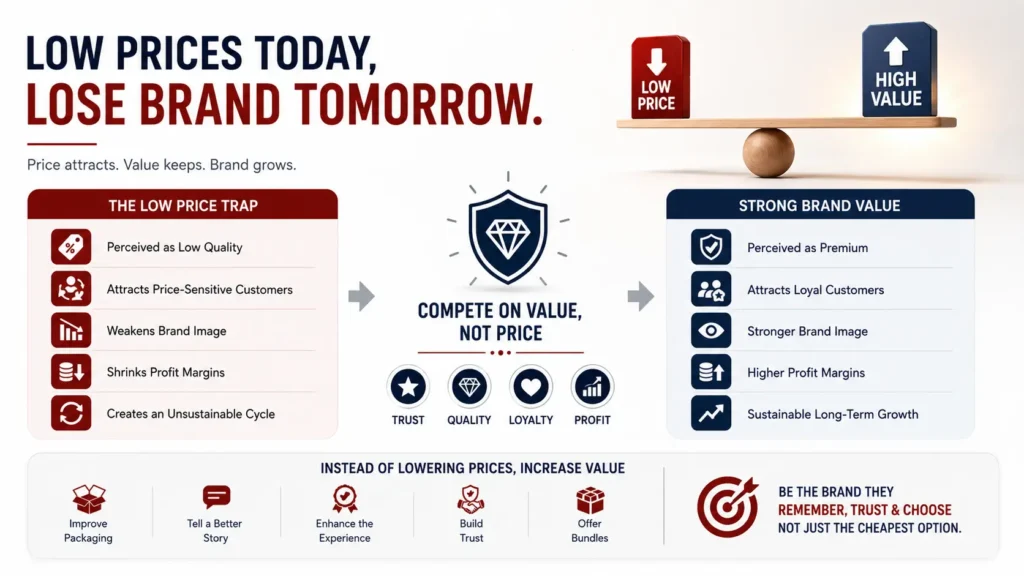
The Hidden Cost of Cheap Pricing
Imagine two skincare brands selling similar products.
- Brand A prices its product at ₹199
- Brand B prices it at ₹499
Without knowing anything else, many consumers will assume Brand B offers better ingredients, better packaging, better quality control, or better results.
That is the power of price perception. As noted in classic economic studies on Harvard Business Review, price is not just a number—it is a signal.
Customers often use price to judge quality, reliability, expertise, and trustworthiness. When a brand is consistently cheap, it risks being perceived as less valuable, even if the product itself is excellent. This explains why low prices kill brand image across competitive categories.
This is why many premium brands rarely compete through discounts.
Are You Selling a Product or a Bargain?
Ask yourself: When customers choose your brand, what are they really buying?
If the answer is “because it’s the cheapest option,” then your business is vulnerable. A customer who buys only because of price will usually leave as soon as someone else offers a lower price.
This creates a dangerous cycle:
- Lower prices
- Lower margins
- Lower marketing budgets
- Lower product investment
- Lower customer experience
- Even more pressure to reduce prices
Eventually, the brand becomes trapped in a race it can never truly win.
The Brand Image Problem
Premium brands are not always expensive because they cost more to produce. They are expensive because they have built perceived value.
Think of leading companies covered in Forbes across fashion, electronics, hospitality, automobiles, or beauty.
People pay more for:
- Better design
- Better service
- Better storytelling
- Better packaging
- Better trust
- Better experience
- Better identity
When your pricing is too low, customers begin to question whether your brand can genuinely deliver these things. This is a primary reason why low prices kill brand image over time.
Instead of looking affordable, your brand may start looking ordinary. And ordinary brands struggle to build loyalty.
Profit Margins: The Silent Killer
Many businesses celebrate revenue while ignoring margin.
The Math Behind Margin Compression
- Sell a product for ₹1,000 with a ₹300 profit
- Reduce the price to ₹800
- Profit falls to ₹100
To earn the same profit as before, you now need to sell three times more units.
More orders mean:
- More packaging
- More shipping
- More customer support
- More returns
- More operational complexity
- More stress
Lower prices demand significantly higher sales volume just to stand still. This is one of the biggest reasons growing businesses suddenly experience cash flow problems despite increasing sales.
The Wrong Customers Become Your Main Customers
Discount-driven customers are usually fundamentally different from value-driven customers.
Discount Customers Often:
- Compare every rupee
- Switch brands frequently
- Wait for offers
- Negotiate heavily
- Have lower loyalty
Value-Driven Customers Often:
- Appreciate quality
- Return repeatedly
- Recommend brands
- Spend more over time
- Trust expertise
A strong brand is built around the second group. Low pricing often attracts the first, demonstrating why low prices kill brand image and customer retention.
Why Premium Brands Grow Faster ?
This may sound surprising, but premium pricing can sometimes increase sales.
Why? Because higher prices create:
- Better positioning
- Stronger trust
- Better marketing budgets
- Better customer experience
- Better packaging
- Better product innovation
- Better profitability
Higher margins give businesses room to improve. Improvement strengthens the brand. A stronger brand attracts better customers. This creates a positive growth cycle. Explore how we structure sustainable growth models at Cholanadu Brand Strategy Services.
Discount vs. Value-Driven Customer Comparison
| Customer Attribute | Discount-Driven Buyer | Value-Driven Buyer |
| Primary Trigger | Price reductions and coupon codes | Perceived quality and brand trust |
| Brand Loyalty | Low (switches for ₹10 savings) | High (advocates to friends/family) |
| Support Overhead | High complaint rate per order | Low complaint rate per order |
| Lifetime Value (LTV) | Minimal repeat revenue | High recurring revenue and upgrades |
A Simple Brand Test
Imagine increasing your price by 15%. Would your customers still buy from you?
If the answer is no, your brand may not be differentiated enough. If the answer is yes, you likely have pricing power.
Branding is the process of creating that pricing power. Learn more about evaluating your market positioning on Cholanadu Digital Marketing Services.
Instead of Lowering Prices, Increase Value
Here are smarter alternatives to discounting:
1. Improve Packaging
Better packaging can dramatically increase perceived value.
2. Tell a Better Story
Customers connect with purpose, heritage, craftsmanship, sustainability, and authenticity.
3. Enhance the Experience
Faster delivery, better support, personalized communication, and thoughtful presentation create memorable experiences.
4. Build Trust
Testimonials, reviews, certifications, guarantees, and consistent branding reduce purchase hesitation.
5. Offer Bundles
Instead of reducing prices, combine products or services to increase perceived value.
Example: Instead of offering 20% off, offer a bonus product, free consultation, premium packaging, extended warranty, or exclusive membership.
Customers often respond better to added value than to reduced prices.
The Real Question
Ask yourself: Do you want customers who choose you because you are cheaper, or because you are better?
The first group disappears when a cheaper option appears. The second group becomes your brand advocates.
That difference determines whether you build a temporary business or a lasting brand. Understanding why low prices kill brand image allows you to make intentional decisions that protect your company’s future.
Cholanadu Takeaway
Low prices may increase short-term sales, but they often reduce long-term brand value.
When pricing becomes your primary strategy, competitors can easily copy you. But when branding, trust, experience, and perceived value become your strategy, price becomes only one part of the decision—not the entire decision.
Strong brands do not merely sell products. They sell confidence, identity, reliability, and emotion. And customers are willing to pay for that.
At Cholanadu, we help businesses build brands that compete on value rather than discounts, creating stronger market positioning, healthier profit margins, and sustainable long-term growth.
Because the goal is not to be the cheapest brand in the market. The goal is to be the brand customers remember, trust, and choose even when you are not the cheapest option available.
