


The Biggest Branding Mistakes Small Businesses Make
Table of Contents
Toggle9 Critical Small Business Branding Mistakes (And How to Avoid Them)
In today’s highly competitive digital landscape, small businesses frequently pour their entire focus into driving immediate sales, optimizing products, and managing daily operations. While these tasks are essential, entrepreneurs often unintentionally overlook one of the most powerful, long-term growth drivers of all: strategic brand identity.
Many business owners still believe that branding is a superficial task limited to a logo or a catchy tagline. In reality, it represents the complete experience, perception, and emotional bond that customers associate with your company. A weak or fractured strategy can make even a truly groundbreaking product feel entirely ordinary.
Understanding the most common small business branding mistakes is the first step toward building an unforgettable corporate footprint. Let’s dive deep into the 9 major pitfalls and how to fix them.
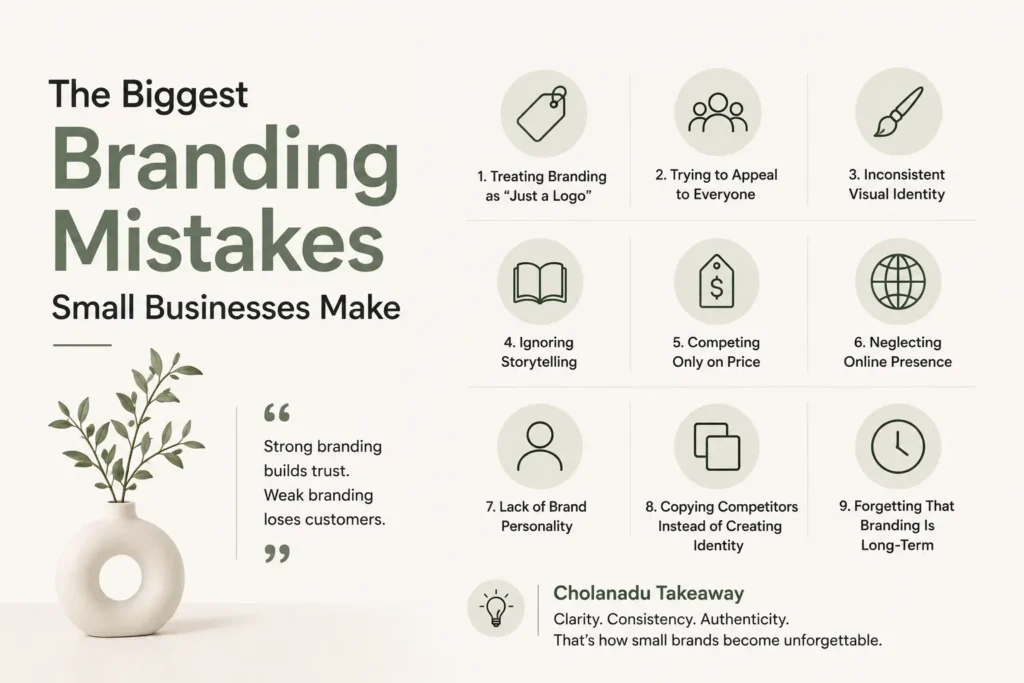
1. Treating Branding as “Just a Logo”
One of the most widespread misconceptions is assuming branding starts and ends with graphic design. While a polished logo is vital, it is merely the visual gateway to your business.
Your brand is actually defined by how customers feel when interacting with your team, your signature communication style, your overall customer experience, and your underlying values. A beautiful layout cannot fix inconsistent messaging, slow shipping, or poor customer support.
2. Trying to Appeal to Everyone
Many scaling startups fall into the trap of trying to target “everyone” to maximize their sales reach. However, messaging that tries to please everyone appeals to no one. When your core message is too broad, your brand identity feels entirely generic.
[ Broad Messaging ] ➔ Appeals to "Everyone" ➔ Generic Vibe ➔ High Competition
[ Niche Messaging ] ➔ Appeals to Ideal Buyer ➔ Unique Value ➔ High Customer Trust
To stand out, you must clearly define your ideal target persona. Ask yourself what specific everyday problem they face, and why they should choose your specific brand over larger, deep-pocketed competitors. According to market research insights on Forbes, over 77% of consumers prefer purchasing from brands they recognize and align with.
3. Maintaining an Inconsistent Visual Identity
Consistency builds effortless recognition. If your Instagram feed looks luxurious, your primary website feels outdated, and your product packaging looks completely unbranded, customers become instantly confused.
Common inconsistencies that drain your professionalism include using different logo variations across channels, changing color palettes randomly, and pairing mismatched fonts on marketing banners.
When your audience repeatedly interacts with a unified visual system across every platform, their subconscious trust in your business naturally increases. Recent data compiled in a brand consistency study on HubSpot reveals that a staggering 68% of organizations directly tie strict brand consistency to consistent revenue growth.
4. Completely Ignoring Storytelling
People do not connect emotionally with cold corporations; they connect with human stories. Focusing purely on functional product features, pricing matrices, and sales offers while ignoring the narrative side of your business is a major misstep.
Customers want to understand the authentic “why” behind your company. Sharing your raw startup journey, your core operational mission, and your guiding principles transforms a basic transaction into an inspirational relationship. Facts inform, but cohesive stories inspire long-term consumer retention.
5. Competing Solely on Low Price Points
Entering aggressive price wars to win quick sales is a dangerous race to the bottom for a small business. There will always be a larger competitor capable of undercutting your margins.
Strategic branding successfully shifts a customer’s core focus from “price” to “perceived value.” Premium brands understand that modern buyers are completely willing to pay more if they are guaranteed high quality, absolute reliability, an unforgettable unboxing experience, and a deep emotional connection.
6. Neglecting Your Primary Online Presence
This year, your digital footprint is your brand presence. Many small businesses still severely underestimate the damage an outdated website or an unorganized social media grid can do to their incoming leads.
Outdated, Slow Web Pages ➔ Reduced Credibility ➔ Immediate Drop in Customer Trust
A prospective client will almost always inspect your digital media assets before ever reaching out to your sales team. If your layout looks unpolished, or your mobile site is slow, trust declines instantly. A clean website, crisp professional imagery, and clear value statements are non-negotiable branding pillars.
7. A Total Lack of Brand Personality
Brands that communicate like cold, robotic algorithms are instantly forgotten. Customers align with businesses that display a human, authentic voice. You must clearly define your corporate persona from day one:
Are you elegant and premium?
Are you friendly, warm, and approachable?
Are you bold, disruptive, and innovative?
Are you traditional, safe, and deeply trustworthy?
Once this voice is defined, it should anchor every single email sequence, caption, and customer service response you publish.
8. Copying Competitors Instead of Building an Identity
Imitation destroys your market originality. Many small businesses replicate the exact design styles and taglines of successful industry leaders, believing it will yield identical financial results.
However, copycat strategies only make you look like a secondary choice. To win, focus strictly on your unique strengths, your individual history, and your specific customer service standards. Originality is what drives long-term consumer memory and brand equity.
9. Forgetting That Branding is a Long-Term Investment
Branding is not a temporary marketing campaign or a weekend project; it is built through relentless consistency over months and years.
Changing your logo frequently, shifting your core messaging to chase viral internet trends, or rebranding without a clear strategic direction shatters customer trust. Iconic brands don’t hop erratically between visual identities; they evolve carefully, maintaining their recognizable core while updating their modern presentation.
The Strategic Breakdown
| Common Pitfall | Direct Business Risk | The Professional Solution |
| Broad Targeting | Dilutes marketing budgets, feels generic | Narrow down to a highly specific ideal buyer persona |
| Visual Inconsistency | Harms professionalism, lowers trust | Create strict, unified brand design guidelines |
| Price Wars | Destroys long-term profit margins | Build premium perceived value via storytelling |
The Cholanadu Takeaway
Strong corporate identity is not a luxury reserved exclusively for massive, multi-million dollar global conglomerates. In fact, an authentic, highly consistent brand is the absolute single biggest advantage a small business possesses over giant, face-less competitors.
If you recognize any of these common small business branding mistakes within your current setup, don’t worry—they are completely fixable. If you are ready to stop running fragmented marketing campaigns and want to construct a premium, unforgettable digital presence that commands authority, explore our tailored web and design solutions at Cholanadu to upgrade your strategy today.
