


Performance Marketing vs. Brand Building: Which Should You Prioritize First?
Table of Contents
Toggle3 Secret Ways Performance Marketing Outperforms Brand Building in 2026
Performance marketing is vital for rapid growth. In today’s digital-first marketplace, businesses are under constant pressure to generate sales, acquire customers, and build a recognizable brand often at the same time.
This creates a common strategic question: Should you invest first in performance marketing to generate immediate results, or focus on brand building to create long-term value?
The answer is not simply one or the other.
The smartest businesses understand that performance marketing and brand building play different roles in the customer journey. Knowing when to prioritize performance marketing can make the difference between short-term growth and sustainable business success.
The Fundamental Difference
Before deciding what comes first, it is important to understand what each strategy actually does.
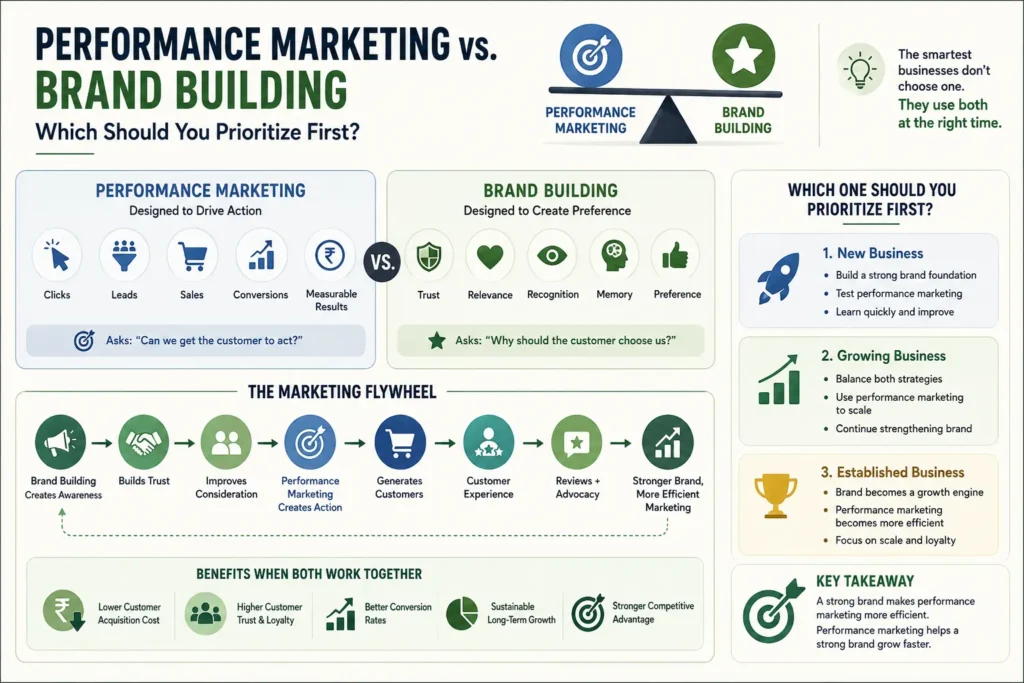
Performance Marketing: Designed to Drive Action
Performance marketing focuses on measurable, trackable outcomes.
Typical objectives include:
- Website visits
- Lead generation
- Product purchases
- App downloads
- Enquiries
- Conversions
- Customer acquisition
Platforms such as Meta Ads, Google, YouTube and other digital advertising channels allow businesses to measure performance marketing through metrics such as CTR, CPC, CPL, CPA, ROAS and conversion rate.
In simple terms, performance marketing asks: “Can we get the customer to act?”
Brand Building: Designed to Create Preference
Brand building operates at a different level. Instead of asking customers to purchase immediately, it focuses on making the brand:
Recognizable → Relevant → Trustworthy → Memorable → Preferred
Brand building includes:
- Brand identity
- Positioning
- Storytelling
- Content
- Visual consistency
- Thought leadership
- Customer experience
- Reputation
- Community building
The objective is not simply to generate today’s sale. It is to influence tomorrow’s purchase decision.
Brand building asks: “Why should the customer choose us instead of everyone else?”
The Real Problem: Choosing One Too Early
A common mistake among growing businesses is treating marketing like an either-or decision.
They may think:
“We need sales, so let’s run performance marketing ads.”
“We need a strong brand, so let’s focus only on branding.”
Both approaches can create problems.
Performance Marketing Without Brand Strength
Imagine seeing an advertisement from a company you have never heard of.
The product looks interesting. The offer is attractive. You click. Then you visit the website.
But the brand feels inconsistent. The content looks weak. The social media presence is inactive. There are few reviews. The positioning is unclear.
What happens? The customer hesitates.
The performance marketing advertisement successfully generated attention but the brand failed to convert that attention into trust.
Brand Building Without Conversion Infrastructure
Now consider the opposite. A company has:
- Beautiful branding
- High-quality content
- Strong storytelling
- Excellent social media presence
- Consistent visual identity
But there is no effective conversion strategy. No clear offer. No landing page optimization. No lead-generation system. No retargeting. No measurable performance marketing acquisition strategy.
The brand may look impressive, but the business struggles to turn attention into revenue.
Think of Marketing as a Flywheel
A powerful way to understand the relationship is to imagine marketing as a flywheel:
Brand Building → Creates Awareness → Builds Trust → Improves Consideration → Performance Marketing → Creates Action → Generates Customers → Customer Experience → Reviews + Advocacy → Strengthens the Brand → More Efficient Marketing
And the cycle continues.
This is where the real advantage appears. A strong brand can make performance marketing more efficient. And performance marketing can help a strong brand scale faster.
So, Which One Should You Prioritize First?
The answer depends on where your business currently stands. There is no universal 70:30 formula or one-size-fits-all strategy. Instead, consider your business stage.
1. If You Are a New Business
For a new business, the first priority should generally be building a credible brand foundation while testing performance marketing.
You don’t necessarily need a massive branding campaign. But you do need:
- Clear positioning
- Professional visual identity
- Strong website
- Consistent messaging
- Compelling content
- Trust signals
- A clearly defined target audience
At the same time, performance marketing campaigns can help you test:
- Which audience responds?
- Which message works?
- Which product converts?
- Which offer attracts attention?
This creates a valuable feedback loop. Learn more growth strategies in our Cholanadu Strategy Section.
Recommended mindset: Build the foundation. Test the market with performance marketing. Learn quickly. Scale intelligently.
2. If You Already Have Product-Market Fit
If customers are already buying your product and you know what works, performance marketing becomes extremely powerful.
Now you can scale acquisition. But this is precisely where many businesses make another mistake.
They increase their performance marketing ad budget while keeping brand investment unchanged. Over time, competitors start offering similar products. Ad costs increase. Customers become less responsive. And the business becomes increasingly dependent on paid traffic.
This is the moment to strengthen brand building. Your goal should shift from: “How do we acquire another customer?” to “How do we become the brand customers actively want?”
3. If Your Customer Acquisition Cost Is Increasing
Rising customer acquisition costs are often treated purely as a performance marketing advertising problem. But sometimes the deeper issue is brand differentiation.
If ten businesses are selling similar products and communicating similar messages, customers have little reason to choose one over another.
The result? Businesses compete through: Discounts → Offers → Ads → More Ads → Higher Acquisition Costs
Strong branding breaks this cycle. When customers recognize and prefer your brand, you don’t have to rely entirely on discounted performance marketing campaigns.
4. If You Are Building a Premium Brand
For premium businesses, brand building becomes even more important. Luxury and premium customers are rarely purchasing only a product. They are purchasing:
- Confidence
- Identity
- Experience
- Status
- Trust
- Design
- Meaning
Performance marketing can introduce them to the brand, but brand perception influences whether they believe the product is worth the price.
A ₹5,000 product cannot always be sold effectively with a ₹500-product performance marketing strategy. The perceived value must justify the price.
The 3-Stage Marketing Framework
A practical approach is to divide your strategy into three stages.
STAGE 01 — Establish (Build the Brand)
Create:
- Positioning
- Brand identity
- Messaging
- Content pillars
- Website experience
- Trust assets
The objective: “Make people understand who you are.”
STAGE 02 — Validate (Run Performance Marketing)
Test:
- Audiences
- Creatives
- Offers
- Landing pages
- Products
- Messaging
The objective: “Discover what makes people take action using performance marketing.”
STAGE 03 — Compound (Combine Brand + Performance)
Now your marketing system becomes more sophisticated. Brand content creates demand. Performance marketing campaigns capture demand. Retargeting nurtures interested audiences. Customer experience creates loyalty. Reviews create social proof. And the brand becomes stronger with every cycle.
The objective: “Create a performance marketing engine that becomes more efficient over time.”
A Simple Example
Imagine two skincare brands.
Brand A
Runs aggressive performance marketing advertisements every day. Its message is: “BUY NOW — 20% OFF!”
The customer sees the advertisement. They purchase because of the offer. But after the campaign ends, the brand disappears from their mind.
Brand B
Invests in educational content around skincare. It explains ingredients, shares customer experiences, builds expertise, and maintains a recognizable visual identity.
Then it uses performance marketing to promote its best-performing products. The customer doesn’t simply remember the advertisement—they remember the brand. That difference becomes incredibly valuable over time.
The Metrics Are Different
One reason businesses struggle with this decision is that the two strategies are measured differently.
Performance Marketing Metrics :
Track key parameters on platforms like Google Ads:
CTR
CPC
CPL
CPA
Conversion Rate
ROAS
Revenue
These help answer: “Is our performance marketing producing measurable action?”
Brand Metrics :
Look at:
Reach
Branded Search
Direct Traffic
Engagement
Share of Voice
Brand Recall
Customer Sentiment
Repeat Purchase
Organic Growth
These help answer: “Is our brand becoming stronger?”
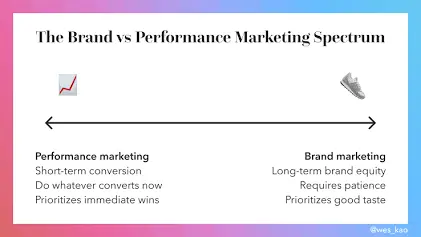
The mistake is expecting every brand-building activity to produce immediate ROAS. And the opposite mistake is expecting performance marketing alone to build a powerful brand.
The 60–40 Myth
You may hear recommendations such as 60% performance marketing + 40% branding or 70% branding + 30% performance marketing.
These can be useful starting points—but they are not universal rules. Your marketing mix should depend on:
Business stage
Industry
Product category
Customer buying cycle
Competition
Budget
Existing brand awareness
Customer acquisition cost
Purchase frequency
Growth objectives
A new D2C brand may need a different performance marketing balance from an established B2B company. Strategy should come before percentages.
The Most Powerful Question to Ask
Instead of asking: “Should we spend more on performance marketing or branding?”
Ask: “What is preventing our business from growing right now?”
Nobody knows about us → Build awareness.
People know us but don’t trust us → Strengthen brand credibility.
People visit but don’t convert → Improve performance marketing and conversion systems.
Customers buy once but don’t return → Improve customer experience and retention.
Advertising is becoming expensive → Strengthen differentiation and brand preference.
We have strong demand but cannot scale → Improve performance marketing infrastructure.
This question produces a much better strategy.
The Future Belongs to Both
The strongest modern businesses don’t separate brand and performance marketing into two disconnected departments. They build an integrated system:
Brand creates demand → Performance marketing captures demand → Content builds trust → Advertising creates action → Customer experience creates loyalty → Loyalty strengthens the brand.
That is the marketing ecosystem modern businesses should aim to build.
Performance marketing can help you grow faster today. Brand building can help you remain valuable tomorrow.
If you prioritize performance marketing without building a brand, you may eventually become dependent on advertising. If you prioritize branding without creating a performance marketing engine, you may struggle to convert attention into revenue.
The smarter approach is to build both but sequence them according to your business challenge and stage of growth.
Remember: Performance marketing buys attention. Brand building earns preference. When the two work together, marketing stops being just an expense—it becomes a long-term business asset.
Cholanadu Perspective
At Cholanadu, we believe modern marketing should not be about choosing between visibility and performance marketing. It should be about creating a strategic connection between the two.
A powerful brand attracts attention. A strong performance marketing strategy converts that attention. And a consistent marketing ecosystem turns customers into long-term brand advocates.
Because the ultimate goal isn’t just to generate a transaction. It is to build a brand people remember, trust and choose.
One final question for your business: Are you optimizing for the next customer with performance marketing, or building a brand that can keep attracting customers for years?
