


Why Cheap Product Photos Are Secretly Costing You Thousands in Returns
Table of Contents
ToggleE-commerce Product Photography: 5 Power Ways to Stop Returns
Your Product Might Be Excellent. But Does Your Photography Prove It?
Imagine a customer browsing your online store. They find a product that looks perfect, click on it, and place an order. When it arrives, however, the colour looks different, the size feels unexpected, or the finish doesn’t match what they saw on the screen.
The result? A disappointed customer, a returned product, wasted shipping costs, and a potential loss of trust in your brand.
Surprisingly, the problem may not be your product. It could be your e-commerce product photography.
In modern retail, e-commerce product photography is more than attractive visuals. It sets expectations, communicates quality, and influences purchasing decisions. When businesses compromise on e-commerce product photography to save money, they may end up spending much more on returns, refunds, and lost customers.
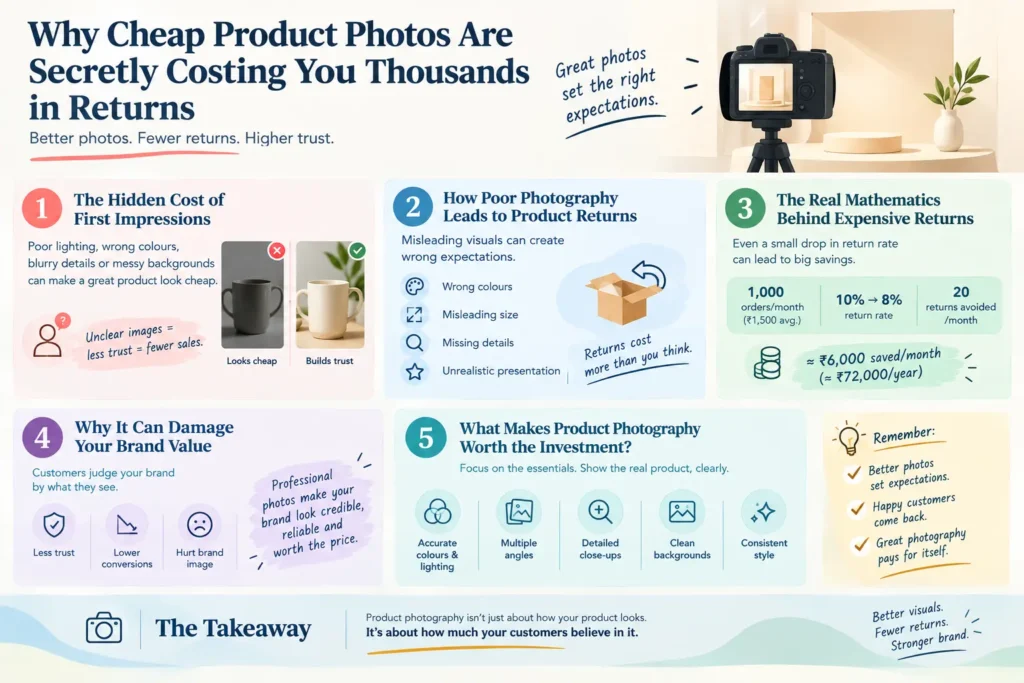
1. The Hidden Cost of First Impressions
Online shoppers cannot physically touch, feel, or examine a product before purchasing it. They depend heavily on images to understand what they are buying.
Poor lighting, inaccurate colours, blurry details, and unprofessional backgrounds can make even a premium product appear cheap.
Worse, unclear e-commerce product photography creates uncertainty. Customers may hesitate to purchase or place an order based on assumptions that the actual product cannot meet.
Think about it: Would you confidently purchase an expensive skincare product, a designer handbag, or a premium electronic accessory if the e-commerce product photography looked unprofessional?
Your customers ask themselves the same question.
Professional e-commerce product photography helps communicate credibility before a customer reads a single line of your product description. To check baseline professional creative standards, review the official AIGA Design Standards
2. How Poor Photography Leads to Product Returns
Not every product return is caused by poor images. However, misleading or incomplete visuals in your e-commerce product photography can contribute significantly to mismatched expectations.
Here are some common examples:
Incorrect colours: A product appears beige online but arrives in a noticeably different shade.
Misleading proportions: A handbag looks larger in photographs than it actually is.
Missing details: Customers cannot clearly see the texture, stitching, material, or finish.
Unclear product features: Important components or accessories are not shown.
Unrealistic presentation: Excessive editing makes the product look different from its real-life appearance.
When customers receive something that differs from their expectations, disappointment follows. For businesses, this can mean reverse shipping charges, packaging expenses, inventory handling, refund processing, and additional customer support.
The original saving on e-commerce product photography can quickly disappear.
3. The Real Mathematics Behind Expensive Returns
Let’s consider a simple example.
Imagine your e-commerce business receives 1,000 orders per month, with an average order value of ₹1,500.
If 10% of those orders are returned, that means 100 returns.
Now, suppose better e-commerce product photography helps reduce returns by just two percentage points, from 10% to 8%.
That means 20 fewer returns every month.
If each return costs your business approximately ₹300 in combined reverse logistics, handling, and processing expenses, you could save:
| Business Metric | Estimated Amount |
| Monthly orders | 1,000 |
| Average order value | ₹1,500 |
| Original return rate | 10% |
| Improved return rate | 8% |
| Returns avoided monthly | 20 |
| Estimated cost saved monthly | ₹6,000 |
| Estimated annual savings | ₹72,000 |
These figures are illustrative, not guaranteed results. Actual savings depend on your product category, return reasons, logistics costs, and the effectiveness of your e-commerce product photography improvements.
And this calculation considers only the direct cost of avoided returns. It doesn’t include potential improvements in customer confidence, conversion rates, or repeat purchases.
The takeaway? E-commerce product photography should be evaluated as a business investment, not merely a design expense.
4. Why Cheap Product Photography Can Damage Your Brand Value
Your product images influence more than individual transactions. They shape how customers perceive your entire business.
Consider two brands selling similar products at comparable prices.
Brand A uses inconsistent lighting, cluttered backgrounds, and basic smartphone photographs.
Brand B presents its products with accurate colours, clean compositions, detailed close-ups, and consistent styling through professional e-commerce product photography.
Even if both products offer similar quality, customers may perceive Brand B as more trustworthy and professional.
This is particularly important for businesses selling premium items. When your visual assets look inexpensive, customers may question whether your product deserves its price.
Quality e-commerce product photography creates a consistent visual identity that supports your brand positioning across your website, marketplaces, advertisements, and social media.
Remember: Customers don’t always judge your product by its actual quality. They often judge it by the quality they can see.
5. What Makes Product Photography Worth the Investment?
You don’t necessarily need an expensive photoshoot for every item. You need e-commerce product photography that communicates the right information clearly and consistently.
Here are five elements worth prioritising:
Accurate Colours and Lighting: Ensure the product’s appearance closely matches reality. Avoid lighting and editing that distort its actual colour or finish.
Multiple Product Angles: Show customers what the product looks like from different perspectives. This is especially useful for clothing, footwear, accessories, furniture, and electronics.
Detailed Close-Ups: Highlight textures, materials, stitching, ingredients, packaging details, and other features that influence purchasing decisions.
Realistic Scale and Proportions: Use appropriate framing and contextual images to help customers understand the product’s actual dimensions.
Consistent Brand Styling: Maintain a cohesive visual appearance across your catalogue using structured e-commerce product photography. Consistency makes your online store look organised, professional, and trustworthy.
The objective isn’t simply to make products look beautiful. It’s to help customers make informed purchasing decisions.
Product Photography Is Also a Conversion Strategy
High-quality e-commerce product photography can do more than reduce uncertainty. It can also support the customer’s journey from browsing to purchasing.
When shoppers can clearly understand a product, they have fewer unanswered questions. Detailed images can demonstrate quality, highlight benefits, and help customers compare options.
For example, a clothing brand can use close-ups to show fabric quality, lifestyle photographs to demonstrate how an outfit looks when worn, and size references to help shoppers make better decisions.
Similarly, a skincare brand can present its packaging clearly, highlight product consistency where relevant, and display essential product information without making unrealistic claims.
The key is to combine visual appeal with accuracy. Beautiful photography attracts attention. Informative e-commerce product photography builds confidence. The best product images do both.
How to Know Whether Your Product Images Are Costing You Money
Before investing in a complete photography overhaul, examine your existing performance.
Start by asking these questions:
Are customers frequently returning products because they look different from the images?
Do product-related complaints mention colour, size, material, or appearance?
Are customers repeatedly asking questions that better e-commerce product photography could answer?
Do some product pages receive traffic but generate relatively few purchases?
Are your product photographs inconsistent across your website and marketplaces?
Next, review your return reasons, customer feedback, conversion rates, and product-page performance. Identify products with unusually high return rates and investigate whether their images contribute to the problem.
You can then test improved e-commerce product photography on selected product pages and compare the results over time.
This approach allows you to make decisions based on actual business performance rather than assumptions.
Stop Saving on Photography and Start Investing in Clarity
Every business needs to manage its expenses carefully. But reducing costs without understanding their long-term consequences can create bigger financial problems.
Cheap images may appear economical initially. Yet, when visual assets fail to communicate product quality accurately, the consequences can extend to returns, customer dissatisfaction, lost sales, and weaker brand perception.
The solution isn’t necessarily to spend more on every photograph. It’s to invest strategically in e-commerce product photography that represents your products honestly, answers customer questions, and strengthens purchasing confidence.
Because in a competitive online marketplace, your product images often become your first salesperson. And unlike a salesperson, they work around the clock.
The Cholanadu Perspective: Build a Brand That Communicates Value
Cholanadu Takeaway
Are your product images selling your products or creating returns?
Your product may offer excellent quality, competitive pricing, and genuine value. But if your e-commerce product photography fails to communicate those qualities, potential customers may never recognise them.
At the same time, misleading visuals can encourage purchases that end in disappointment. The smarter approach is to create e-commerce product photography that balances aesthetics, accuracy, and commercial strategy.
At Cholanadu, we believe effective visual communication goes beyond making a product look attractive. It helps businesses build trust, communicate value, and create a stronger customer experience. To align your overall visual strategy, explore our guide on Cholanadu Brand Strategy Services.
Before spending another rupee acquiring customers, take a closer look at the images they’re using to make their decisions.
Your next opportunity to reduce returns might be hiding in plain sight: your e-commerce product photography.
