


What to Do When a Competitor Undercuts Your Prices ?
Table of Contents
Toggle7 Powerful Ways to Respond When a Competitor Undercuts Your Prices
When a competitor undercuts your prices, the right response is not always to lower your own prices.
Price wars are rarely won by the business with the lowest price. They are won by the business with the strongest value.
Imagine this: a customer who was about to choose your product suddenly says, “Your competitor is offering the same thing for much less.” Your first instinct might be to immediately reduce your prices.
But pause for a moment.
Lowering prices may protect a few sales today, yet it can quietly damage your profits, brand perception, and long-term growth. Premium brands are not built by reacting to every discount in the market. They are built by understanding why customers choose them in the first place.
If a competitor undercuts your prices, the goal is not simply to become cheaper. The goal is to become more valuable.
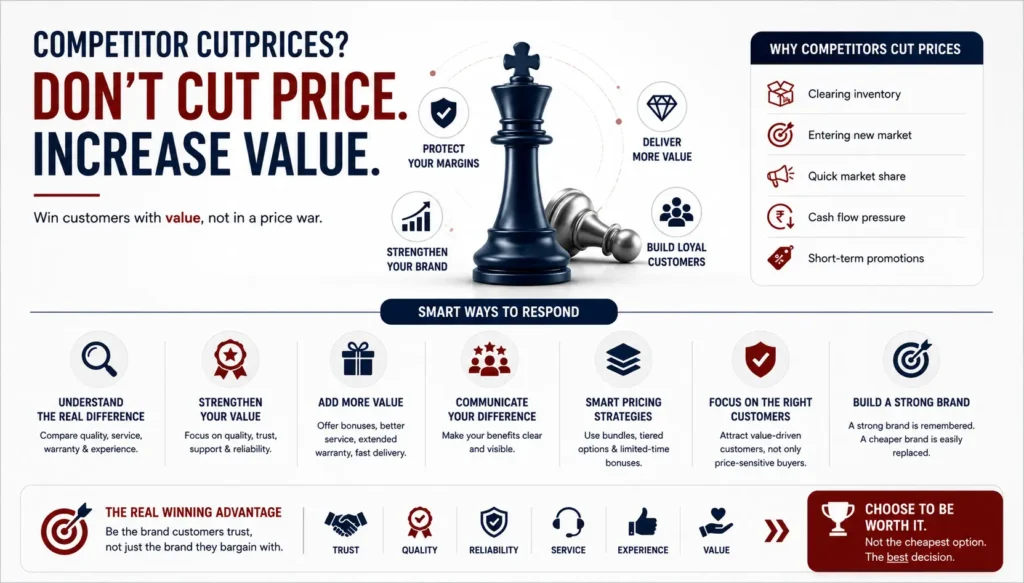
What to Do When a Competitor Undercuts Your Prices
When a competitor undercuts your prices, start by understanding the difference between price and value before making any changes to your pricing strategy.
The First Question: Is It Really the Same Product?
Before responding, ask yourself:
- Are the products or services truly identical?
- Is the competitor offering the same quality?
- The same materials?
- The same customer experience?
- The same warranty, support, or reliability?
In many cases, businesses panic because they compare price alone, while customers compare overall value.
A ₹1,000 product that lasts two years is often a better purchase than a ₹700 product that lasts six months.
Insight: Competing on price is easy. Competing on value is powerful.
Why Competitors Cut Prices ?
Understanding the reason behind the discount changes everything.
A competitor may be:
- Clearing old inventory
- Entering a new market
- Trying to gain quick market share
- Facing cash flow problems
- Running a short-term promotional campaign
- Positioning themselves as a budget brand
Not every price reduction is a permanent threat.
A temporary discount should not force you into a permanent pricing mistake.
If a competitor undercuts your prices through a temporary offer, reacting with a permanent price reduction could create unnecessary pressure on your business.
The Most Dangerous Response: Immediate Price Matching
Many businesses automatically lower prices to match competitors.
This creates a chain reaction:
- Lower margins
- Reduced cash flow
- Less money for marketing
- Less investment in quality
- Less investment in customer experience
- A weaker brand over time
Ask yourself:
“If I reduce my prices today, can I still deliver the same quality and service six months from now?”
If the answer is no, price matching may be more expensive than losing a few sales.
When a competitor undercuts your prices, immediate price matching can make the situation worse instead of solving the underlying problem.
Focus on What Customers Actually Buy
Customers rarely buy only a product.
They buy:
- Trust
- Convenience
- Quality
- Expertise
- Speed
- Support
- Reputation
- Reliability
A restaurant does not sell food alone.
It sells ambience, hygiene, service, consistency, and experience.
A digital agency does not sell a website alone.
It sells growth, credibility, performance, and business outcomes.
When a competitor becomes cheaper, remind customers what they receive beyond the price tag.
Strengthen Your Value Proposition
You can increase perceived value by offering:
- Better customer support
- Faster delivery
- Free installation
- Extended warranty
- Personalized consultation
- Premium packaging
- Loyalty rewards
- After-sales service
- Educational resources
- Easier returns
Sometimes adding a ₹100 benefit is smarter than removing ₹100 from your price.
A strong value proposition can help businesses respond when a competitor undercuts your prices without immediately sacrificing profitability.
For more on how value propositions influence customer decisions, see Harvard Business Review – Customer Value Propositions in Business Markets.
Communicate Your Difference Clearly
Many businesses lose customers not because they are expensive, but because they fail to explain why they cost more.
Make your differentiation visible.
Customers cannot appreciate what they do not understand
A competitor undercuts your prices situation becomes less threatening when customers clearly understand the additional value they receive from your business.
Avoid Competing on Every Customer
Not every customer is your customer.
There will always be buyers whose only decision factor is price.
Trying to win all of them can transform a premium business into a struggling discount business.
Instead, identify customers who value:
- Quality
- Trust
- Expertise
- Brand reputation
- Long-term relationships
These customers are often more profitable, more loyal, and more likely to recommend your business.
Use Smart Pricing Instead of Cheap Pricing
There are alternatives to lowering prices across the board.
Bundle Products
Instead of reducing the price of one product, create a package that feels like a better deal.
Example:
- Product A: ₹1,000
- Product B: ₹500
Bundle price: ₹1,300
The customer perceives additional value while you protect margins.
Offer Limited-Time Bonuses
Examples:
- Free consultation
- Free shipping
- Complimentary accessories
- Priority support
- Loyalty points
Bonuses preserve pricing integrity while increasing attractiveness.
Create Tiered Options
Offer:
- Basic
- Standard
- Premium
This gives price-sensitive customers an entry point without forcing your flagship offering to become cheaper.
These approaches can be especially useful when a competitor undercuts your prices and you want to provide customers with stronger perceived value without starting a price war.
Let Your Brand Do the Heavy Lifting
Strong brands survive price pressure better than weak brands.
Think about companies people continue buying even when cheaper alternatives exist.
Why?
Because branding creates:
- Emotional connection
- Familiarity
- Trust
- Status
- Confidence
- Reduced purchase risk
If customers believe your brand is dependable, they become less sensitive to price differences.
This is why investing in branding is often a better long-term defense than constant discounting.
A strong brand positioning strategy can help reduce the pressure created when a competitor undercuts your prices.
You can also explore Cholanadu’s approach to Brand Audit vs Brand Strategy to understand how strategic positioning can support long-term business growth.
When You Should Actually Lower Prices
Yes, there are situations where price adjustments make sense.
Consider reducing prices if:
- Your pricing is significantly above market without additional value
- Customer research shows price is the primary barrier
- Your costs have decreased substantially
- You are repositioning the brand
- You have a clear profitability strategy behind the reduction
A price cut should be strategic, not emotional.
If a competitor undercuts your prices, the decision to reduce your price should come from research, positioning, and profitability rather than panic.
The Real Competitive Advantage
Businesses often believe the lowest price wins.
In reality, the clearest value wins.
Customers remember the brand that solved their problem, respected their time, delivered consistent quality, and stood behind its promise.
Competing only on price makes you replaceable.
Competing on value makes you memorable.
When a competitor undercuts your prices, your strongest competitive advantage may therefore be the value, trust, and experience that customers associate with your brand.
Cholanadu Takeaway
A competitor undercutting your prices is not a signal to panic it is a signal to sharpen your positioning.
Instead of joining a race to the bottom, build a business that customers choose even when cheaper alternatives exist.
Because the strongest brands are not the ones that are least expensive.
They are the ones that are most worth paying for.
At Cholanadu, we help businesses build brands that compete on value, trust, positioning, and long-term profitability not just price. In a crowded market, the smartest strategy is not always to charge less. It is to become impossible to compare.
For businesses looking to strengthen their brand positioning and strategy, Cholanadu Media Corporation can help build a stronger foundation for long-term brand growth.
