


Studio Shoots vs. CGI Renders: Which Visual Strategy Actually Converts Better?
Table of Contents
ToggleProduct Visual Strategy: 7 Power Secrets to Boost Conversions
Studio Shoots vs. CGI Renders: Which Visual Strategy Actually Converts Better?
The Visual Decision That Can Shape Your Brand’s Success
Imagine launching a premium product with a carefully designed campaign. Your marketing message is compelling, your audience is well-defined, and your advertising budget is ready.
But there is one important decision left: Should you photograph the actual product in a professional studio or create photorealistic visuals using Computer-Generated Imagery (CGI) as part of your ideal product visual strategy?
Both approaches can produce exceptional visuals. Both can strengthen brand perception. And both can support sales when used strategically within your product visual strategy.
However, they serve different purposes. Studio photography captures a physical product in the real world, while CGI creates digital representations that can offer greater flexibility over lighting, materials, angles, and environments.
The right choice depends on your product, audience, marketing objectives, production budget, and the type of trust your customers need before making a purchase. Let’s explore how these two visual strategies compare and how to choose the one that delivers the greatest value for your business through a smart product visual strategy.
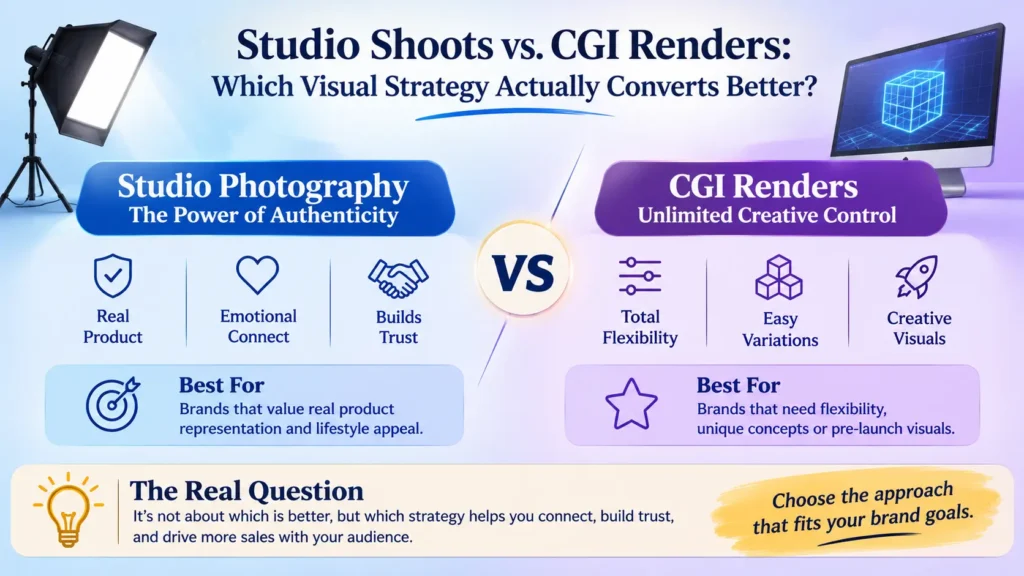
Studio Photography: The Power of Authenticity
Studio photography involves capturing an actual product using professional cameras, lighting equipment, backgrounds, and carefully arranged compositions as a foundational element of any product visual strategy.
From luxury skincare packaging to consumer electronics and fashion accessories, studio shoots help brands present their products with clarity and precision. Their greatest strength is simple: customers can see a real physical product rather than a digital representation.
Why brands choose studio shoots:
Authentic product representation: Studio photographs capture real materials, physical textures, reflections, and product details. When executed accurately, they can help customers understand what they will receive under a dependable product visual strategy.
Greater emotional connection: Lifestyle-oriented studio shoots can communicate a product’s personality through styling, props, models, and carefully designed environments.
Credibility and reassurance: For products where physical appearance matters, genuine photographs can help customers assess details such as texture, finish, colour, and proportions.
Human storytelling: Models, real environments, and physical interactions can make a product feel more relatable and help customers imagine using it themselves.
Where studio photography faces challenges: Studio shoots require physical products, equipment, production planning, and often a team of photographers, stylists, assistants, and creative professionals. Changing the product’s colour, background, lighting, or composition after the shoot may require additional photography or substantial editing. For brands with frequent product launches, multiple packaging variations, or extensive catalogues, these requirements can increase production complexity.
Best suited for: Brands that prioritise authentic product representation, human interaction, physical detail, and lifestyle storytelling within their core product visual strategy. To review professional design and agency standards, check guidelines from the AIGA Design Association
CGI Renders: Unlimited Creative Control
Computer-Generated Imagery, commonly known as CGI, uses specialised 3D software to create digital representations of products and environments as part of an advanced product visual strategy.
Rather than photographing a physical product, designers build or recreate its geometry, materials, textures, lighting, and surroundings digitally. The result can range from a simple product image on a clean background to a highly sophisticated visual that resembles a photograph.
Why brands are investing in CGI:
Complete environmental control: CGI allows designers to adjust lighting, shadows, reflections, camera angles, backgrounds, and materials without rebuilding a physical studio setup.
Easy product variations: Once a suitable 3D model exists, designers can often create different colours, finishes, configurations, and packaging variations without photographing every version.
Creative flexibility: A product can be placed in a futuristic environment, suspended in mid-air, surrounded by digital elements, or presented in a setting that would be expensive or impractical to build physically.
Consistency across campaigns: CGI can help brands maintain consistent lighting, composition, and presentation across large product collections.
Visuals before manufacturing: For some products, CGI can create marketing visuals before physical samples are available, provided the designs and specifications are sufficiently developed. This can be particularly useful for product launches, architectural visualisation, furniture concepts, and certain consumer-electronics campaigns.
Where CGI renders face challenges: High-quality CGI requires skilled 3D artists, accurate product specifications, suitable software, and careful material and lighting development. Photorealistic rendering is not automatically inexpensive or quick. Complex models, realistic simulations, detailed materials, and multiple revisions can demand substantial effort. There is also a trust consideration: if a render exaggerates a product’s appearance or hides limitations, customers may feel misled when the real product arrives.
Best suited for: Brands that need flexible visual variations, imaginative environments, consistent catalogues, or product visuals before physical samples are available through a modern product visual strategy.
The Real Question: Which Strategy Converts Better?
Here is where the discussion becomes interesting. A visually stunning campaign does not necessarily generate more sales than a simpler one. Conversion depends on several factors, including customer expectations, product quality, pricing, website experience, messaging, and the credibility of the visuals defined by your product visual strategy.
The important question is not simply which image looks better. It is which visual helps your target customer make a confident purchasing decision?
Consider three examples:
Scenario A: A premium skincare brand
A skincare brand wants to promote a new moisturiser. A studio shoot can capture the actual bottle, its packaging finish, the product’s physical appearance, and models using it in a lifestyle setting. CGI can create beautifully controlled lighting, elegant product compositions, and digital environments that complement the brand’s premium positioning.
The strategic choice: Use studio photography when genuine product appearance and human interaction are central to the message. Use CGI when controlled visual styling and multiple campaign variations are priorities within your product visual strategy. A combination can be particularly effective: authentic product photographs supported by carefully designed digital campaign visuals.
Scenario B: A furniture brand launching a new collection
A furniture company wants to showcase a collection in several interior styles. Photographing every product in multiple physical locations may require significant coordination. CGI can place the same furniture model in different digitally created interiors, making it easier to explore different room styles and visual compositions. However, the digital model must accurately represent the product’s dimensions, materials, colours, and construction.
The strategic choice: CGI may offer greater flexibility for large collections and multiple room configurations, while real product photographs can help customers assess the physical finish and craftsmanship.
Scenario C: A fashion brand selling clothing online
A fashion brand needs visuals that communicate fit, fabric movement, colour, and how garments appear on different people. Real photography can capture the actual garment on a model, showing its drape, movement, and interaction with natural body shapes. CGI can support conceptual campaigns, virtual product presentations, and certain colour or styling variations. However, inaccurate digital representations can create misleading expectations about fabric, fit, or texture.
The strategic choice: Studio photography is often valuable for authentic product presentation, while CGI can complement creative campaigns and selected digital experiences.
These examples illustrate an important principle: the best product visual strategy depends on what customers need to understand before buying.
The Hidden Cost Factor: Think Beyond the First Shoot
Many businesses compare studio photography and CGI based only on the initial production quotation. That can lead to an incomplete decision when evaluating a long-term product visual strategy.
A better approach is to consider the total cost of producing, updating, and reusing visuals over time.
Studio photography costs may include:
Photographer and production team.
Studio rental and lighting equipment.
Product preparation and styling.
Props, locations, and models.
Travel and logistics.
Editing and post-production.
Additional shoots for product changes.
CGI production costs may include:
3D modelling and product reconstruction.
Material and texture development.
Lighting and scene creation.
Rendering and post-production.
Revisions and new camera angles.
Model maintenance when product specifications change.
For a single product requiring a simple image, a studio shoot may be the more practical choice. For a large collection requiring many colour variations and repeated campaign updates, reusable CGI assets within an optimized product visual strategy may offer long-term efficiencies.
However, these savings depend on the quality of the original models, the number of variations required, and the complexity of each new scene. The smarter question is not, “Which option costs less today?” It is, “Which option delivers the best value across the entire campaign?”
Why Visual Accuracy Matters More Than Visual Perfection
Premium branding often aims for polished, sophisticated imagery. But excessive visual perfection can become counterproductive when it creates expectations the real product cannot meet, undermining your overall product visual strategy.
Imagine a customer ordering a skincare product after seeing a digitally enhanced image that makes the packaging appear more reflective, the colour more vibrant, or the container more substantial than it actually is. Even if the product is perfectly functional, the difference between expectation and reality may create disappointment.
This is why visual accuracy matters:
For studio photography: Ensure the lighting, editing, and colour correction represent the product fairly. Avoid editing techniques that materially misrepresent its appearance.
For CGI renders: Use accurate product dimensions, realistic materials, and faithful colours. Make sure the final render reflects the actual product rather than an idealised version that cannot be manufactured.
For products where appearance directly affects purchasing decisions, consider using real photographs alongside CGI in your multi-channel product visual strategy.
The objective is not merely to impress customers before a purchase. It is to ensure the product meets the expectations created by your marketing.
The Hybrid Strategy: Why You Don't Have to Choose Just One
Studio photography and CGI are often treated as competing approaches. In practice, they can complement each other inside a comprehensive product visual strategy.
A hybrid strategy combines the authenticity of real photography with the flexibility of digital rendering. For example, a brand might photograph its actual product and then use CGI to create additional backgrounds, visual effects, or campaign environments. Alternatively, a business might use CGI for catalogue variations while relying on real photography for customer testimonials, demonstrations, and lifestyle campaigns.
A practical hybrid content plan:
For your website: Use accurate product photography or photorealistic renders that faithfully represent the product.
For social media: Combine real product demonstrations with creative campaign visuals.
For advertising: Test different visual approaches against the same audience and marketing message.
For product launches: Use CGI for approved pre-launch concepts, then introduce real photographs when physical samples become available.
For premium campaigns: Combine authentic product details with sophisticated digital environments when the creative concept benefits from both.
The key is consistency. Every visual should reflect the same brand identity and communicate the product’s real value.
How to Find Out Which Visuals Actually Convert Better
Industry assumptions cannot tell you with certainty which visual approach will perform best for your particular brand. Testing assets within your chosen product visual strategy is essential.
The most reliable way to evaluate conversion performance is to test both approaches under comparable conditions:
Step 1: Define your objective. Decide whether you want to improve product-page conversions, advertisement click-through rates, add-to-cart activity, or completed purchases. These metrics measure different stages of the customer journey.
Step 2: Create comparable visual alternatives. Prepare a studio photograph and a CGI render that communicate the same product, offer, and core message. Both should be accurate, professionally executed, and appropriate for your audience.
Step 3: Keep other factors consistent. Where practical, use the same audience, pricing, advertising copy, placement, and campaign period to reduce the influence of unrelated variables.
Step 4: Measure meaningful outcomes. Track metrics such as click-through rate, product-page engagement, add-to-cart rate, purchase conversion rate, cost per acquisition, and return and complaint rates related to product expectations. A higher click-through rate does not necessarily mean higher sales. The winning approach should be evaluated against your actual business objective.
Step 5: Repeat and learn. Avoid making major decisions based on a small number of clicks or purchases. Collect enough data to make a meaningful comparison, account for differences in traffic and audience behaviour, and repeat the test when necessary.
Your audience—not industry hype—should determine which visual strategy works best for your brand.
The Cholanadu Perspective: The Best Visual Strategy Is the One That Builds Confidence and Drives Results
Studio photography offers something powerful: a direct view of a physical product, captured in the real world. CGI offers something equally valuable: creative flexibility, digital consistency, and the ability to create product visuals without relying on a physical shoot for every variation.
Neither method guarantees better conversions on its own. The right choice depends on what you sell, what customers need to see, how frequently your visuals change, and how effectively your content communicates value through your selected product visual strategy.
For some businesses, authentic photography will be the strongest foundation. For others, CGI will provide greater flexibility. For many brands, combining both approaches will create the most balanced visual strategy.
At Cholanadu, we believe that effective visual branding is about more than creating beautiful images. It is about choosing the right creative approach to strengthen brand perception, communicate product value, and support measurable business objectives. To align your brand growth plan with expert frameworks, explore our guide on Cholanadu Brand Strategy Services.
Before investing in your next campaign, ask yourself one final question: Are your visuals simply attracting attention or are they helping customers feel confident enough to buy?
The answer should guide your next creative decision.
