


Why Chennai’s Top D2C Brands Are Ditching Traditional Advertising
Table of Contents
ToggleD2C Advertising Strategies: 5 Powerful Reasons Brands Shift
From Billboards to Brand Communities: How Modern Businesses Are Rethinking Advertising
Imagine launching a premium skincare brand in Chennai. Your products are excellent, your packaging is attractive, and your pricing is competitive. You invest in newspaper advertisements and outdoor hoardings, but are these investments actually bringing customers to your business?
This is the question driving many Direct-to-Consumer (D2C) brands to rethink their D2C advertising strategies.
With digital advertising, influencer collaborations, and social media marketing gaining prominence, businesses have more opportunities to reach their target audiences and measure campaign performance.
The real shift is not about abandoning traditional advertising. It is about investing in D2C advertising strategies that deliver measurable value and lasting customer relationships.
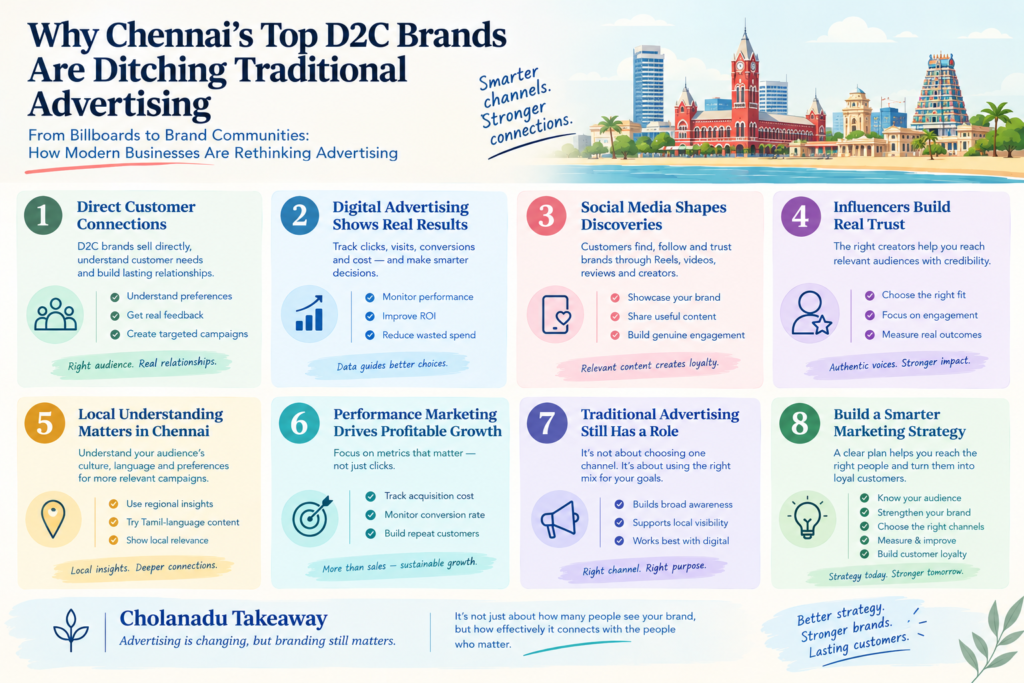
1. Why D2C Brands Prefer Direct Customer Connections
D2C brands sell directly to customers through their own websites and online channels, giving them greater opportunities to understand customer preferences and build lasting relationships through targeted D2C advertising strategies.
For example, a Chennai-based personal care brand can use its website and social media platforms to educate customers about its products, collect feedback, and understand purchasing behaviour.
This helps businesses identify what customers want and improve their marketing accordingly.
Rather than depending entirely on broad promotional campaigns, brands can develop more focused communication strategies. The goal is simple: reach the right audience, understand their needs, and give them reasons to return.
2. Digital Advertising Makes Performance Easier to Measure
Traditional advertising can create widespread awareness, but measuring its direct impact on sales can sometimes be challenging. Digital advertising offers tools to track website visits, enquiries, conversions, and customer acquisition costs.
For example, a business investing ₹50,000 in a digital campaign can analyse how many customers purchased through that campaign and evaluate whether the investment was worthwhile.
However, digital advertising is not automatically cheaper or more profitable. Results depend on targeting, competition, product pricing, and campaign quality.
The real advantage of modern D2C advertising strategies lies in using performance data to make informed decisions. Smart businesses don’t just ask how many people saw their advertisements. They ask what those advertisements achieved. To check design and communication standards across digital executions, review guidelines from the AIGA Design Association
3. Social Media Has Changed How Customers Discover Brands
Today, customers can discover new products through Instagram Reels, YouTube videos, creator recommendations, and customer reviews.
For D2C brands, social media provides opportunities to showcase products, explain benefits, answer questions, and build trust. Consider a Chennai-based fashion brand. Instead of relying only on promotional advertisements, it can share styling tips, fabric details, customer experiences, and behind-the-scenes content.
This approach helps the brand communicate its personality while giving customers useful reasons to engage.
However, posting frequently does not guarantee sales. Content must be relevant, consistent, and aligned with customer interests. Beautiful content attracts attention. Valuable content gives people a reason to stay connected.
4. Influencer Marketing: Building Trust Through the Right Voices
Influencer marketing allows brands to introduce products through creators whose audiences may already trust their recommendations. For Chennai businesses, regional creators can be particularly useful when targeting Tamil-speaking audiences.
A skincare brand, for example, might collaborate with a beauty creator who regularly shares skincare education and product demonstrations. The right partnership depends on audience relevance, credibility, engagement, and campaign objectives—not just follower count.
Brands should also evaluate actual business outcomes and ensure paid partnerships are disclosed appropriately.
Influencer marketing is not a guaranteed shortcut to growth, but well-planned collaborations can help businesses reach relevant audiences.
5. Why Local Understanding Matters for Chennai Brands
Chennai’s consumers have diverse preferences, purchasing habits, and cultural influences.
A brand targeting young professionals in OMR may require a different marketing approach from one serving families across Tamil Nadu. Businesses can use regional insights to develop more relevant campaigns, whether through Tamil-language videos, locally relevant storytelling, or targeted digital advertisements.
For example:
Personal care brands can create educational content about skincare and haircare.
Food brands can highlight regional flavours and familiar recipes.
Fashion brands can showcase styling ideas suited to local preferences.
Lifestyle brands can communicate practical benefits that matter to their target customers.
The objective is to connect with customers in ways that feel natural and relevant. Effective localisation is not merely translating advertisements. It is understanding what matters to your audience.
6. Performance Marketing: Focus on Profitable Growth
Performance marketing allows businesses to measure campaigns against specific objectives, such as purchases, leads, and customer enquiries. But generating sales does not automatically mean generating profit.
Imagine a brand spends ₹50,000 on advertising and acquires 100 new customers. Its advertising cost per acquired customer is ₹500.
If the profit contribution from each customer’s first purchase is lower than ₹500, the campaign may not be profitable initially.
This is why businesses should monitor important metrics such as:
Customer Acquisition Cost: The cost of acquiring a customer.
Conversion Rate: The percentage of visitors who complete a desired action.
Average Order Value: The average amount spent per order.
Repeat Purchase Rate: How frequently customers return.
Customer Lifetime Value: The expected value of a customer relationship over time.
These measurements help businesses understand whether their marketing supports sustainable growth. The objective is not simply to generate clicks. It is to acquire valuable customers at a sustainable cost.
7. Is Traditional Advertising Becoming Irrelevant?
Not necessarily. Newspapers, television, radio, and outdoor advertising can still be effective for businesses seeking broad awareness or strong local visibility.
For example, a product launch might combine outdoor advertising to generate awareness, social media to encourage engagement, and digital campaigns to drive website purchases.
Each channel serves a different purpose. Rather than choosing traditional advertising over digital marketing or vice versa, businesses should identify which combination best suits their audience, budget, and objectives.
The strongest strategy is one where every channel contributes to a clearly defined business goal.
8. How Chennai's D2C Brands Can Build a Smarter Marketing Strategy
Businesses can begin improving their marketing by focusing on five essential steps:
Understand Your Audience: Identify customer needs, preferences, and purchasing motivations.
Strengthen Your Brand Identity: Maintain consistency across your logo, website, packaging, and marketing communication.
Choose the Right Channels: Use social media, search advertising, influencer partnerships, and traditional media according to your objectives.
Measure Performance: Track conversions, acquisition costs, profit margins, and repeat purchases.
Build Customer Loyalty: Use relevant content, quality service, and thoughtful communication to encourage long-term relationships.
These steps help businesses move beyond isolated promotional campaigns towards a more cohesive marketing strategy. To align your strategy with professional growth frameworks, review our guide on Cholanadu Brand Strategy Services.
The Cholanadu Perspective: Advertising Is Changing, but Branding Still Matters
Chennai’s D2C brands have more opportunities than ever to reach customers, understand their preferences, and measure marketing performance.
Digital advertising, influencer collaborations, and content marketing can help businesses become more targeted and responsive. However, traditional advertising still has a role when it supports the right objectives.
Ultimately, successful marketing requires more than choosing a popular platform. It requires a clear brand identity, a strong understanding of customers, and consistent communication.
At Cholanadu, we believe effective branding goes beyond advertising. It connects a business’s identity, values, and customer experience into a meaningful and recognisable brand.
Because successful brands don’t simply compete for attention. They build trust, communicate value, and give customers compelling reasons to choose them.
A Question for Business Owners
Would you rather reach one million people who may never purchase from your business or ten thousand people who genuinely need your product? The answer depends on your objectives, but one principle remains clear:
Marketing success is not just about how many people see your brand. It’s about how effectively your brand connects with the people who matter.
