


Stop Burning Cash on Meta Ads: The Missing Piece in Your Brand Funnel
Table of Contents
ToggleMeta Ads Brand Funnel: 5 Power Ways to Boost Your Sales
Your Meta Ads are running. Your budget is being spent. People are clicking, scrolling, and visiting your website. But where are the sales?
For many businesses, this is a frustrating reality. They invest in Facebook and Instagram advertising, experiment with different audiences, and increase their budgets, hoping for better results. Yet enquiries remain inconsistent, conversions disappoint, and advertising costs continue to rise.
Before blaming the algorithm, consider a different possibility.
Your problem may not be your ads. It may be what happens before and after people see them. Building a structured meta ads brand funnel is the key.
Successful advertising requires more than an attractive creative or a compelling offer. It needs a strong meta ads brand funnel that guides potential customers from their first interaction to the final purchase.
Let’s explore the missing piece that could be holding your advertising performance back.
1. The Biggest Mistake: Expecting Every Ad to Generate Sales
Imagine someone discovers your brand for the first time through an Instagram advertisement. They have never heard of your business, don’t know whether your product is reliable, and have no reason to trust your claims yet.
Would they immediately purchase an expensive product simply because your advertisement looks attractive?
Sometimes, yes. But many customers need more information and reassurance before making a decision.
This is where businesses often go wrong with their meta ads brand funnel. They expect people who have never encountered their brand to behave like loyal customers. Instead of building familiarity and trust, they push directly for a sale.
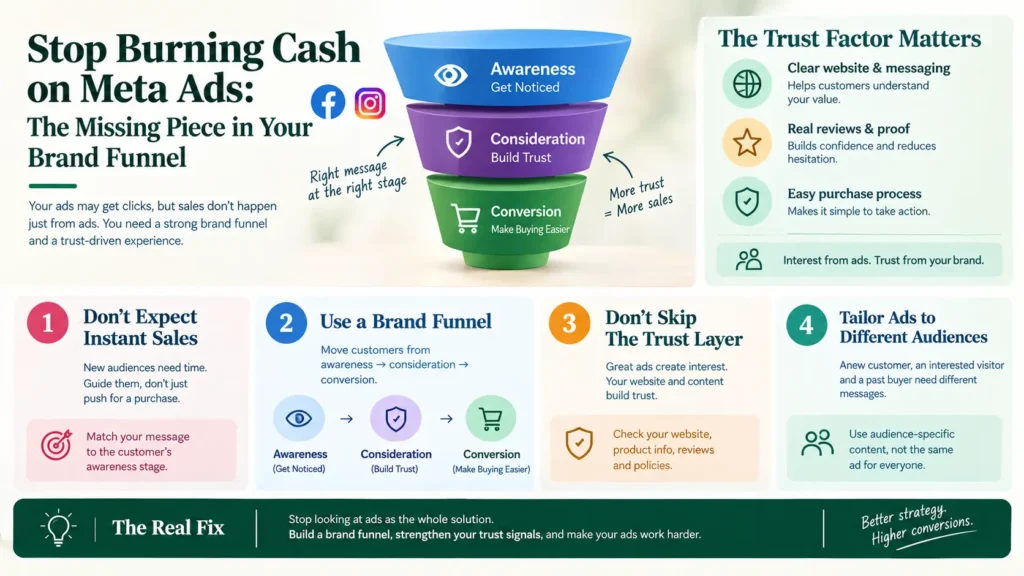
The solution? Match your advertising message to the customer’s stage of awareness within your meta ads brand funnel. Not everyone seeing your advertisement is ready to buy. Your funnel should recognise that difference.
2. What Is a Brand Funnel, and Why Does It Matter?
A meta ads brand funnel is the journey a potential customer takes from discovering your business to becoming a paying customer and, ideally, a repeat buyer.
A simple meta ads brand funnel has three stages:
Stage 1: Awareness – Get Noticed
At this stage of the meta ads brand funnel, people are discovering your brand. Your goal is to introduce your business, communicate a relevant problem, or demonstrate something useful.
Example: A skincare brand creates an Instagram video explaining why skin can feel dry even after moisturising. The content attracts people interested in the problem before asking them to purchase a product.
Stage 2: Consideration – Build Trust
Now, potential customers know your brand exists. They need reasons to consider your offering. Use educational content, product demonstrations, customer testimonials, and clear explanations of your product’s benefits in your meta ads brand funnel.
Example: The skincare brand explains how its product works, demonstrates its texture, and answers common customer questions.
Stage 3: Conversion – Make Buying Easier
At this final stage of the meta ads brand funnel, interested customers need a clear reason and a convenient way to take action. Present a relevant offer, explain the benefits, address remaining objections, and make the purchase process straightforward.
Example: The brand shows the product’s price, ingredients, usage instructions, delivery information, and a clear purchase button.
The key insight: Awareness attracts attention. Consideration builds confidence. Conversion turns suitable opportunities into sales.
3. The Missing Piece: Your Brand's Trust Factor
You can create excellent advertisements and target the right audience, but customers may still hesitate if they don’t trust your brand.
Think about your own buying behaviour. Before purchasing from an unfamiliar business, you might check its website, read reviews, compare prices, or look for evidence that the product delivers what it promises.
Your customers do the same when navigating your meta ads brand funnel. If your advertising creates interest but your website looks outdated, your messaging is confusing, or your product information is incomplete, that interest may disappear. To learn about official Meta advertising guidelines and policies, review the Meta Business Help Center.
Before increasing your Meta Ads budget, examine the experience customers encounter after clicking:
Does our website communicate our value clearly?
Do customers understand what makes our product different?
Are genuine reviews or other trust signals available?
Are our prices, benefits, and policies easy to understand?
Is purchasing simple on mobile devices?
Your advertisement makes a promise. Your brand experience must support it.
4. Stop Sending Every Customer to the Same Advertisement
A person discovering your business for the first time has different needs from someone who has already visited your product page. Yet many businesses show similar sales messages to both audiences across their meta ads brand funnel.
A more thoughtful approach considers the customer’s existing relationship with your brand:
| Audience Stage | Recommended Funnel Approach |
| New Audiences | Introduce the problem, product, or brand |
| Engaged Viewers | Share educational content and product demonstrations |
| Interested Visitors | Address objections and provide useful product information |
| Previous Customers | Encourage relevant repeat purchases or introduce complementary products |
Meta offers advertising tools that can help businesses reach different audiences, including eligible retargeting audiences within a meta ads brand funnel.
However, your strategy should depend on audience size, customer behaviour, privacy requirements, and campaign objectives. Retargeting is not automatically profitable, and some businesses may benefit more from improving their website or offer first. Don’t simply advertise more. Give each audience a more relevant reason to engage.
5. Your Creative May Be Attracting Attention but Not Buyers
A visually striking advertisement in your meta ads brand funnel can generate clicks without generating meaningful sales. Why? Because attention and purchase intent are not the same thing.
For example, an advertisement offering a huge discount may attract people who are primarily interested in low prices. If your business depends on premium positioning and healthy margins, those clicks may not translate into profitable customers.
Similarly, a beautiful product photograph may attract attention but fail to explain the product’s benefits or give viewers a compelling reason to act. Effective advertising creative in your meta ads brand funnel should combine three elements:
Attention: Give people a reason to stop scrolling.
Relevance: Show them why the product or message matters to them.
Action: Make the next step clear and appropriate.
Test different creative approaches, including educational videos, product demonstrations, customer testimonials, and benefit-focused advertisements. Measure their contribution to meaningful business outcomes rather than judging success by likes and clicks alone.
6. Interactive Check: Where Is Your Brand Funnel Leaking?
Before spending more money on advertisements, identify where potential customers may be dropping off in your meta ads brand funnel.
Answer these five questions honestly:
1. Are your ads reaching the right audience?
Yes, our audience is well-defined.
We receive clicks, but the quality of traffic is inconsistent.
We haven’t clearly identified our ideal customer.
2. Does your website build trust?
Yes, our website clearly explains our offering and provides relevant trust signals.
It looks good, but some information may be missing.
We haven’t reviewed the customer experience recently.
3. Do you have content for customers who aren’t ready to buy?
Yes, we provide educational and consideration-stage content.
Most of our content focuses on selling.
We haven’t developed a clear content plan.
4. Do you know what happens after someone clicks your ad?
Yes, we track important actions and conversions.
We mainly monitor clicks, reach, and engagement.
We aren’t confident our tracking is accurate.
5. Do you evaluate advertising profitability?
Yes, we consider revenue, margins, and customer acquisition costs.
We mainly look at cost per lead or cost per purchase.
We increase spending without consistently reviewing profitability.
What Your Answers May Reveal
Audience-related problems: Revisit targeting, creative relevance, and campaign objectives.
Trust-related problems: Improve your website, product information, and customer reassurance.
Content-related problems: Develop messages for different stages of the customer journey.
Tracking-related problems: Verify your conversion tracking before making optimisation decisions.
Profitability-related problems: Evaluate acquisition costs, contribution margins, and the quality of the customers you attract.
7. Don't Confuse Revenue With Profit
One of the most expensive mistakes in digital advertising is celebrating sales without understanding their profitability within your meta ads brand funnel.
Imagine spending ₹20,000 on Meta Ads and generating ₹60,000 in sales. At first glance, the campaign looks successful. But what about product costs, shipping, discounts, taxes, returns, and other expenses? If these costs consume most of the revenue, your advertising may be generating very little profit or even a loss.
Track metrics that reflect your actual business goals across your meta ads brand funnel:
Cost per qualified lead
Customer acquisition cost
Conversion rate
Average order value
Return on ad spend (ROAS)
Contribution margin and overall profitability
ROAS measures attributed advertising revenue relative to advertising spend. It does not, by itself, tell you whether a campaign is profitable. The real objective is not simply to generate more sales. It is to acquire customers sustainably.
8. Strategic Framework and Insights
The Cholanadu Perspective: Strategy Before Scaling
At Cholanadu, we believe effective digital marketing begins with a clear brand strategy. Advertising can amplify your message, but it cannot automatically fix unclear positioning, weak communication, or a poor customer experience.
Before increasing your budget, ensure that your brand has:
A clear position: Customers should understand what makes your business different.
A compelling message: Your advertising should communicate relevant benefits.
A consistent identity: Your ads, website, and other touchpoints should feel connected.
A trustworthy experience: Customers should find the information and reassurance they need.
A measurable funnel: You should understand how people move from engagement to conversion and repeat purchase.
When these elements work together, Meta Ads become part of a larger growth strategy rather than an isolated marketing expense. To build a stronger strategic foundation, explore our guide on Cholanadu Brand Strategy Services.
Cholanadu Takeaway
If your Meta Ads are consuming your budget without delivering the results you expect, don’t immediately assume you need more money, more creatives, or a different targeting strategy.
First, examine the journey behind the advertisement. Are you attracting the right people? Are you giving them a reason to trust your brand? Are you helping them understand your offering? Are you making it easy to buy?
The answers may reveal opportunities that another advertising campaign cannot solve on its own. Because successful advertising isn’t just about getting people to click. It’s about building a meta ads brand funnel that gives the right people a reason to choose you.
Stop spending blindly. Strengthen your meta ads brand funnel, measure what matters, and scale with a strategy.
