


The Dark Side of Discounting: Why Dropping Prices Destroys Brand Value
Table of Contents
ToggleDiscounting: 9 Powerful Ways It Damages Brand Value
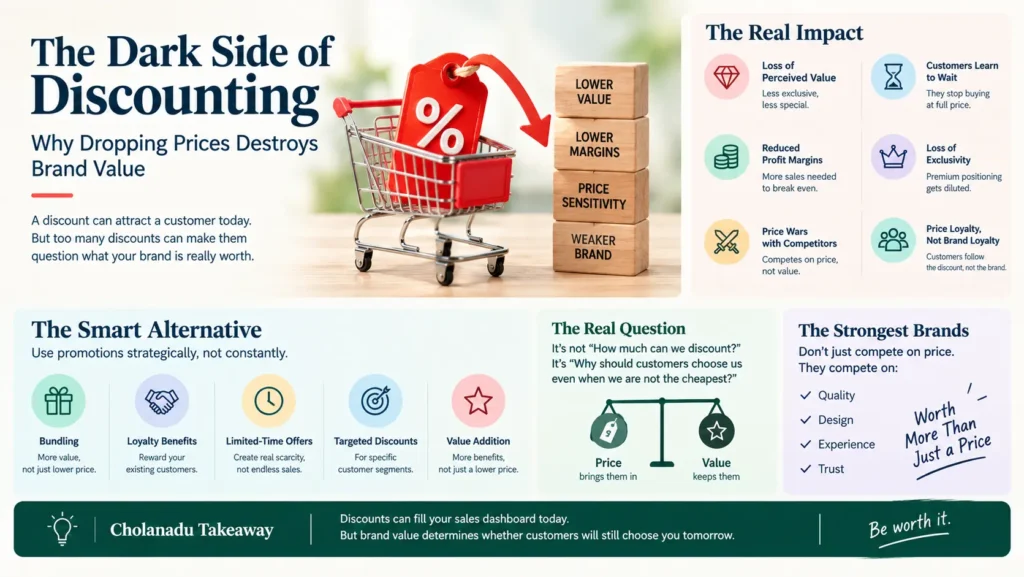
A discount can attract a customer today. But too much discounting can make them question what your brand is really worth.
Discounts are one of the most powerful tools in marketing.
“Flat 50% Off.”
“Buy 1, Get 1 Free.”
“Limited-Time Offer.”
“Clearance Sale.”
These words instantly grab attention. They create urgency, encourage purchases, and can bring new customers through the door.
But there is a hidden danger.
When a brand constantly relies on discounting, it may slowly train customers to stop buying at full price.
And once customers start believing that your product is always available for less, your brand value begins to decline.
The Psychology Behind Discounting
Price is not just a number.
Customers often use price as a signal of quality, exclusivity, and value.
Imagine two identical-looking products:
- Brand A sells for ₹2,000.
- Brand B sells for ₹800.
Even without trying them, many customers may assume Brand A offers something more better quality, better craftsmanship, stronger reputation, or greater exclusivity.
This is known as perceived value.
When a premium brand suddenly starts offering deep discounts every week, customers may begin asking:
“If they can sell it for 50% less, was it really worth the original price?”
That question can be damaging.
Research in consumer psychology has found that consumers can rely on price as a predictor of quality, meaning repeated price reductions can influence how customers interpret the value of a product.
The Discount Trap
Discounting usually starts innocently.
A brand wants to increase sales.
So it offers a 10% discount.
Sales improve.
Then another promotion is introduced.
Then another.
Eventually, customers become accustomed to waiting for the next offer.
The buying pattern changes:
Full Price → “Too expensive”
Discount → “Good deal”
The customer is no longer evaluating the product based on its value.
They are evaluating the size of the discount.
And that is where the trap begins.
1. Discounts Can Destroy Perceived Value
Luxury and premium brands understand an important principle:
Scarcity creates desire.
If a premium product is constantly discounted, it becomes less special.
A ₹10,000 product repeatedly sold for ₹5,000 may eventually feel like a ₹5,000 product not a ₹10,000 product on sale.
The original price starts losing credibility.
Your brand isn’t just selling a product anymore.
It is selling a discount.
That is one of the biggest risks of excessive discounting.
2. Customers Learn to Wait
One of the biggest long-term problems with frequent discounting is customer conditioning.
Suppose an online store runs a sale every month.
Customers quickly learn the pattern.
Why buy today?
They think:
“There will probably be another sale next month.”
This creates a dangerous cycle:
Discount → Sales Spike → Customers Wait → Full-Price Sales Fall → Bigger Discount → Another Sales Spike
The business appears busy, but the underlying brand becomes weaker.
3. Your Profit Margins Take the Hit
Revenue is not the same as profit.
Consider a simple example.
A product sells for ₹1,000.
After production, packaging, shipping, salaries, marketing, and other expenses, suppose the business makes ₹250 in contribution.
Now imagine a 30% discount.
The selling price becomes ₹700.
The brand may still attract more customers but the amount left to cover costs and generate profit becomes significantly smaller.
This means the company needs to sell many more units just to achieve the same financial result.
Discounting can therefore create the illusion of growth while quietly damaging profitability.
4. Premium Brands Lose Their Exclusivity
Think about brands built around exclusivity.
Luxury fashion.
Premium automobiles.
High-end watches.
Designer accessories.
Specialty cosmetics.
Their appeal is not simply the product.
It is the experience, identity, craftsmanship, and status associated with owning it.
Constant discounting can weaken that positioning.
If everyone expects a premium product to be 40–60% cheaper during frequent sales, the product begins to feel less exclusive.
Premium positioning requires consistency.
5. Competitors Can Drag You Into a Price War
Discounting rarely happens in isolation.
One company reduces its price.
A competitor responds.
Another competitor goes even lower.
Soon, the market enters a price war.
The problem?
Customers benefit temporarily, but businesses can suffer long-term.
Instead of competing on:
- Quality
- Innovation
- Service
- Brand experience
- Design
- Trust
companies start competing on one question:
“Who can be cheaper?”
And the cheapest brand doesn’t always become the strongest brand.
Uncontrolled discounting can turn differentiation into a race to the bottom.
6. Discounts Attract the Wrong Kind of Loyalty
Not every customer attracted by a discount becomes a loyal customer.
Some customers are loyal to the offer not the brand.
If Brand A gives 40% off today and Brand B gives 50% off tomorrow, these customers may simply move to Brand B.
That isn’t genuine brand loyalty.
It is price loyalty.
A stronger brand creates customers who say:
“I prefer this brand even when it costs more.”
That is the kind of loyalty businesses should build.
The goal is not to make customers dependent on discounting.
The goal is to make them confident in your value.
So, Should Brands Stop Discounting?
Not necessarily.
Discounts are not inherently bad.
The problem is uncontrolled discounting.
Smart brands use promotions strategically rather than making them the foundation of their marketing strategy.
Instead of constantly cutting prices, businesses can create value through:
Bundling
Combine multiple products and offer a package value without aggressively reducing the price of each item.
Loyalty Benefits
Reward existing customers with exclusive perks rather than publicly discounting everything.
Limited-Time Offers
Use genuine scarcity and specific occasions instead of running endless promotions.
Targeted Discounts
Offer discounts to specific customer segments rather than reducing prices for everyone.
Value Addition
Instead of reducing the price, add something valuable.
Free delivery.
Extended warranty.
Premium packaging.
Complimentary service.
Exclusive access.
Sometimes adding value is better than cutting price.
This approach allows brands to use discounting strategically without making lower prices the central reason customers buy.
The IKEA Lesson: Value Beyond Price
Brands such as IKEA have demonstrated how strong positioning can make customers focus on the overall value proposition rather than simply chasing discounts.
The experience, design, functionality, accessibility, and brand identity work together to justify the purchase.
IKEA describes its Democratic Design approach around form, function, quality, sustainability and low price, showing how price can be positioned as one part of a broader value proposition rather than the entire brand message.
The lesson is simple:
A strong brand gives customers a reason to buy beyond “It’s cheaper.”
The Real Question Isn't “How Much Can We Discount?”
It is:
“Why should customers choose us even when we are not the cheapest?”
That question changes everything.
If the answer is:
Quality.
Build quality.
If the answer is:
Design.
Own the design language.
If the answer is:
Experience.
Make the experience unforgettable.
If the answer is:
Trust.
Build trust consistently.
Because sustainable brands don’t simply compete on price.
They compete on perceived value.
Strong brand positioning is also reflected in how brands communicate quality, consistency and differentiation. Cholanadu’s SGR 777 Brand Audit case study provides a related example of how consistent quality and heritage can contribute to brand value.
The Discounting Equation
A simple way to think about it:
Short-Term Discount = Sales Boost
But:
Constant Discounting = Lower Perceived Value + Lower Margins + Customer Price Sensitivity
And ultimately:
Strong Brand Value = Strong Perceived Value + Consistent Experience + Pricing Confidence
The objective is not to eliminate every promotion.
It is to prevent discounting from becoming the identity of the brand.
Cholanadu Takeaway
Discounts can fill your sales dashboard today.
But brand value determines whether customers will still choose you tomorrow.
A discount should feel like an opportunity.
It should never become the reason your customers believe your product is worth buying.
The strongest brands don’t constantly tell customers:
“We are cheaper.”
They communicate something much more powerful:
“We are worth it.”
Because when customers believe in your value, you don’t have to keep lowering your price to keep them.
For businesses reviewing their overall brand strength, Cholanadu’s Jaguar Brand Audit Report – “Copy Nothing” Rebrand is another useful related resource on positioning, differentiation and long-term brand equity.
Cholanadu internal links
SGR 777 Brand Audit — useful for brand value, consistency and quality.
Jaguar Brand Audit – “Copy Nothing” Rebrand — useful for brand positioning, differentiation and brand equity.
IKEA Democratic Design — supports the article’s IKEA value proposition example.
Price–Quality Inference Research – Journal of Consumer Psychology — useful external resource for the psychology behind price and perceived quality.
