


Dove’s Real Beauty Campaign: How Emotional Connection Drives Viral Marketing
Table of Contents
Toggle5 Power Secrets of the Dove Real Beauty Campaign
The Dove Real Beauty campaign changed how brands talk to consumers. What if the most powerful marketing strategy isn’t selling a product but making people feel seen? In an advertising world filled with flawless faces, perfect bodies, polished visuals, and carefully edited lifestyles, Dove chose a different path.
It chose real people. Real stories. Real emotions. And that decision transformed Dove Real Beauty from an advertising campaign into one of the most recognisable examples of emotional brand marketing.
The Problem: Beauty Advertising Had Become Predictable
For decades, beauty advertising followed a familiar formula:
Perfect model → Perfect skin → Perfect body → Perfect lifestyle → Buy the product.
Dove challenged that formula when developing its strategic core.
Instead of asking, “How can we make our product look more desirable?”, the brand asked a more powerful question:
“How can we make people feel better about themselves?”
That shift changed everything for the Dove Real Beauty vision.
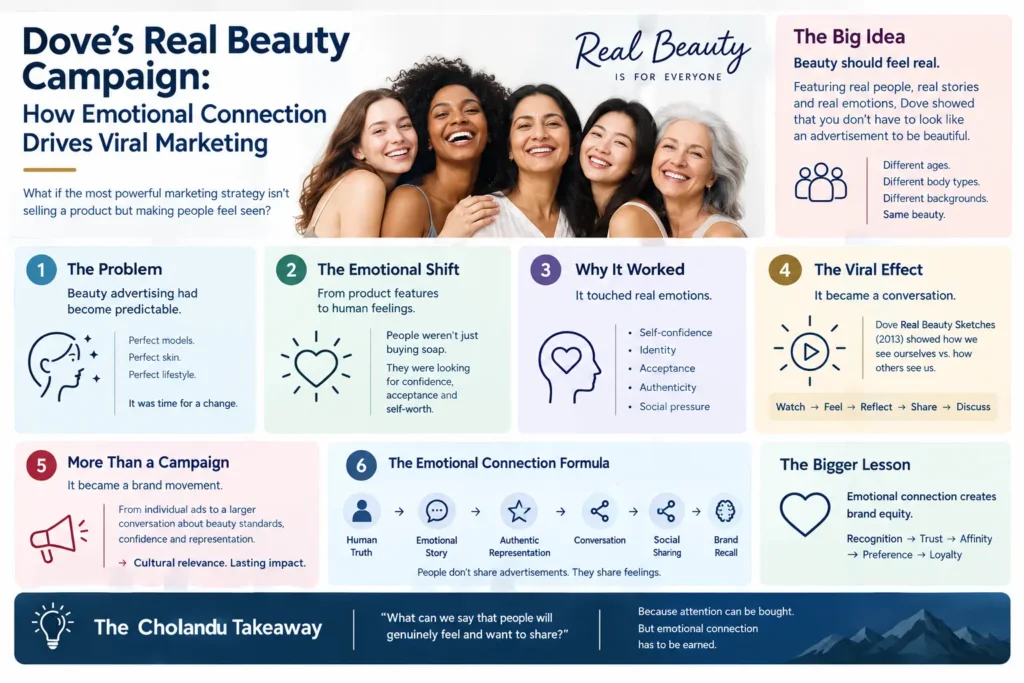
The Big Idea: Beauty Should Feel Real
Launched in 2004, the Dove Real Beauty campaign moved away from conventional beauty advertising and featured women of different ages, body types, ethnicities and appearances.
The message was simple: You don’t have to look like an advertisement to be beautiful.
The Dove Real Beauty movement redefined international skincare positioning.
That idea created something traditional advertising often struggles to generate: Emotional identification. People didn’t simply watch Dove’s advertisements. They recognised themselves in them.
And when people see themselves in a brand’s story, the brand becomes more than a logo. It becomes a part of their identity through the authentic lens of Dove Real Beauty.
Why Emotional Marketing Worked in the Dove Real Beauty Strategy
Dove understood an important psychological principle: People remember how a brand makes them feel. A product feature may be forgotten. A discount may disappear. But an emotional experience can stay for years.
Within every Dove Real Beauty narrative, communication consistently touched themes such as:
Self-confidence
Identity
Acceptance
Beauty standards
Social pressure
Authenticity
Self-worth
These aren’t merely advertising topics. They are human topics. And human topics naturally create conversation around Dove Real Beauty.
The Viral Marketing Effect of Dove Real Beauty
Here is where the strategy becomes particularly interesting. Dove didn’t simply create advertisements designed to be watched. It created ideas designed to be discussed.
One of the most famous examples was “Dove Real Beauty Sketches”, released in 2013.
The campaign explored the difference between how women perceived themselves and how others perceived them. The emotional reveal became highly shareable because viewers weren’t just consuming an advertisement. They were experiencing a story in the iconic Dove Real Beauty lineup.
Watch → Feel → Reflect → Share → Discuss
That is the emotional engine behind viral marketing. Strategic analysis published by Harvard Business Review often highlights how values-driven storytelling fosters organic user growth.
Viral Doesn't Always Mean Funny
When people hear “viral marketing,” they often think of:
Humour
Trends
Catchy audio
Unexpected moments
But the Dove Real Beauty initiative demonstrated another route: Emotion can be viral too. People share content because it makes them feel something, think differently, see themselves in the story, want others to experience it, or express a belief or value.
The strongest viral content often gives people a reason to share beyond the content itself.
Dove Wasn't Just Selling Soap
This is perhaps the most important marketing lesson. Dove could have focused entirely on: “Our soap makes your skin feel soft.”
Instead, its communication increasingly connected the brand with a larger belief: Dove Real Beauty deserves recognition.
The product remained important, but the brand meaning became bigger than the product. This is powerful positioning. Because competitors can copy ingredients, packaging, product benefits, pricing, and promotions. But copying an emotional association built by Dove Real Beauty is much harder.
From Advertisement to Brand Movement
The Dove Real Beauty platform evolved beyond individual advertisements. It became a broader conversation around beauty standards, confidence and representation. Learn more about long-term identity framing on our Cholanadu Brand Architecture page.
That gave Dove something extremely valuable: Cultural relevance.
When a brand participates in a conversation people already care about, marketing stops feeling like interruption. It starts feeling like participation. And participation creates stronger engagement across every Dove Real Beauty touchpoint.
The Emotional Connection Formula
The Dove Real Beauty approach can be simplified into a powerful marketing framework:
Human Truth → Emotional Story → Authentic Representation → Conversation → Social Sharing → Brand Recall
Notice what is missing? “Make the advertisement louder.”
Viral marketing doesn’t necessarily come from shouting louder. Sometimes, it comes from saying something people were already waiting to hear through campaigns like Dove Real Beauty.
The Business Value of Emotional Branding
Emotional branding isn’t just about creating beautiful campaigns. It can influence how people perceive the entire brand. Explore how to map out sustainable market growth on our Cholanadu Strategy overview.
When consumers associate a company with a meaningful idea like Dove Real Beauty, they may develop:
Recognition → Trust → Affinity → Preference → Loyalty
This creates what marketers often call brand equity—the additional value created by what people believe and feel about a brand. Industry insights on Adweek consistently demonstrate that emotional loyalty outlasts price discounts.
Dove’s greatest achievement wasn’t creating one successful advertisement. It was building a recognisable emotional territory around Dove Real Beauty.
What Other Brands Can Learn from Dove Real Beauty
01. Start With a Human Truth
Don’t begin with: “What do we want to sell?” Start with: “What does our audience genuinely care about?” This fundamental shift guided Dove Real Beauty to international acclaim.
02. Make People the Hero
Your brand doesn’t always have to be the star. Sometimes, the customer should be. When audiences see themselves in the story, engagement becomes more natural.
03. Create Something Worth Sharing
Ask: “Why would someone send this to a friend?” If the only answer is “because our product is good,” the campaign may need a stronger emotional idea akin to Dove Real Beauty.
04. Build a Platform, Not Just a Campaign
One advertisement can generate attention. A consistent brand idea can generate recognition. The Dove Real Beauty platform demonstrates the long-term power of consistency.
05. Don’t Manufacture Emotion
Audiences are increasingly sophisticated. If a brand tries to manufacture emotion without genuinely supporting the message, people can quickly sense the disconnect. Authenticity is not a creative decoration; it is a strategic asset.
The Bigger Lesson
The Dove Real Beauty campaign demonstrates a fundamental principle of modern marketing: People don’t share advertisements. They share feelings, beliefs and stories.
The most effective brands understand that marketing isn’t simply about getting attention. It is about earning emotional space in people’s minds.
Dove didn’t build one of the world’s most recognisable beauty campaigns by showing people what they should look like. It built connection by showing people that they already belonged in the conversation through Dove Real Beauty.
And that is why the campaign became bigger than advertising. It became a brand story people could see themselves in.
The Cholanadu Takeaway
In an age where brands compete for attention every second, the question isn’t: “How do we make our content go viral?”
A better question inspired by Dove Real Beauty is: “What can we say that people will genuinely feel and want to share?”
Because attention can be bought. But emotional connection has to be earned. And when a brand earns that connection, viral marketing becomes a consequence of relevance—not the objective itself.
