


What is Brand Architecture and How Does It Help Multi-Product Businesses?
Table of Contents
ToggleBrand Architecture: 7 Proven Ways It Helps Scale Multi-Product Brands
A strategic brand architecture is the master foundation of modern enterprise growth. Imagine walking into a supermarket and seeing dozens of products from what appears to be the same company—soap, shampoo, skincare, food items, clothing, and even electronics. Some carry the company’s main name proudly, while others have completely different brand names. Have you ever wondered why companies organize their offerings in distinct ways?
The answer lies in establishing a clear brand architecture.
For businesses that sell multiple products or operate across different categories, structuring your portfolio is not just a marketing concept—it is a strategic business framework. It influences how customers perceive your company, how easily new products can be launched, how marketing budgets are spent, and how your business grows over time.
At Cholanadu, we believe that strategic clarity is what transforms a collection of products into a high-value portfolio.
What is Brand Architecture?
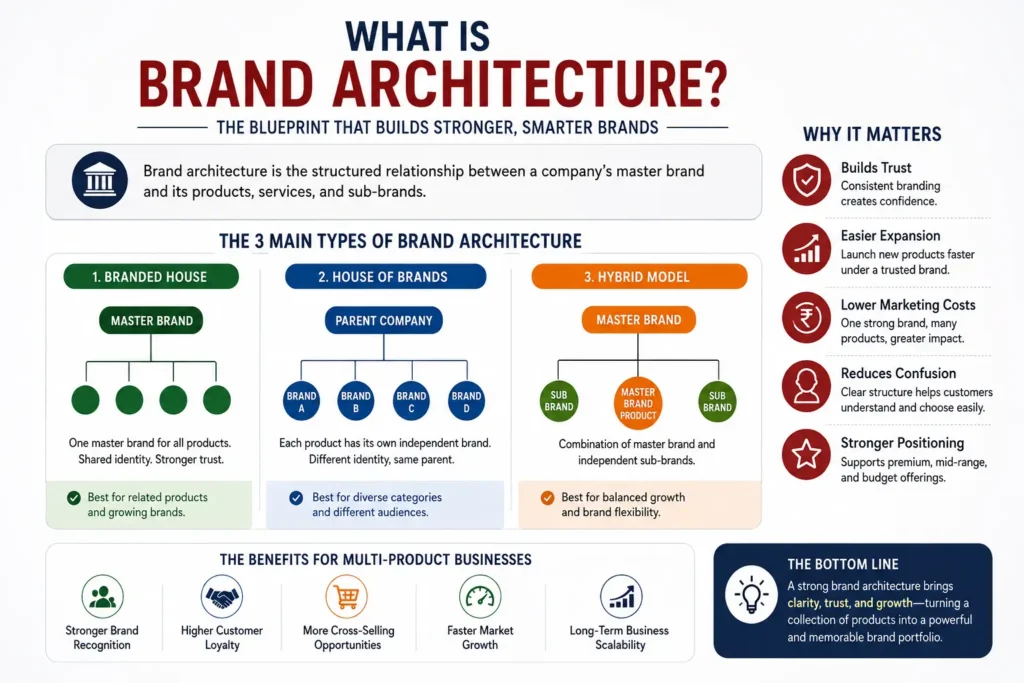
A formal brand architecture is the structured relationship between a company’s master brand and its products, services, sub-brands, and business divisions. Think of it as the strategic blueprint of your brand portfolio.
Just as an architect designs a building so that every room has a distinct purpose and connection, structuring your visual identity organizes every product under a unified growth strategy.
Without a clear structure, expanding catalog businesses face major consumer confusion:
- Is this product made by the same company?
- Is it a premium version or an entirely different brand?
- Can I trust this new line?
- Why do these items look completely unrelated?
A well-executed system resolves these questions before customers even ask them, creating instant clarity, trust, and higher recall.
A Simple Real-World Example
Imagine a growing business called “NaturePure” that produces:
- Herbal soap
- Face wash
- Hair oil
- Shampoo
- Baby care products
The company has two primary structural options:
One Master Brand (Branded House): NaturePure Herbal Soap, NaturePure Face Wash, NaturePure Hair Oil, NaturePure Shampoo.
Multiple Individual Brands (House of Brands): GlowLeaf Soap, SilkRoot Hair Oil, FreshAura Face Wash, TinyBloom Baby Care.
Both approaches can work—but they create vastly different customer experiences and operational demands. Understanding this choice is the heart of defining your portfolio strategy.
The Three Main Types of Brand Architecture
1. Branded House
In a Branded House model, the master brand takes center stage. Every product carries the identical parent brand identity.
Examples: Google (Google Maps, Google Drive, Google Photos).
Advantages: Lower marketing costs, faster trust building, easier cross-selling, and immediate brand recognition.
Best For: D2C brands, Ayurvedic companies, and FMCG businesses selling related products under a unified heritage.
2. House of Brands
In a House of Brands, each product line has an independent market identity. Consumers may not even know the sub-brands share a parent owner.
Advantages: Targets diverse audiences, isolates reputation risks between categories, and allows separate budget and premium positioning.
Best For: Large diversified enterprises operating across unrelated industries.
3. Hybrid Model
Most growing businesses eventually adopt a hybrid framework. According to HubSpot’s Marketing and Branding Strategy Guide, hybrid structures offer flexibility by allowing core lines to share master equity while experimental or luxury lines build standalone sub-identities.
7 Ways Brand Architecture Helps Multi-Product Businesses
1. It Makes Product Expansion Faster & Cheaper
Launching new SKUs is expensive. If customers already trust your master brand, introducing new items becomes significantly easier. A customer using your herbal hair oil is far more likely to try your herbal shampoo if both share a recognizable identity, drastically reducing customer acquisition costs.
2. It Strengthens Brand Trust
When shoppers recognize a consistent structure across products, they assume similar quality standards. This creates a “trust transfer effect,” where a positive experience with Product A immediately generates buying confidence for Product B.
3. It Drastically Reduces Marketing Costs
Promoting five distinct products under five independent brand names requires five ad campaigns, five websites, and five marketing budgets. Organizing products under a single master brand architecture ensures every ad dollar spent builds cumulative equity for the whole catalog.
4. It Prevents Customer Confusion
Confused customers rarely complete a checkout. A structured framework helps shoppers instantly distinguish entry-level items, mid-range products, premium lines, and specialized collections.
5. It Supports Premium Product Positioning
A clear portfolio hierarchy allows companies to launch luxury lines alongside value-focused items without damaging overall brand perception or confusing budget-conscious buyers.
6. It Improves Retailer and Distributor Confidence
Distributors and retail partners prefer working with well-structured brand portfolios. Clean hierarchies make shelf placement, catalog integration, and inventory management much simpler for trade partners.
7. It Maximizes Digital Conversion Rates
Consistent typography, logo placement, and packaging across product pages lead to longer browsing sessions and higher average order values on e-commerce sites.
Check out our related guide on how professional product photography boosts e-commerce sales to see how visual presentation complements your brand hierarchy.
Signs Your Business Needs a Strategic Structure
Ask yourself these core operational questions:
Are you planning multiple new product launches this year?
Do customers struggle to understand how your product range connects?
Are different products using conflicting logos, colors, or packaging designs?
Is your customer acquisition cost rising across separate ad accounts?
Are trade partners or distributors confused about your product tiers?
If you answered yes to two or more, it is time to formalize your structural strategy.
Common Mistakes to Avoid
Creating Too Many Sub-Brands: Not every new SKU requires a new brand identity. Over-segmentation dilutes resources and inflates marketing spend.
Inconsistent Visual Packaging: Products in the same family should share visual cues to reinforce brand recognition on shelves and screens.
Mixing Premium and Value Positioning: Luxury products require distinct packaging cues from value-focused lines to protect perceived value.
How to Build an Effective Framework?
Audit Your Portfolio: List every active SKU and service offering.
Group Related Categories: Segment items into natural verticals (e.g., Skincare, Haircare, Personal Care).
Identify Your Master Brand: Decide which brand name carries the highest consumer equity.
Establish Visual Rules: Standardize logo positioning, color systems, typography, and layout rules across all lines.
Test Consumer Understanding: Gather customer feedback to ensure buyers easily recognize parentage and product tiers.
Cholanadu Takeaway
Structuring your brand is often invisible to customers, but its strategic impact on business growth is enormous.
For multi-product companies, a deliberate brand architecture serves as the foundation connecting every product, ad campaign, and customer touchpoint into a single scalable asset. Whether you run an Ayurvedic brand, an e-commerce catalog, or a manufacturing enterprise, investing in a structured portfolio eliminates confusion and accelerates long-term growth.
At Cholanadu, we believe that great brands are built on strategy, structure, and trust. The right framework is the bridge that turns a random collection of products into a powerful, memorable brand.
