


- Prepared for: Sakthi Masala
- Prepared by: Cholanadu Media Corporation pvt, ltd
- Date: 17-12-2025
BRAND OVERVIEW
Origins & Early History
- The seed of Sakthi Masala was planted in 1977, when the founder P. C. Duraisamy — then a small-time turmeric trader — started trading turmeric with just ₹10,000.
- He began by trading turmeric, then expanded into producing pure spice powders like turmeric, chilli, and coriander.
- Over time, the operations grew from a tiny cottage-industry (initially a small space ~300 sq ft) to large-scale manufacturing.
Transition to a Big Brand
- In 1997, the business was formally incorporated as Sakthi Masala Private Limited, with P. C. Duraisamy as Managing Director and his partner (and life-partner) Santhi Duraisamy as Director.
- From that point onwards, the company steadily scaled — transforming from a small trader to one of the major branded masala/spice manufacturers in southern India.
- The brand grew by carefully blending traditional cooking practices (flavour, aroma, local tastes) with modern manufacturing, packaging and quality control — striking what they call a balance of “tradition and technology.”
What They Make & Market Positioning
- Today, Sakthi Masala offers a wide portfolio: over 50 varieties of spice and masala powders, plus pickles, pappads, flours, edible oils, etc.
- Their primary customers are households — especially people looking for convenient, ready-to-use spices and masala blends instead of grinding/spicing from scratch.
- Over time, as more women began working outside home and lifestyles changed (less time for home grinding), the acceptability of ready masalas increased. Sakthi used this shift and positioned itself as a trusted brand for quality and convenience.
- Through its branding as “The Queen of Spices”, Sakthi established itself as a household-name, especially in Southern India, for authentic taste aligned with local cooking traditions.
VISION
To be the finest humanitarian assistance organization that carres the sufferings of the under previleged – ther poor, the disabled and the illiterates and to champion the cause of creating a green earth.
MISSION
Sakthi Masala ensures product superiority by offering Quality products, enhances the corporate imae through Fair Buiness Practices and shall emulate the cardinal principle – Service to humanity is the Best Work of Life.
BRAND ARCHETYPE
“CAREGIVER”
Reason:
Sakthi positions itself as a brand that cares — for families, farmers, rural workers, the underprivileged, and traditional cooking culture.
Traits that match the Caregiver archetype:
- Focus on purity → “protecting the family’s health”
- Social initiatives (healthcare, education, trust activities) Emphasis on rural employment and fair sourcing
- Simple and humble brand communication
Sakthi’s narrative is always:
“We take care of you with purity and honesty.”
EXTERNAL AUDIT
MARKET CONTEXT
INDUSTRY LANDSCAPE
- India remains one of the largest producers, consumers, and exporters of spices globally.
- As of 2023–2024, the domestic spice market (loose + packaged) is huge — consumption in volume terms is multi-million tons per annum.
- The branded, packaged spices and spice-blends segment (the “organized” part) is growing significantly.
- This shift is driven by: rising urbanization; busier lifestyles (less time for grinding or preparing spices at home); increasing demand for convenience; food safety/hygiene awareness; and wider retail distribution (supermarkets, kirana-store distribution, regional penetration).
Structure of the Landscape: Organized vs Unorganized; (Pure vs Blended Spices)
- The spices industry is broadly divided into unbranded/loose spices (small traders, local mills, mandi-based supply) and branded & packaged spices (organized players).
- Within packaged: there are pure spices (single spices like turmeric, chilli, coriander) and blended/spice-mix products (masala powders for sambar, biryani, garam masala, regional dishes, etc.).
- As of 2024, pure spices form a larger chunk by value — but blended spices (masala mixes) are the fastest-growing sub-segment (higher CAGR forecast).
- Distribution remains heavily skewed toward traditional retail (kirana shops, small stores) across urban, semi-urban, and rural India — especially for regional/spice-heavy brands.
MARKET TRENDS
The Indian spice market is undergoing major shifts driven by changing consumer behavior, rising health awareness, and the growth of organized retail. Overall, the category is expanding steadily across both basic and blended masalas.
Shift Toward Branded & Hygienic Spices
Consumers are moving away from loose, unbranded masalas and choosing packaged, safe, hygienically processed spice products. This shift benefits established brands with trust and quality assurance.
Fast Growth of Blended Masalas
Blended spice mixes like sambar, rasam, biryani masala, garam masala, chicken masala, etc., are growing faster than basic spices because consumers want convenience and consistent flavour.
E-Commerce & Online Grocery Boom
More customers now shop for spices on Amazon, BigBasket, Blinkit, Jiomart, especially in metro cities. Online search visibility and review-based purchase decisions are shaping modern buying behavior.
Preference for Regional & Authentic Flavours
Regional brands delivering authentic, localized taste profiles are winning consumer loyalty. South Indian blends, especially sambar, rasam, kulambu, and podis, are seeing rising demand across India.
Premium & Organic Segment Growing
There is a noticeable rise in interest for organic, preservative-free, cold-ground, and premium-quality spices, especially in urban and health-conscious consumer segments.
Rising Competition From Regional & D2C Brands
Small regional companies and digital-first brands are expanding quickly, offering unique blends, premium experiences, and modern branding, increasing competitive pressure on traditional brands.
COMPETITOR TRENDS
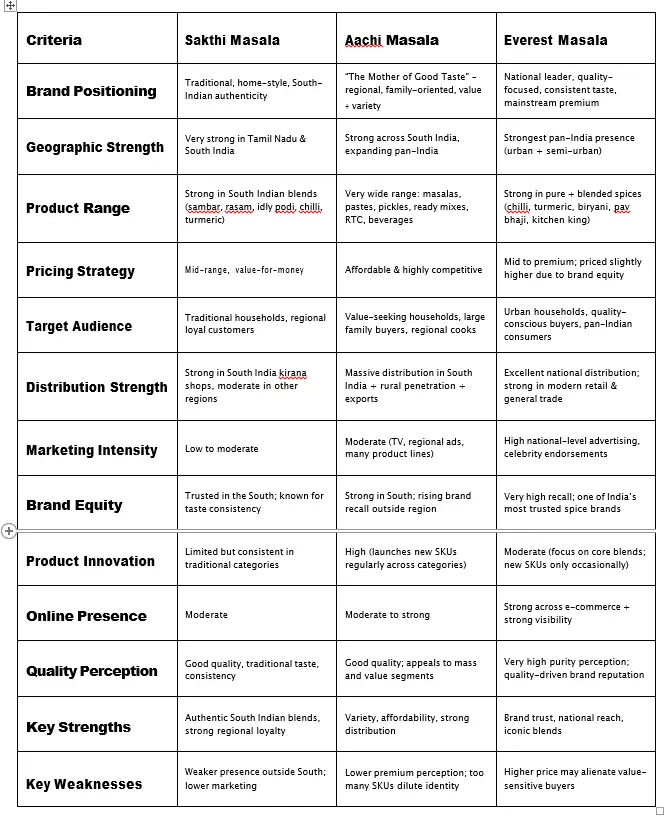
COMPETITOR MATRIX
COMPETITOR BENCHMARKING
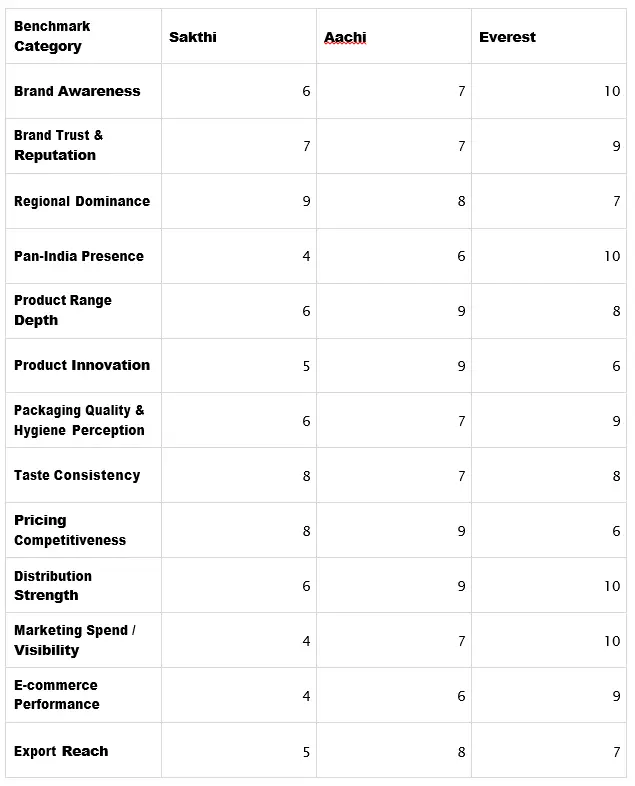
KEY INSIGHTS IN COMPETITOR BENCHMARKING
Brand Strength
- Everest has national brand equity built through decades of advertising.
- Aachi holds strong regional recall and is expanding nationally.
- Sakthi dominates Tamil Nadu but lacks strong presence outside the South.
Product Portfolio & Innovation
- Aachi leads with an extremely diversified portfolio: masalas, mixes, pastes, pickles, ready meals.
- Everest maintains strong leadership in core pure spices and iconic blends.
- Sakthi has a focused range but lags in innovation and new product launches.
Distribution & Market Reach
- Everest is the most widely distributed spice brand in India.
- Aachi has an aggressive distribution network in rural and semi-urban markets.
- Sakthi has strong distribution only within Tamil Nadu, limiting national growth.
Marketing & Communication
- Everest invests highest in TV ads, celebrity endorsements, and pan- India campaigns.
- Aachi runs consistent regional advertising and maintains higher visibility.
- Sakthi’s presence is low, with minimal storytelling or digital marketing.
Pricing & Value Proposition
- Aachi is the price leader, appealing strongly to value-seeking consumers.
- Sakthi offers mid-range pricing, perceived as good value but not cheap.
- Everest is premium-priced, justified by brand reputation and packaging.
SWOT ANALYSIS
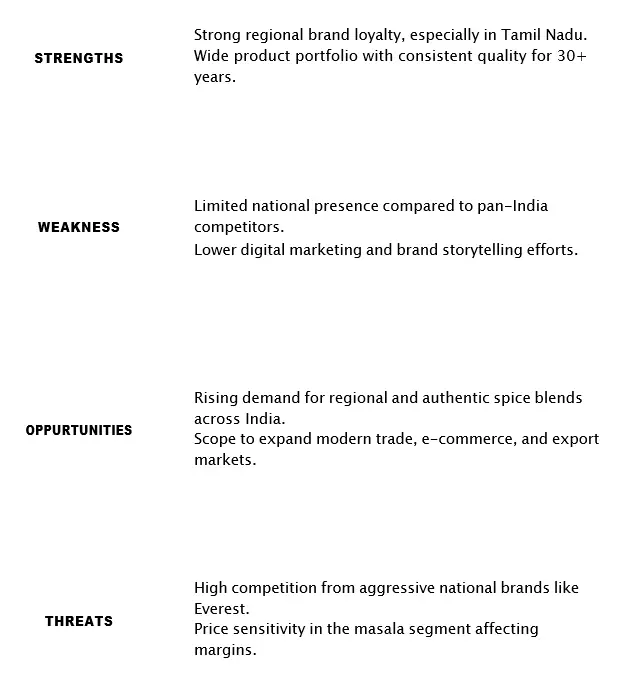
SAKTHI MASALA
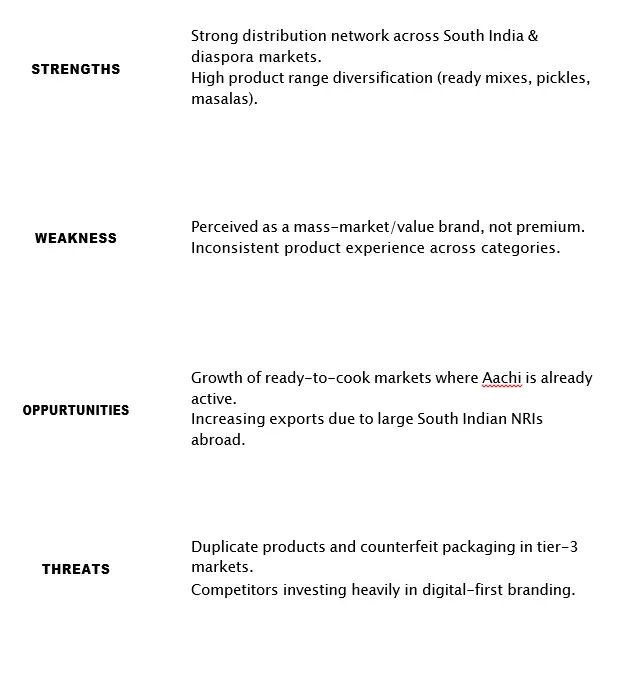
AACHI MASALA
EVEREST
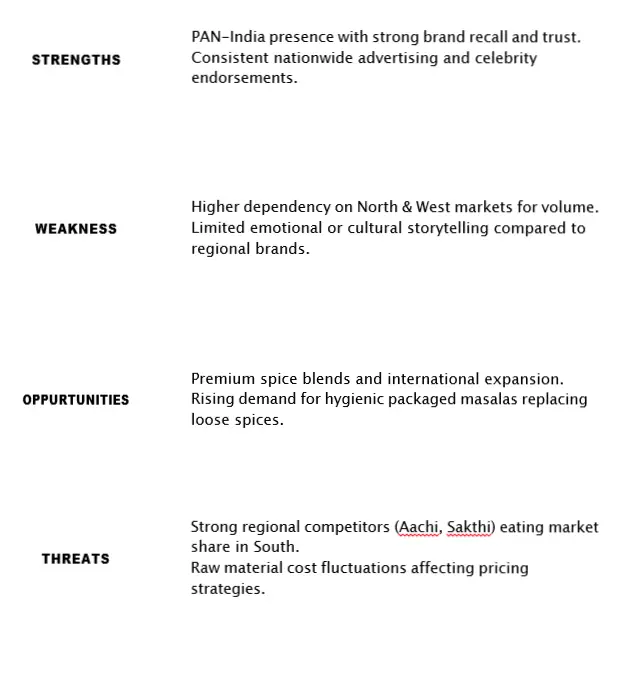
BRAND PERFORMANCE
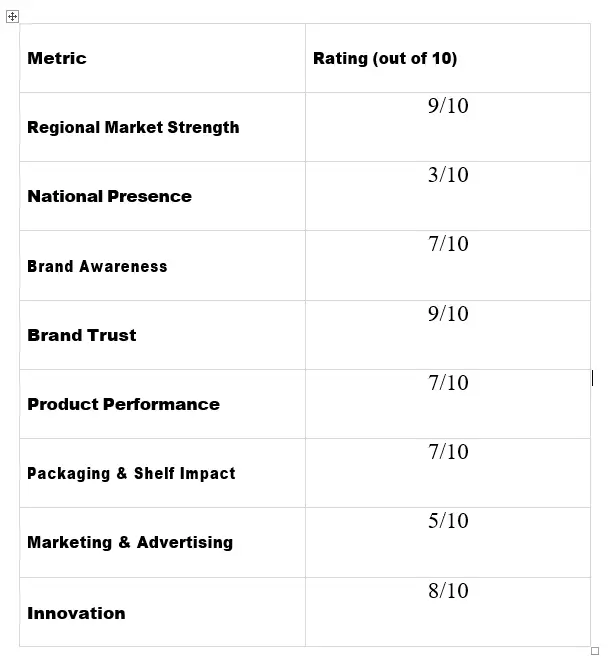
Sakthi Masala has maintained strong regional dominance, especially in Tamil Nadu, by leveraging product quality, traditional preparation methods, and trust built over decades. While it does not have the aggressive national marketing presence of Everest or the expansion- driven approach of Aachi, it continues to perform steadily in its core markets.
Sales Performance & Market Standing
- Consistent sales growth within Tamil Nadu and nearby states due to strong household penetration.
- Performs best in basic masalas (turmeric, chilli, coriander) and traditional South India blends.
- Retains high repeat purchase rates, driven by quality and long-term trust.
Distribution & Retail Presence
- Strong in general trade, moderately present in modern trade, and growing slowly in e-commerce channels.
- Deep distribution in tier-2 and tier-3 towns maintains volume stability.
Brand Equity
- Strong emotional recall with the phrase “Sakthi Masala – The Queen of Spices”, especially among older customers.
- Known for purity, tradition, and consistency, giving the brand a legacy- driven image
Marketing & Communication Performance
- Limited digital presence compared to national competitors.
- Relies mainly on traditional advertising (TV, print), women-centric messaging, and community goodwill.
- Brand awareness is strong regionally but weak outside the South.
Product Portfolio Performance
- High performance in core masalas, less dominance in value-added categories like ready mixes, blended spices, or premium segments.
- Slow innovation compared to Aachi or Everest.
Overall Performance Outlook
- Stable and trusted in its home market.
- Under-leveraged brand potential at the national level.
- With focused modernization (digital, packaging, national distribution), Sakthi Masala can convert legacy strength into wider market expansion.
BRAND PERFORMANCE RATING
EMOTIONAL APPEAL
Sakthi Masala’s emotional appeal is rooted in nostalgia, trust, and family culture — not modern celebrity-driven storytelling.
Cultural Familiarity
- Ads highlight homely cooking, traditional recipes, and the warmth of South Indian kitchens, making the brand feel like part of the household heritage.
- Visual cues—such as mothers cooking, festive foods, home gatherings— evoke comfort and belonging.
Community Goodwill Through CSR
Major long-running initiatives like:
THALIR tree-planting programme
Scholarships, libraries, and women empowerment programmes
These create emotional associations of care, humility, and social responsibility, deepening love for the brand especially in Tamil Nadu.
Trust Through Longevity
- Being a brand that has grown from a cottage industry to a household name in 40+ years creates a “trust through familiarity” effect.
Regional Pride
- Sakthi is often seen as a Tamil Nadu success story, which generates emotional loyalty among consumers who identify with a regional, home- grown brand.
Overall: Sakthi appeals emotionally by reminding consumers of heritage, purity, and community values — making it more familial and less commercial compared to larger national brands.
DIFFERENTIATION
Sakthi’s differentiation stands out in a market dominated by Everest and Aachi:
Purity-Centric, Tradition-Led Positioning
- While competitors push “taste” and “celebrity presence,” Sakthi strongly differentiates through purity, quality, and traditional preparation.
- Its messaging is less flashy, more authentic.
Deep Tamil Nadu Distribution Strength
Sakthi’s dominance in small kirana/grocery stores and rural markets creates reach-based differentiation — especially in its home state.
CSR-Driven Brand Image
- Unlike Everest (recipe-centric) and Aachi (celebrity-heavy mass appeal), Sakthi differentiates with:
- Massive tree plantation drives Educational upliftment
- Rural women support
- This builds an identity tied to trustworthiness, social goodness, and grounded values.
Strong Traditional Product Portfolio
- Specialisation in South Indian masala blends (sambar powder, rasam powder, kulambu masala, idly podi) gives Sakthi an edge where regional authenticity matters.
Understated, Non-Aggressive Communication
- Sakthi does not chase national advertising wars; its low-noise, high-trust strategy makes it appear humble, dependable, and family-oriented — a unique position.
- Overall: Sakthi differentiates not by advertising volume or celebrity power, but by trust, tradition, purity, and community-connectedness, which no competitor fully replicates.
IDENTIFIED GAPS
Minimal Mass-Media Visibility
Very limited TV presence outside South India.
No sustained national campaigns, celebrity ambassadors, or high-impact brand films.
Weak Digital Marketing
Low presence on YouTube, Instagram, and other social platforms compared to Aachi/Everest.
No influencer strategy, recipe content ecosystem, or SEO-optimized masala usage content.
No Mobile App or Cooking Community
Missed opportunity to build recipe communities or home-chef engagement, especially among younger cooks.
Weak Export Branding
Despite potential, Sakthi’s international brand story is not strongly communicated.
No specialised export packaging or global blends.
Executive Summary
Sakthi Masala holds strong cultural equity and recognition across Tamil Nadu, built on a heritage-driven visual identity that prioritizes bold typography, saturated colours, and product-centric packaging. While the brand has deep market recall, the current visual system lacks consistency, modern structure, and scalability across digital and shelf environments.
This audit evaluates Sakthi Masala’s visual identity components—logo, typography, colour palette, packaging, hierarchy, layout, and imagery—and compares them with key competitors (Aachi, Everest, Eastern). Findings indicate that while Sakthi maintains high distinctiveness at shelf level, the brand requires visual system refinement to improve clarity, cohesion, and adaptability to modern platforms.
Audit Objective
The purpose of this visual audit is to:
- Evaluate Sakthi Masala’s current visual identity using structured benchmarks.
- Identify inconsistencies, visual gaps, and system weaknesses.
- Compare the brand with established masala competitors in Tamil Nadu and India.
- Provide clarity on how the existing identity performs across physical and digital touchpoints.
- Deliver actionable recommendations for improving brand clarity, scalability, and shelf impact.
Brand Identity Analysis
Logo Evaluation
Strengths
- The Sakthi wordmark carries powerful cultural familiarity and immediate recognition.
- Bold, block-style typography supports high readability at mid-to-large packaging scales.
- Strong color contrast enhances visibility on shelves.
Weaknesses
- The logo lacks a modernized geometric balance and feels visually heavy compared to contemporary FMCG competitors.
- Inconsistent logo lockups across SKUs reduces cohesion.
- No micro-version or simplified mark exists for small-scale formats such as app icons or favicons.
Opportunities
- Introduce a refined version of the logo with improved stroke balance.
- Create a simplified emblem or monogram for digital and micro usages.
- Define rules for spacing, clear space, and lockup variations to improve consistency.

Colour Palette Evaluation
Strengths
- Dominant use of red, yellow, and orange creates strong shelf impact and immediate association with spice categories.
- High-contrast combinations ensure visibility even in crowded retail settings.
Weaknesses
- Over-saturated palette feels dated and visually noisy.
- Lack of secondary neutrals limits hierarchy and legibility.
- Inconsistent shade tones across SKUs causes visual instability.
Opportunities
- Introduce a structured primary + secondary palette system.
- Add neutral tones for clarity and modernity.
- Create palette rules for categories, hierarchy, and backgrounds.

Typography
Strengths
- Bold headline typography ensures clear product identification at shelf distance.
- Heavy typographic choices support heritage-driven visual cues familiar to regional markets.
Weaknesses
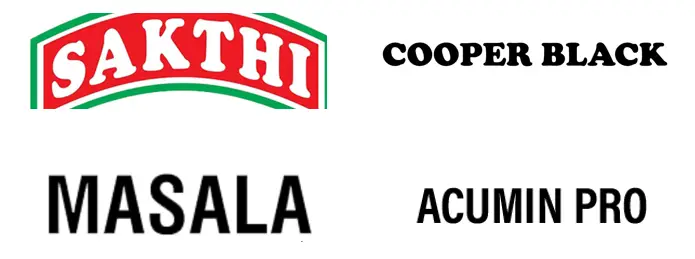
- Use of heavy serif fonts like Cooper Black affects readability in small text blocks.
- Inconsistent usage of secondary typefaces results in uneven visual balance across SKUs.
- Lack of a formal type hierarchy (H1, H2, body, caption) weakens overall system structure.
Opportunities
- Introduce a modern sans-serif family for sub-copy and ingredient listings.
- Define a consistent type scale to improve readability and layout discipline.
- Restrict heavy display fonts to primary product names or key highlights only.
Packaging Layout & Composition
Strengths
- The layout effectively prioritizes product name, reinforcing quick shopper recognition.
- Visual elements such as spice imagery and product illustrations support flavor identification.
- The consistent logo placement improves brand familiarity across the range.
Weaknesses
- Packaging often appears cluttered due to multiple badges, seals, and dense information blocks.
- Lack of a standardized margin or grid system leads to inconsistent visual rhythm across SKUs.
- Multiple visual elements compete for attention, disrupting eye flow and reducing premium perception.
Opportunities
- Establish a unified packaging grid with consistent margins, alignment rules, and spacing.
- Simplify information hierarchy to make claims and product names clearer.
- Harmonize badge and icon design styles for a cleaner, more cohesive look.
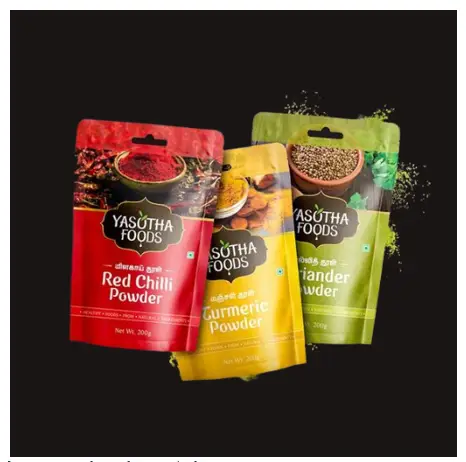
old packaging style
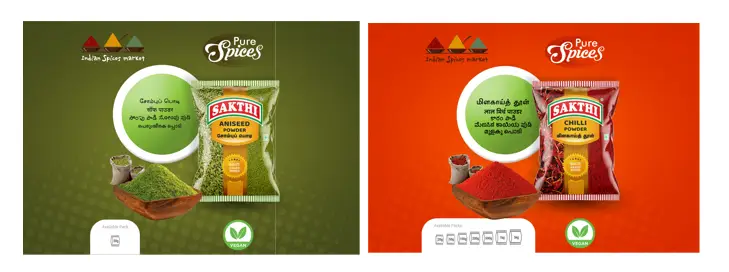
Modern packaging style
Imagery & Iconography Evaluation
Strengths
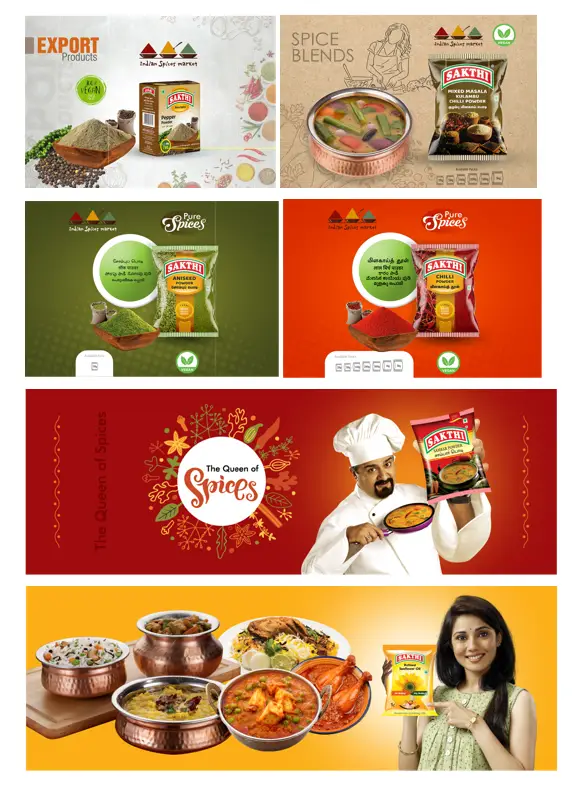
- Spice imagery is category-appropriate and supports product credibility.
- Realistic visuals reinforce traditional, home-style cooking associations.
Weaknesses
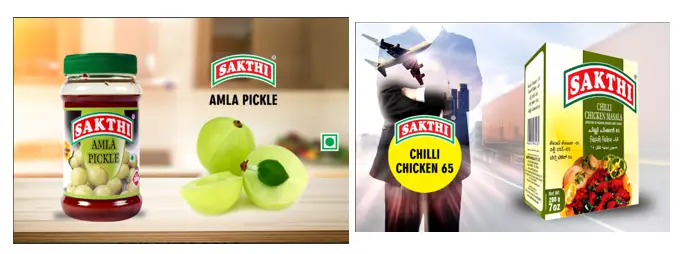
- Imagery style varies across products, causing inconsistency in tone and quality.
- Blend of photographic and illustrative elements reduces overall visual unity.
- Some images appear dated or low-resolution compared to modern FMCG standards.
Opportunities
- Create uniform guidelines for photography style, lighting, and composition.
- Build an iconography system with consistent stroke weight and visual logic.
- Replace inconsistent or low-quality photos with contemporary, high-quality imagery.
Competitor Benchmarking
Compared Brands:
- Aachi Masala
- Everest
- Eastern

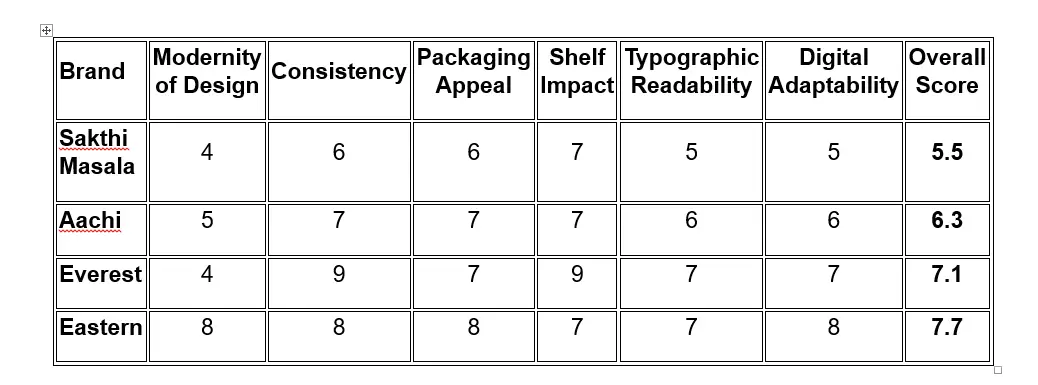
Competitor Benchmarking Table — Sakthi Masala vs Competitors
Scoring Scale:
1 = Very Poor
10 = Best Practice
Visual Benchmarking Table
Interpretation for Presentation
- Eastern leads due to modern packaging, clean typography, and digital-friendly systems.
- Everest ranks high because of consistency and shelf dominance, though its design is traditional.
- Aachi is balanced, moderately modern, and very consistent.
- Sakthi has strong shelf recall, but scores lower due to traditional, cluttered packaging and low digital adaptability.
Insights
Market & Category Insights
- The Indian spice market is shifting toward clean, modern, digitally adaptive packaging (e.g., Eastern’s minimalism).
- Traditional FMCG packaging still performs extremely well on retail shelves (Everest, Aachi), proving that heritage is a competitive asset if modernized correctly.
- Consumers increasingly prefer clarity, simplicity, and clean visuals, especially on ecommerce platforms where thumbnails influence purchase decisions.
Brand Identity Insights
- Sakthi Masala has exceptional brand recall due to its consistent logo placement and bold, traditional packaging.
- The brand’s visual language is strongly rooted in heritage cues, which resonates with older consumers and long-time loyal customers.
- However, the identity struggles to translate effectively into digital-first contexts due to high saturation, dense information layout, and complex visual structure.
Consumer Behaviour Insights
- Younger consumers (25–35) associate modern packaging with purity, cleanliness, and quality.
- Traditional packaging is trusted by older consumers, but not perceived as premium.
- Modern competitors like Eastern attract new-age households, especially in urban markets and ecommerce.
Problem Identification
Key Issues Identified
- Overcrowded packaging layouts reducing clarity.
- Lack of unified typography system.
- No micro-logo for small digital formats.
- Inconsistent application of brand colours.
- Mixed imagery styles creating visual disconnect.
- Outdated elements that reduce premium perception.
- Absence of a standardized grid system.
Conclusion
Sakthi Masala holds a powerful heritage position in the spice market, backed by unmistakable visual identity and strong shelf presence. However, the brand’s current design system is rooted in traditional FMCG styles that limit growth in digital-first environments and modern retail preferences.
Competitors like Eastern have set a new benchmark for modern spice packaging, while Everest maintains dominance through clarity and consistency despite its traditional aesthetic.
To stay culturally relevant, digitally adaptable, and visually competitive, Sakthi should pursue a heritage-respectful modernization of its identity and packaging system.
This evolution will allow the brand to retain its loyal customer base while unlocking appeal among younger consumers and strengthening performance across both physical retail and ecommerce platforms.
