


Why Static Logos Are Dying: The Rise of Adaptive & Motion Brand Systems
Table of Contents
ToggleAdaptive and Motion Brand Systems: 8 Power Secrets to Win Growth
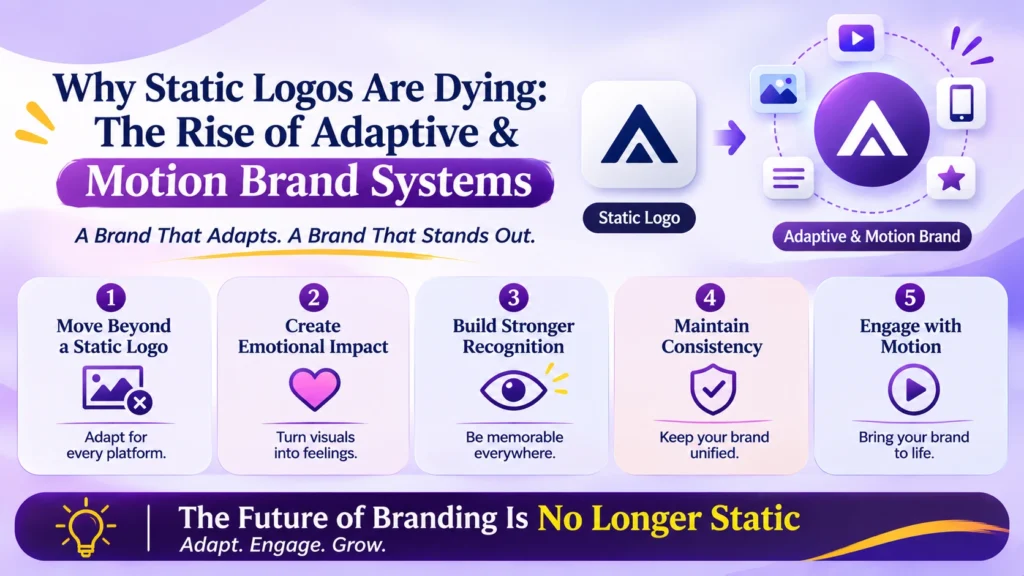
Why Static Logos Are Dying: The Rise of Adaptive & Motion Brand Systems
The Future of Branding Is No Longer Static
For decades, a logo was considered the visual identity of a business. A carefully designed symbol, a memorable font, and a consistent colour palette were enough to establish brand recognition.
But the digital world has changed the rules. Today, brands appear across websites, mobile applications, social media platforms, digital advertisements, smart devices, and even immersive virtual environments. Each platform has different dimensions, formats, and user experiences that demand adaptive and motion brand systems.
A logo that looks perfect on a website header may not work as effectively in an Instagram Reel, a mobile application, or a digital advertisement without adaptive and motion brand systems.
This shift has introduced a new era of branding: adaptive and motion brand systems.
The question is no longer whether a logo looks good. It is whether adaptive and motion brand systems can move, adapt, communicate, and remain recognisable everywhere.
1. Why Traditional Static Logos Are Losing Their Advantage
Traditional logos were designed primarily for print materials, signboards, packaging, and stationary advertisements.
While they remain valuable, today’s digital-first environment demands more flexibility through adaptive and motion brand systems.
Consider a business using the same logo across:
Website headers and mobile screens.
Instagram posts, Stories, and Reels.
Digital advertisements and video commercials.
Application icons and notification screens.
Large LED displays and outdoor digital billboards.
A detailed logo may become difficult to recognise when reduced to a small mobile icon. Similarly, a static logo may struggle to create visual excitement in a fast-moving video advertisement without adaptive and motion brand systems.
The problem is not that static logos have become useless. It is that relying on one unchanging logo is no longer enough without adaptive and motion brand systems.
2. What Exactly Is an Adaptive Brand System?
An adaptive brand system—the structural core of adaptive and motion brand systems—is a flexible visual identity that changes its presentation according to the platform, audience, context, or communication requirement while maintaining a consistent brand personality.
Instead of depending on one fixed logo, businesses develop a collection of connected visual elements within adaptive and motion brand systems.
An adaptive brand system may include:
Responsive Logos: Different logo variations for different screen sizes.
Flexible Typography: Fonts and layouts that remain readable across platforms.
Dynamic Colour Systems: Colour variations that maintain brand recognition.
Flexible Graphic Elements: Patterns, illustrations, and visual assets that can evolve.
Platform-Specific Designs: Visual identities optimised for websites, mobile applications, and social media.
For example, a brand may use its complete logo on a website, a simplified symbol on a mobile application, and a compact animated version in a video advertisement.
Although the presentation changes, the brand remains recognisable through adaptive and motion brand systems.
3. Motion Branding: When a Logo Comes to Life
One of the most exciting developments in modern branding is motion design, which powers adaptive and motion brand systems.
Motion branding introduces movement, transitions, animation, and sound into a brand’s visual identity.
Think about how a logo appears at the beginning of a commercial. Instead of simply displaying the symbol, it might unfold, transform, rotate, or assemble itself through a carefully designed animation inside adaptive and motion brand systems.
Motion branding can include:
Animated logo reveals.
Moving typography.
Brand-specific transition effects.
Animated icons and illustrations.
Video intros and outros.
Sound identities and audio signatures.
These elements create a more engaging experience and help audiences remember how a brand communicates.
However, motion should have a purpose. Random animation may attract attention momentarily, but meaningful movement strengthens brand personality within adaptive and motion brand systems. To explore industry standards on design systems and visual identity evolution, review guidelines from the AIGA Design
4. Why Brands Need to Think Beyond a Single Logo
Modern consumers rarely interact with a brand through just one platform.
A customer might discover a business through Instagram, visit its website, watch a YouTube advertisement, and finally purchase through a mobile application.
Every interaction becomes an opportunity to build brand recognition using adaptive and motion brand systems.
An adaptive identity ensures that the experience feels connected across all these touchpoints.
The real advantage of adaptive and motion brand systems is consistency without unnecessary repetition.
A successful brand does not need to look identical everywhere. It needs to feel like the same brand everywhere.
5. Real-World Brands That Understand Motion and Adaptability
Several globally recognised brands demonstrate how flexible visual identities and adaptive and motion brand systems can strengthen brand experiences:
Google uses its familiar four-colour identity across multiple products. Its logo also adapts through animated Google Doodles, creating fresh visual experiences without losing its recognisable identity.
Netflix
Netflix uses its iconic red identity and the animated N logo reveal to create a recognisable opening experience across its entertainment platforms.
Spotify
Spotify combines its recognisable symbol and colour identity with expressive typography, album artwork, motion graphics, and personalised visual campaigns.
These examples demonstrate that a brand can evolve its presentation while protecting its core identity through adaptive and motion brand systems.
6. How Businesses Can Build an Adaptive Brand System
Businesses do not need enormous budgets to embrace modern branding and adaptive and motion brand systems. What they need is a clear strategy.
Here are five important steps to implement adaptive and motion brand systems:
Step 1: Establish the Core Identity
Define the brand’s logo, colours, typography, personality, and visual principles. These elements form the foundation of every variation in adaptive and motion brand systems.
Step 2: Create Responsive Logo Variations
Develop primary, secondary, horizontal, vertical, and simplified logo versions. Each variation should serve a specific purpose.
Step 3: Introduce Motion Guidelines
Define how the logo moves, how transitions work, and how animation reflects the brand’s personality.
Step 4: Design for Every Digital Touchpoint
Test the identity across websites, mobile applications, social media, video advertisements, and digital displays.
Step 5: Maintain Consistency
Create brand guidelines that explain how every visual element should be used. Flexibility within adaptive and motion brand systems should never become visual confusion.
7. Is Motion Branding Suitable for Every Business?
Absolutely, but the approach to adaptive and motion brand systems should depend on the business.
A technology startup may benefit from futuristic animations and dynamic visual elements. A luxury jewellery brand may prefer subtle transitions and elegant movement. A healthcare brand may require simple, trustworthy, and calming animations.
The objective is not to make every logo move.
The objective of adaptive and motion brand systems is to create a visual identity that communicates effectively in every environment.
Even a well-designed static logo can remain powerful when supported by a flexible brand system.
8. The Future: Branding That Responds, Moves and Evolves
As artificial intelligence, augmented reality, interactive websites, and immersive digital experiences continue to develop, brand identities and adaptive and motion brand systems will become increasingly dynamic.
We can expect more brands to experiment with:
AI-assisted personalised visual experiences.
Interactive logos that respond to user activity.
Motion identities that change according to digital environments.
Responsive visual systems across devices.
Dynamic brand experiences in augmented and virtual reality.
The future of branding will not be defined by how beautifully a logo is designed in isolation. It will be defined by how effectively the entire identity works across different experiences through adaptive and motion brand systems.
The Cholanadu Perspective: Don't Just Design a Logo. Build a Brand System.
A logo is still one of the most valuable assets a business can own. But in today’s competitive digital environment, it cannot carry the entire responsibility of brand recognition without adaptive and motion brand systems.
Businesses need identities that are flexible, memorable, consistent, and ready for the future.
Adaptive branding provides flexibility. Motion branding creates engagement. Together, adaptive and motion brand systems transform a traditional visual identity into a living brand experience.
The brands that stand out tomorrow will not simply be the ones with the best-looking logos. They will be the ones that know how to make their identities work everywhere.
At Cholanadu, we believe branding goes beyond creating a symbol. It is about building a complete visual experience that connects businesses with audiences across every platform. To explore how our strategic frameworks build future-ready identities, read our guide on Cholanadu Brand Strategy Services.
