


What Happens When a Brand Tries to Appeal to Everyone? (Spoiler: Nothing)
Table of Contents
ToggleTarget Audience Positioning: 6 Proven Ways to Stop Generic Failures
What Happens When a Brand Tries to Appeal to Everyone? (Spoiler: Nothing)
When You Speak to Everyone, Nobody Feels Special
Imagine a brand that sells affordable products but wants to look luxurious. It targets teenagers, working professionals, families, and business owners. Its advertisements talk about quality, affordability, style, convenience, and everything in between.
Sounds familiar?
Many businesses make this mistake. They believe reaching more people means attracting more customers without establishing a clear target audience positioning.
But here’s the reality:
A brand that tries to appeal to everyone often struggles to connect with anyone because it lacks a focused target audience positioning.
Successful branding isn’t about pleasing every customer. It’s about executing a strong target audience positioning strategy to become the right choice for the right audience.
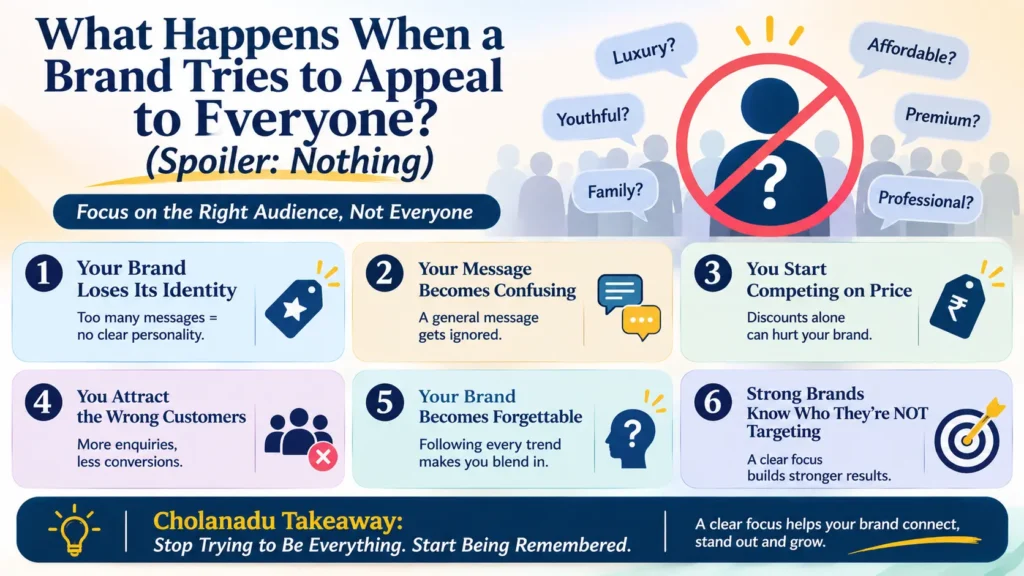
1. Your Brand Loses Its Identity
Imagine a brand changing its communication style every week.
One day, it looks luxurious. The next day, it focuses on budget-friendly pricing. Then it tries to appear youthful, followed by a corporate and professional image that dilutes its target audience positioning.
Customers eventually struggle to understand what the brand actually represents.
A strong brand needs a clear personality and a defined target audience positioning.
How to fix it:
Define your brand values.
Establish a consistent visual identity.
Choose a clear tone of voice.
Communicate one strong brand promise aligned with your target audience positioning.
Your brand should be recognisable even before customers read its name. To explore professional design and brand strategy standards, review resources from the AIGA Design Association
2. Your Marketing Message Becomes Confusing
When businesses try to speak to multiple audiences simultaneously, their messages often become too general, weakening their target audience positioning.
For example:“We offer quality products at affordable prices for everyone.”
There is nothing particularly memorable about that statement.
Compare it with:“Premium everyday skincare designed for people who want simple, effective routines.”
The second message speaks to a more specific audience and communicates a clearer purpose through sharp target audience positioning.
How to fix it: Identify your ideal customer’s needs, challenges, and expectations. Then build your marketing message around what matters most to them to reinforce your target audience positioning.
Clarity attracts attention. Generic communication gets ignored.
3. You Start Competing Only on Price
When customers cannot understand why your brand is different due to weak target audience positioning, price often becomes the easiest way to compare products.
This creates a dangerous situation.
Businesses begin offering discounts, reducing prices, and running constant promotions to attract attention.
Over time, profit margins suffer and the brand may struggle to establish a premium position without a tailored target audience positioning approach.
How to fix it: Build a clear reason for customers to choose you beyond price using your target audience positioning.
It could be product quality, specialised expertise, convenience, craftsmanship, design, or customer experience.
Don’t make your brand cheaper just to become attractive. Make its value easier to understand.
4. You Attract the Wrong Customers
More enquiries do not always mean better business, especially when your target audience positioning is unaligned.
If your marketing attracts people who are not genuinely interested in your product, you may spend more time and money without improving conversions.
For example, a premium furniture brand targeting customers looking only for the lowest price may generate enquiries but struggle to close sales.
The issue is not necessarily the product. It may be the audience the brand is attracting due to flawed target audience positioning.
How to fix it:
Identify your ideal customer.
Understand their purchasing behaviour.
Focus your advertising on relevant audiences.
Communicate your product’s actual value through your target audience positioning.
Create content that addresses their needs.
The objective is not to attract everyone. It is to attract people who genuinely value what you offer.
5. Your Brand Becomes Forgettable
Think about some of the most recognisable brands you know.
They usually have a distinctive identity, a clear audience, and a consistent message driven by effective target audience positioning.
They don’t change their personality to please every customer.
When your brand tries to follow every trend and appeal to every market, it loses the qualities that make it memorable and damages its target audience positioning.
How to fix it: Develop a recognisable brand personality and stay consistent with your target audience positioning.
You can evolve your products and marketing without changing your core identity every time customer preferences shift.
6. Strong Brands Know Who They Are NOT Targeting
This is one of the most important branding lessons in target audience positioning.
A business must understand not only who its ideal customers are, but also who may not be the right fit for its target audience positioning.
For example:
A luxury brand may not target customers looking exclusively for the lowest price.
A specialised skincare brand may focus on a particular skin concern.
A premium restaurant may target customers who value ambience and dining experience.
A professional design agency may focus on businesses looking for strategic brand development.
This doesn’t mean rejecting customers unnecessarily. It means having a clear market position.
The stronger your positioning and your target audience positioning, the easier it becomes for the right customers to recognise your value.
The Cholanadu Perspective: Stop Trying to Be Everything. Start Being Remembered.
A successful brand doesn’t need to attract every person in the market.
It needs to understand its audience, communicate its value, and create a meaningful connection with the people it wants to serve through purposeful target audience positioning.
Trying to please everyone can dilute your identity, confuse your message, and make your business difficult to differentiate without structured target audience positioning.
At Cholanadu, we believe powerful branding begins with clarity. When businesses understand who they are, whom they serve, and what makes them different through target audience positioning, their marketing becomes more focused and meaningful. To see how our strategic services guide business growth, explore our internal guide on Cholanadu Brand Strategy Services.
Remember: You don’t need everyone to choose your brand. You need the right people to remember why they chose you through solid target audience positioning.
The Cholanadu Perspective: Great Products Need Great Brands
In 2026, product quality remains the foundation of a successful business. But quality alone cannot guarantee visibility, customer trust, or long-term growth without a modern brand growth strategy.
Businesses must combine excellent products with purposeful branding, strong digital presence, meaningful differentiation, and memorable customer experiences.
At Cholanadu, we believe that successful businesses are built when product quality and brand strategy work together. To see how our branding frameworks empower businesses, explore our internal guide on Cholanadu Brand Strategy Services.
Don’t simply focus on creating a better product. Focus on creating a brand that customers recognise, trust, and want to choose through a modern brand growth strategy.
Because in today’s competitive market, having a great product gets you into the game. Building a great brand helps you stand out.
