


What If Your Brand Name Is Actually Holding Your Business Back?
Table of Contents
Toggle5 Ways a Bad Brand Name Can Hold Your Business Back
Your brand name is more than just a word on your visiting card, website, or product packaging. It is often the first point of contact between your business and the outside world.
Your business may have an excellent product, a talented team, and a powerful vision. But what if the very brand name customers use to identify your business is quietly limiting its growth?
A strong brand name shapes first impressions, influences recall, and helps customers decide whether your brand feels relevant to them. Yet many businesses continue using names that no longer reflect their identity, market position, or future ambitions.
Some names are difficult to pronounce. Others are too generic to remember. Some were perfect when the business started but became restrictive as it expanded.
The result? A business that has outgrown its brand name.
Let’s explore how your brand name could be holding your business back and how to recognise when it’s time for a change.
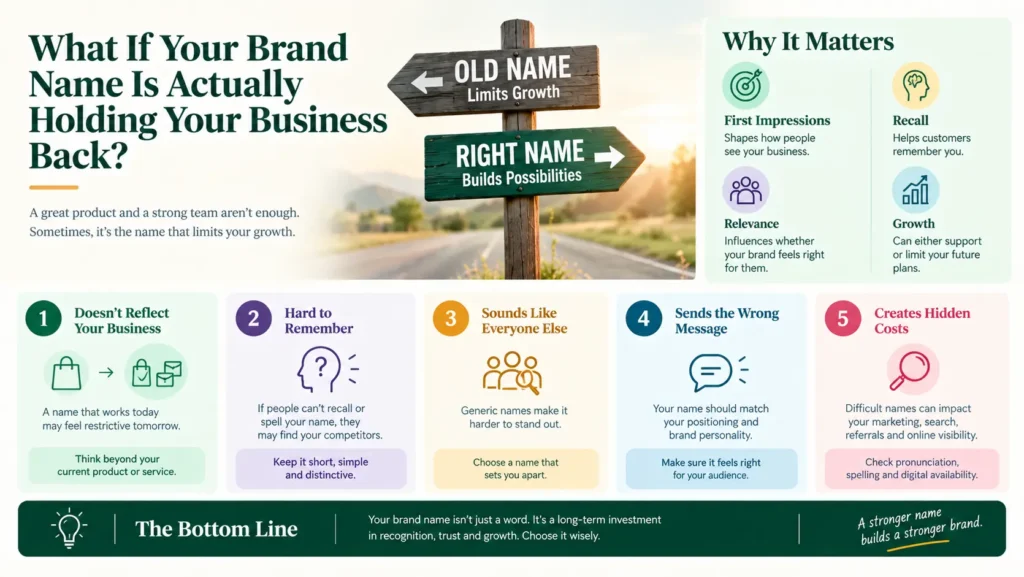
1. When Your Brand Name No Longer Reflects Your Business
Imagine starting a business selling handmade leather wallets and choosing a restrictive brand name like The Wallet House. Initially, the brand name works perfectly. But a few years later, you expand into premium handbags, travel accessories, and lifestyle products.
Suddenly, your original brand name feels restrictive. Customers may still associate your business exclusively with wallets, even though your product portfolio has grown significantly.
This is the problem with a brand name that describes only what a business does today rather than allowing room for what it might become tomorrow. A strong brand name should reflect your identity without unnecessarily limiting your future.
Before choosing a brand name, think beyond your current product or service. Consider your long-term vision, potential market expansion, and the kind of company you want to build. For insights on building scalable positioning, check out external branding research on Brand Strategy Frameworks (rel=\x22nofollow\x22).
2. The Problem With Names Nobody Remembers
How often have you discovered a business, forgotten its brand name, and struggled to find it again? That small moment can represent a missed opportunity.
Customers encounter hundreds of corporate identities across advertisements, social media, search results, and everyday conversations. A brand name that is difficult to recall can make repeat discovery harder.
Consider the difference between a brand name that is short, distinctive, and easy to pronounce and one that is lengthy, complicated, or filled with unnecessary abbreviations. A memorable brand name gives customers something simple to retain and share.
However, shortness alone doesn’t guarantee success. The brand name should also be distinctive, relevant to your positioning, and suitable for the audience you want to reach. The real question isn’t whether your brand name sounds impressive. It’s whether people can remember it when they need you.
3. When Your Name Makes You Look Like Every Other Business
Generic identities create another challenge: differentiation. Names built around familiar words such as Global Solutions, Premium Enterprises, or Quality Services may communicate a broad category, but they often struggle to establish a unique brand name identity on their own.
When customers see several businesses using similar language, distinguishing one from another becomes more difficult. A distinctive brand name can help your business occupy a clearer position in the customer’s mind.
Think about the brands you recognise instantly. Their brand name has become connected with particular products, experiences, values, or emotions through consistent marketing and customer interactions. The brand name is only the beginning, but it provides the foundation for that recognition.
Before settling on a brand name, ask:
Does it sound different from competitors?
Can customers identify it without confusion?
Does it create the right impression?
Can it become recognisable through consistent marketing?
If your brand name blends into the market, your branding may have to work harder to establish a unique identity.
4. Your Brand Name May Be Sending the Wrong Message
First impressions matter, and a chosen brand name can heavily influence customer expectations. A brand name that sounds playful may suit a youth-focused lifestyle brand but feel inappropriate for a premium financial consultancy.
A brand name that sounds highly technical may communicate expertise to one audience while feeling inaccessible to another. Neither approach is inherently wrong. The problem occurs when the brand name creates expectations that conflict with the experience your business wants to deliver.
For example, a company positioning itself as a sophisticated luxury brand may struggle if its brand name feels overly casual, generic, or disconnected from its visual identity. Your brand name, logo, tone of voice, and customer experience should work together. Your business should sound, look, and feel like the same entity at every touchpoint.
5. The Hidden Cost of a Difficult Brand Name
A confusing brand name doesn’t automatically damage sales, but it can introduce friction into your marketing. Consider what happens when customers struggle to spell your brand name, search for it online, or distinguish it from another company.
They may find the wrong business, mistype the website address, or fail to recommend you accurately to others. A brand name that is difficult to communicate can also create challenges across advertising, word-of-mouth referrals, and digital discovery.
That is why practical considerations matter as much as creativity. Before finalising a brand name, evaluate:
Pronunciation: Can your target audience say it comfortably?
Spelling: Can people type it correctly after hearing it?
Digital availability: Are suitable domain names and social handles available?
Distinctiveness: Is it easily confused with an existing brand name?
Legal availability: Can it be used and protected in your intended markets?
Domain availability does not establish trademark rights, and a brand name that sounds unique is not necessarily legally available. Proper trademark checks are essential before committing to a rebrand.
The Three Questions Every Business Owner Should Ask
Before deciding whether your brand name needs to change, take a step back and assess it honestly.
Question 1: Does it represent who we are today?
Your business may have evolved considerably since its launch. Does your brand name reflect your current expertise, values, and positioning?
Question 2: Can it grow with us?
Will the brand name still make sense if you introduce new products, enter different markets, or serve a new audience?
Question 3: Does it help customers recognise us?
Is the brand name distinctive, memorable, and easy enough to communicate, or does it require constant explanation?
If your brand name performs poorly across several of these areas, it may be worth reviewing its strategic fit. One weakness alone doesn’t necessarily justify changing an established brand name. Strong customer recognition, trust, and brand equity can be more valuable than a theoretically perfect new moniker.
Should You Rename Your Business or Reposition It?
This is where many businesses make an expensive mistake. They assume that a new brand name will automatically solve problems related to visibility, customer perception, or sales. But sometimes, the real issue is not the brand name at all.
Your business may need clearer messaging, a stronger visual identity, more consistent marketing, or a better-defined target audience. To align your overall visual communication and strategy, explore our internal resources on Cholanadu Brand Strategy Services.
Consider these two situations:
Situation A: Customers recognise your brand name, trust your business, and understand your offering, but your website communicates your value poorly. A messaging and positioning refresh may be sufficient.
Situation B: Your brand name creates persistent confusion, restricts your intended expansion, or creates legal conflicts. A rename may deserve serious consideration.
The distinction is important because rebranding involves much more than replacing a logo. It can require new packaging, signage, website updates, marketing assets, and customer communication. A successful change should solve a specific strategic problem.
How to Build a Brand Name That Supports Growth
If you decide to explore a new brand name, begin with strategy rather than a list of attractive words.
Step 1: Define your brand identity. Clarify what your business stands for, whom it serves, and what makes it different.
Step 2: Understand your audience. Consider the language, expectations, and associations that matter to your target customers.
Step 3: Explore naming directions. You might choose a descriptive name, an evocative name, a coined word, or a name connected to your founder or heritage.
Step 4: Test for clarity and recall. Ask people from your intended audience to pronounce the brand name, remember it after a short interval, and explain what it makes them expect.
Step 5: Check legal and digital availability. Investigate relevant trademarks, domain names, and social media handles before making a final decision.
Step 6: Connect the name to a complete brand identity. Typography, colours, messaging, packaging, and customer experience should reinforce the meaning you want the brand name to communicate.
A Quick Brand Name Health Check
The Cholanadu Perspective: Your Name Is a Business Asset
At Cholanadu, we believe branding is not merely about choosing attractive words or creating an elegant logo. It is about building a distinctive identity that supports business strategy.
A well-considered brand name can strengthen recognition, communicate positioning, and provide room for future growth. But a brand name alone cannot build a successful business. It needs to be supported by a clear value proposition, consistent visual communication, meaningful customer experiences, and a product or service that delivers on its promise.
When these elements work together, your brand name becomes easier to recognise, understand, and trust. The right brand name doesn’t guarantee growth. It gives your business a stronger foundation on which to build it.
Cholanadu Takeaway
What if your brand name isn’t simply a label but a strategic decision influencing how customers discover, understand, and remember your business?
Before investing more money in advertising, redesigning your website, or expanding into new markets, take a moment to examine the identity at the centre of everything. Does your brand name communicate your value? Does it distinguish you from competitors? Does it leave room for the business you want to become?
If the answer is no, don’t rush into changing it. Understand the problem first, evaluate the alternatives, and make a decision grounded in strategy. Because the best brand name isn’t just one that sounds good today. It’s one that continues to serve your business tomorrow.
