


Jaguar 2024 “Copy Nothing” Rebrand: Risks Luxury Brands Face During Identity Shifts
Table of Contents
Toggle4 Luxury Rebrand Secrets: Power Lessons From Jaguar 2024
Can a luxury rebrand campaign help an iconic marque reinvent itself without losing what made it legendary?
In 2024, Jaguar answered that question with one of the boldest luxury rebrand moves in automotive history.
Its new direction, built around the philosophy “Copy Nothing,” moved dramatically away from Jaguar’s familiar visual language. No traditional leaping jaguar. No conventional automotive advertising. A radically different visual identity. A stronger focus on creativity, culture and modern luxury.
It was more than a logo change. It was a complete luxury rebrand repositioning. And that is exactly where the opportunity and the risk begins.
The Big Idea: "Copy Nothing" in a Luxury Rebrand
Jaguar wanted to move away from being perceived simply as another luxury car manufacturer. The new luxury rebrand direction aimed to create something more distinctive, artistic and culturally relevant.
The message was clear: Don’t follow the category. Define your own category.
The campaign generated enormous attention because it challenged expectations.
But attention is not the same as acceptance.
And this is where every established luxury rebrand needs to be careful.
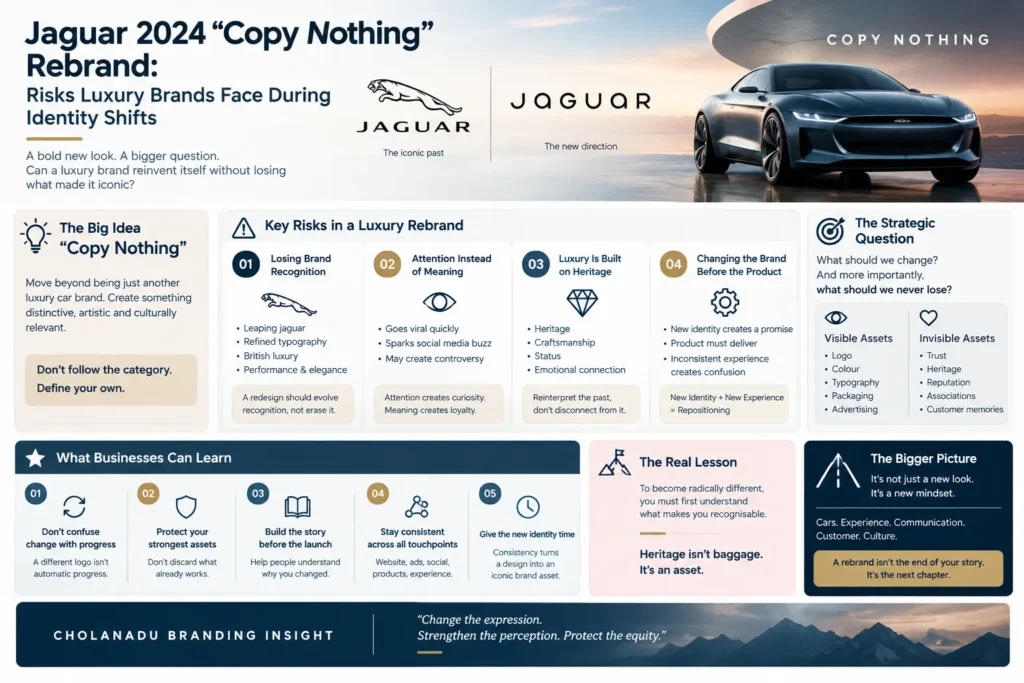
Risk 1: Losing Brand Recognition in a Luxury Rebrand
For decades, Jaguar’s identity was closely associated with certain visual and emotional assets.
The leaping jaguar. The refined typography. British luxury. Performance. Elegance.
When an established marque executes a luxury rebrand that changes too much, consumers may ask:
“Is this still the brand I know?”
Brand recognition is an asset built over years and sometimes generations. A luxury rebrand should evolve that asset, not accidentally erase it.
Risk 2: Creating Attention Instead of Meaning
A bold luxury rebrand can become viral very quickly. People discuss it. Social media reacts. Marketing publications cover it. But the real question is: Will customers remember the brand or only remember the controversy?
A successful luxury rebrand needs to move beyond “Look at our new design” toward: “Here is why our brand has changed, and here is what we now stand for.”
Attention creates curiosity. Meaning creates loyalty.
Risk 3: Luxury Is Built on Heritage
Brands operating in the luxury tier function differently from everyday consumer goods. Their history is part of the product. A luxury customer isn’t only buying functionality.
They are buying:
Heritage
Craftsmanship
Status
Story
Exclusivity
Emotional association
This creates a delicate luxury rebrand challenge. How do you become modern without becoming disconnected from your heritage?
The strongest luxury rebrand strategies usually don’t destroy the past. They reinterpret it.
Risk 4: Changing the Brand Before the Product
There is another important lesson. A luxury rebrand creates a promise. The product must deliver that promise. If the visual identity says future-facing luxury, but the customer experience still feels traditional, inconsistent or ordinary, the rebrand becomes cosmetic.
The equation is simple: New Identity + New Experience = Repositioning
But:
New Identity + Old Experience = Confusion
A luxury rebrand cannot redesign perception faster than it redesigns reality.
The Strategic Question Every Luxury Rebrand Should Ask
Before executing a luxury rebrand, ask: What should we change? And more importantly: What should we never lose? That distinction is critical.
A brand has two sides:
Visible Assets Logo • Colour • Typography • Packaging • Advertising
Invisible Assets Trust • Heritage • Reputation • Associations • Customer memories
Changing the visible layer is relatively easy. Changing the invisible layer during a luxury rebrand is much harder.
Explore positioning frameworks on Cholanadu Brand Architecture and strategic growth guides on Cholanadu Strategy. Learn more about brand equity analysis on Harvard Business Review and industry commentary on Adweek.
Jaguar’s Bigger Luxury Rebrand Challenge
Jaguar’s 2024 transformation wasn’t simply about making the brand look different. It was about making people think differently about Jaguar through a luxury rebrand. That is a much bigger challenge.
The company was attempting to move toward a more modern, design-led and electric future while remaining relevant to luxury consumers.
That means the luxury rebrand ultimately has to be judged not by the launch campaign alone but by everything that follows.
The cars. The experience. The communication. The customer. The culture. That’s where a luxury rebrand proves itself.
5 Lessons Businesses Can Learn From a Luxury Rebrand
01 Don’t confuse change with progress
A different logo does not automatically create a stronger brand. Change should have a strategic reason.
02 Protect your strongest brand assets
If customers already associate your brand with something powerful, don’t discard it without understanding its value during a luxury rebrand.
03 Build the story before launching the identity
People need to understand why the brand changed.
04 Make every touchpoint consistent
Website, packaging, advertising, social media, products and customer experience must communicate the same positioning.
05 Give the new identity time
A new identity rarely becomes iconic overnight. Consistency turns a design into brand assets.
The Real Lesson of a Luxury Rebrand
Jaguar’s “Copy Nothing” philosophy represents the ambition required to escape category conventions. But there is an important luxury rebrand paradox:
To become radically different, you must first understand what makes you recognisable. The challenge isn’t simply to create something new.
It is to create something new without destroying the emotional equity you already own.
Because in luxury branding, heritage isn’t baggage.
It is an asset.
And the smartest luxury rebrand strategies don’t run away from the past.
They use the past to build the future.
Cholanadu Branding Insight
A luxury rebrand should not make people forget who you were. It should make them understand why you had to evolve.
Change the expression. Strengthen the perception. Protect the equity.
That’s the difference between a redesign and a strategic luxury rebrand.
