


The $44 Billion Rebranding Disaster: What Went Wrong When Twitter Became X?

August 31, 2026

A comprehensive brand audit reveals critical strategic lessons when evaluating one of the most talked-about identity shifts in digital history.

The $44 Billion Rebranding Disaster: What Went Wrong When Twitter Became X?

A Brand Audit Analysis of One of the Most Controversial Rebrands in Modern Business What happens when a company spends billions acquiring one of the world’s most recognizable brands only to dismantle the brand equity that made it valuable?

In July 2023, Twitter began transforming into X. The familiar blue bird disappeared. The word “Tweet” gradually lost its central role. The recognizable visual language was replaced with a stark black-and-white identity. Even the vocabulary surrounding the platform started changing.

For some, it represented bold reinvention. For others, it was one of the most dramatic examples of brand destruction disguised as brand transformation.

And that distinction matters. Because rebranding is not simply about changing a logo.

It is about managing recognition, relevance, reputation, emotional associations, customer expectations and accumulated brand equity. The Twitter-to-X transformation offers a fascinating case study in what can happen when a business confuses starting over with moving forward.

Twitter was acquired by Elon Musk in October 2022 for approximately $44 billion. That figure is frequently connected to the “Twitter became X” rebranding story but there is an important distinction.

The $44 billion was the acquisition price for Twitter, not the amount spent on the rebrand. That distinction is essential for a serious brand audit.

brand audit

The strategic question is therefore not: “Did X spend $44 billion on a logo change?”

It is: “What happened to the brand equity contained within the business Musk acquired and how effectively was that equity transferred into X?” That is where the real branding lesson begins.
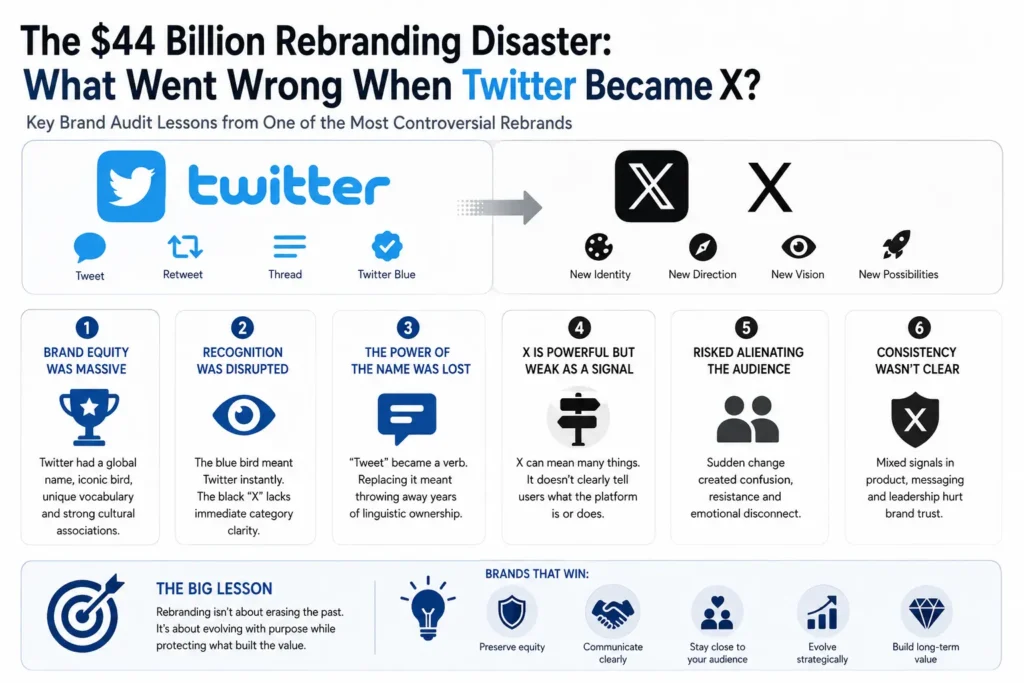
01 Twitter Was More Than a Logo

Before the rebrand, Twitter possessed something most companies spend decades trying to build:

A globally recognized brand language. Twitter wasn’t merely a social network.

It had developed an entire ecosystem of recognizable brand assets:

Twitter → Tweet → Retweet → Twitter thread → Twitter Blue → Twitter bird → Tweeting

The brand had effectively become a verb. People didn’t simply “post something on Twitter.” They tweeted.

That is extraordinary brand penetration.

Consider what had accumulated over more than a decade:

  • A globally recognized name

  • The blue bird symbol

  • A highly recognizable interface

  • A distinctive vocabulary

  • Cultural associations with breaking news

  • Political discourse

  • Journalism

  • Entertainment

  • Memes

  • Public personalities

  • Real-time conversations

  • A massive archive of social interactions

This wasn’t just visual identity. It was brand equity that any professional brand audit would score near perfection.

02 The First Strategic Problem: Destroying Recognition

A successful rebrand should answer a fundamental question: What existing brand equity should we preserve?

Instead, the Twitter-to-X transition appeared to ask:

What can we replace? The difference is enormous.

Imagine a customer seeing a familiar blue bird.

They immediately know: Twitter. No explanation required. Now imagine seeing a black “X.”

What does it mean? It could represent:

  • A social network

  • A technology company

  • A messaging platform

  • A financial product

  • An operating system

  • A media company

  • A placeholder

  • A mathematical variable

The symbol itself carries enormous cultural familiarity in many contexts, but less category-specific meaning.

That creates a fundamental branding challenge:

Recognition is not the same as meaning.

Twitter had both. X initially had far less.

03 The Power of the Word Twitter

One of the most underestimated assets lost in the transition was the name itself. “Twitter” had personality.

It suggested:

  • Short bursts of conversation

  • Birds

  • Chatter

  • Activity

  • Social interaction

  • Real-time communication

The name had acquired meaning through years of cultural use. And then there was the verb:

Tweet.

“Tweet” was extraordinarily powerful because users understood exactly what it meant.

Brands dream of achieving this level of linguistic ownership.

When a brand name becomes a verb, the company has crossed an important threshold: The brand has entered everyday language.

Replacing such a name is not merely a naming exercise.

It is an attempt to rewrite consumer vocabulary. That is incredibly difficult.

04 The Second Problem: X Is a Powerful Symbol but a Weak Category Signal

There is nothing inherently wrong with the letter X. In fact, from a branding perspective, X can communicate several attractive qualities:

Future. Technology. Exploration. Transformation. Mystery. Crossing boundaries.

The problem is not necessarily the letter. The problem is context. A brand name must help consumers answer:

“What is this?” Twitter did that naturally. X does not.

The new identity therefore required significant investment in rebuilding meaning around the name.

This is the classic branding principle highlighted in every brand audit:

A distinctive name can be powerful—but only if the market attaches meaning to it.

05 Rebranding vs. Brand Replacement

This is where the Twitter-to-X case becomes particularly interesting. A conventional rebrand typically follows a progression:

Existing Equity → Evolution → New Expression The Twitter transition looked much closer to:

Existing Equity → Disruption → New Identity

That distinction matters. A rebrand should ideally preserve what is valuable while changing what has become limiting.

A brand replacement, however, risks discarding valuable associations along with outdated ones.

Think of it like renovating a luxury hotel.

You don’t demolish the lobby, remove the signage, erase the address and then expect guests to automatically understand that the new building is the same destination.

You preserve the valuable architecture while modernizing the experience. You can review industry standards on Brand Finance Valuation Studies to see how corporate equity shifts affect market valuation.

06 The Logo Problem: When Simplicity Becomes Generic

The X logo generated enormous attention because it was radically different from the iconic bird. The previous Twitter bird was: Simple + Friendly + Distinctive + Memorable

The new X identity was:

Simple + Bold + Minimal + Potentially Ambiguous Minimalism is not automatically good branding.

A logo becomes valuable when it is:

Distinctive enough to be remembered. This is an important lesson for businesses during a brand audit.

A minimalist logo is not necessarily a strong logo. A beautiful logo that could belong to 500 other companies is not necessarily effective.

The Twitter bird had accumulated recognition through repetition. The X symbol had to start rebuilding that recognition from scratch.

07 The Third Problem: Brand Architecture Became Unclear

Another important issue was the broader ambition surrounding X. The vision extended beyond being a social media platform toward becoming a broader “everything app.”

That strategic ambition could potentially be powerful. But brand architecture becomes challenging when the consumer cannot easily understand the relationship between:

X X.com X Premium Grok Payments Creator tools Messaging Advertising News AI Social networking

A brand can stretch. But it cannot stretch infinitely without risking dilution.

The bigger the ambition, the more important the underlying brand architecture becomes.

08 The Vocabulary Shift Was More Significant Than It Looked

One of the most revealing parts of the transformation was the attempt to change familiar terminology. Twitter had a deeply established language.

People understood:

Tweet Retweet Twitter thread Twitter followers These weren’t merely product labels. They were part of the culture. Changing language requires changing habits. And habits are among the strongest forces in consumer behavior.

This creates a fascinating branding question:

Should a company change terminology simply because the brand has changed? Not necessarily.

Sometimes the strongest strategy is to keep familiar language even after a visual rebrand. Because consumers don’t experience brands according to the company’s brand guidelines.

They experience brands according to habit.

09 The Brand Equity Equation

A useful way to understand the situation in any brand audit is: Brand Value = Recognition + Meaning + Trust + Habit + Distinctiveness

Twitter possessed significant amounts of all five. The rebrand immediately challenged at least three:

Recognition ↓ The familiar bird and name disappeared.

Meaning ↓ X required new associations to be built.

Habit ↓ Users had to adjust to new terminology and identity.

Meanwhile: Distinctiveness became debatable.

And trust became increasingly connected to the company’s broader strategic and operational changes not simply the visual identity.

This demonstrates a critical branding principle:

You cannot instantly transfer 15+ years of brand equity into a new name. You have to rebuild it.

10 But Was Everything About the Rebrand Wrong?


No. A serious brand audit should avoid simplistic conclusions.

There were strategic reasons for pursuing X. The broader ambition was to build something significantly larger than the original Twitter proposition.

From that perspective, keeping the Twitter identity could potentially constrain the company’s future positioning.

If the long-term objective is to transform the platform into a broader ecosystem involving communication, payments, commerce, AI and other services, then a new umbrella brand could make strategic sense.

So the question isn’t: “Was X a bad idea?”

The better question is: “Was the transition from Twitter to X strategically and operationally managed well enough to preserve the value of the old brand while building the new one?”
That is a much harder question.

11 The Biggest Lesson: Rebranding Is Not a Reset Button

This is perhaps the most important takeaway for business owners. Many companies think:

New logo = New brand.

It doesn’t. A brand lives inside people’s minds.

Your logo is only one entry point.

Your brand also consists of:

  • What customers remember

  • What customers expect

  • How customers describe you

  • What customers associate with you

  • How customers feel about you

  • What they trust you to deliver

  • What they tell others about you

You can redesign your logo overnight. You cannot redesign customer memory overnight.

12 The Cost of Lost Brand Equity

Here’s an uncomfortable question for every entrepreneur performing a brand audit: How much did your existing brand cost you to build?

Imagine spending: 10 years building recognition. Millions on advertising. Thousands of customer interactions. Countless social media mentions. Hundreds of media articles. A recognizable visual identity. A loyal customer base. Now imagine replacing the name.

You haven’t simply changed your logo.

You have potentially reduced the efficiency of everything that previously relied on recognition.

This is why established brands should treat brand equity as an asset, not decoration. Learn how we evaluate these assets through our strategic services at Cholanadu

13 What Could Have Been Done Differently?

A more conservative transformation strategy could have followed a staged approach based on a preliminary brand audit.

Phase 1 Introduce X

Twitter becomes “Twitter by X” or “X, formerly Twitter.”

Allow consumers to gradually associate the new identity with the existing product.

Phase 2 Build the New Meaning

Introduce a strong brand narrative explaining:

Why X? What does X stand for? What future does X represent?

Phase 3 Preserve Valuable Vocabulary

Keep familiar terms where they improve usability.

Consumers don’t need to forget “tweet” simply because the corporate identity changed.

Phase 4 Expand the Brand Architecture

Introduce new services under X gradually.

Build clear relationships between:

X → Communication → Payments → AI → Commerce

Phase 5 Retire Legacy Assets Strategically

Only remove highly recognizable assets when the new identity has sufficient recognition to replace them. This is how brand transitions become evolution rather than erasure.

14 The Cholanadu Brand Audit Scorecard

Let’s evaluate the transformation from a pure brand audit perspective.

Brand Recognition

Twitter: ★★★★★ X: ★★☆☆☆

Twitter possessed exceptional recognition. X had to rebuild it.

Distinctiveness

Twitter: ★★★★★ X: ★★★☆☆

The X symbol is visually striking, but the letter itself is widely used across industries.

Brand Vocabulary

Twitter: ★★★★★ X: ★★☆☆☆

Twitter had deeply embedded terminology. X required new linguistic habits.

Future Expansion Potential

Twitter: ★★★☆☆ X: ★★★★★

Here, X potentially has the advantage because the name is broad and not inherently tied to short-form social posting.

Existing Brand Equity

Twitter: ★★★★★ X: ★★☆☆☆

Twitter had accumulated years of equity. X had to rebuild associations.

Strategic Flexibility

Twitter: ★★★☆☆ X: ★★★★★

As a broad concept, X can theoretically encompass a much wider ecosystem.

15 The Paradox of X

And this is where the case becomes fascinating. X may be strategically bigger than Twitter.

But Twitter was arguably a stronger brand than X at the moment of transition.

That creates a paradox:

The company may have increased the potential scope of the brand while simultaneously reducing the immediate strength of the brand.

This is one of the most important distinctions in modern branding and every brand audit.

Brand potential ≠ Brand equity.

A name can have enormous future potential while possessing relatively little current consumer equity.

16 The Real Rebranding Disaster

So, was Twitter becoming X a $44 billion rebranding disaster? The answer requires nuance.

The $44 billion figure represents the acquisition—not a rebranding budget.

And it is still too early to reduce the entire strategic experiment to a simple logo-success or logo-failure judgment.

But from a brand audit equity perspective, the transformation demonstrates a significant risk:

The company replaced one of the world’s most recognizable digital brands with a name whose meaning had to be rebuilt.

That’s an enormous strategic bet.

The most important lesson isn’t that companies should never rebrand.

It’s this:

Never destroy valuable brand equity simply because you are excited about creating something new.

A powerful rebrand should make a company feel new to the market without making it feel unfamiliar to its customers.

The Final Brand Audit

Twitter had something incredibly difficult to manufacture: Memory. People remembered the name.

They remembered the bird.

They remembered the sound of a “tweet.”

They remembered what Twitter meant.

X inherited the technology, users and platform but had to work to rebuild the emotional and cultural meaning surrounding the name.

And that is why the Twitter-to-X transformation will remain one of the most fascinating branding case studies of the digital era.

Because it demonstrates a timeless truth:

A logo can be changed overnight.

A name can be changed overnight.

A website can be changed overnight.

But a brand lives in people’s minds and minds don’t rebrand on command.

At Cholanadu, we believe great branding isn’t about making a business look different.

It’s about making the business mean something more.

Because the best rebrand doesn’t erase your past.

It transforms your existing equity into your next chapter.

Your brand is not what you change. Your brand is what people continue to remember after you change.

Leave A Comment