


How to Create a Brand Identity for an E-Commerce Store ?
Table of Contents
Toggle17 Proven Ways to Build a Powerful Brand Identity for E-Commerce
Building a strong brand identity is the fastest way to turn casual online shoppers into loyal, lifetime customers.
Your products may drive sales, but your brand identity makes customers remember, trust, and choose you. In a crowded digital marketplace, customers form impressions within seconds based on your logo, colours, typography, photography, website, packaging, and tone of voice.
A strong e-commerce brand identity creates consistency, builds credibility, communicates positioning, and makes your business memorable.
Brand identity is the visual and verbal system through which your business presents itself.
It may include:
Brand name and logo
Colours and typography
Photography and graphic design
Packaging and website design
Social media visuals
Brand voice and messaging
Advertising and customer communication
Your product is what you sell. Your brand identity is how customers experience it.
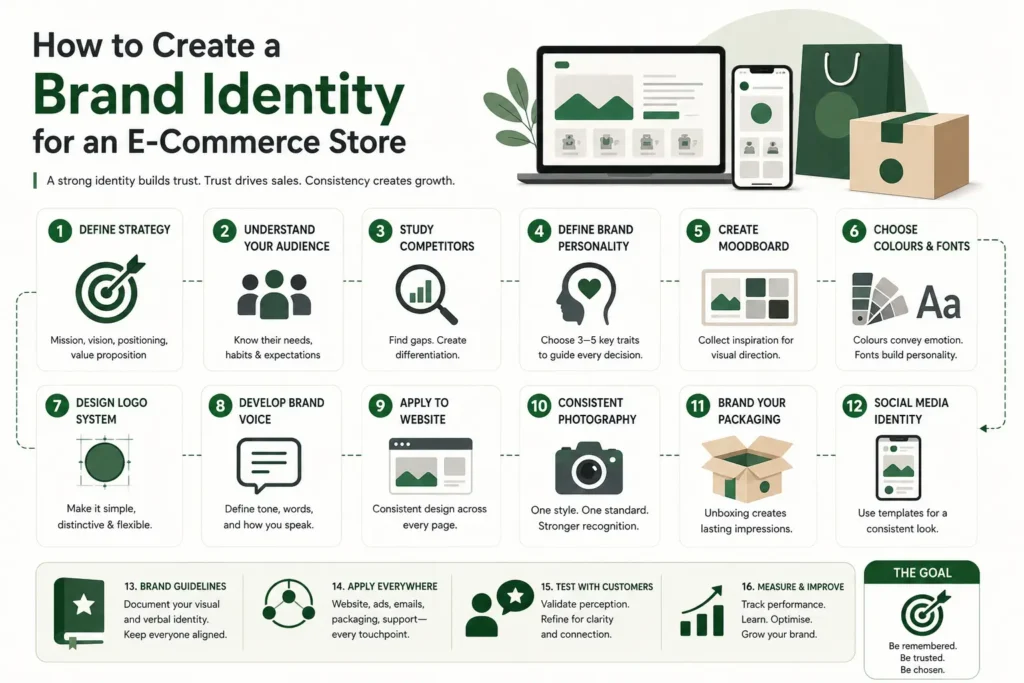
Step 1: Define Your Brand Strategy
Don’t start with the logo. First clarify:
Who are we?
Who are we selling to?
What problem do we solve?
Why should customers choose us?
What makes us different?
How should customers perceive us?
Define your:
Mission: Why the brand exists
Vision: Where it is going
Target audience: Your ideal customer
Positioning: The space you want to occupy
Value proposition: Why customers should choose you
Personality: For example, modern, trustworthy, bold, or playful
Complete this sentence:
“We help __________ achieve __________ through __________, unlike __________.”
This statement can guide your entire brand identity.
Step 2: Understand Your Audience
Design for your ideal customers, not just your personal preferences.
Research their:
Age, lifestyle, income, and interests
Buying behaviour and digital habits
Pain points and expectations
Preferred platforms
Competitors and purchase motivations
Ask:
“What should customers feel when they interact with our brand?”
Possible emotions include trust, confidence, luxury, excitement, simplicity, or authenticity.
Step 3: Study Competitors
Review competitors’:
Logos, colours, and fonts
Websites and packaging
Photography and social media
Taglines, promotions, and tone
Identify where brands look similar and where you can differentiate.
Similarity creates category recognition. Differentiation creates memorability for your brand identity.
Step 4: Define Your Brand Personality
If your brand were a person, how would it behave?
Choose 3–5 traits, such as:
Elegant + Trustworthy + Modern + Authentic
Use these traits to evaluate every creative decision across your brand identity.
Step 5: Create a Moodboard
Collect references for:
Colours and typography
Packaging and packaging layout
Website layouts
Textures, shapes, and illustrations
A moodboard turns abstract ideas like “premium” or “modern” into a clear visual direction for your brand identity. You can explore industry guidelines on Shopify E-Commerce Branding Concepts to gather inspiration.
Premium branding often comes from clean design, strong hierarchy, quality photography, thoughtful spacing, and consistent messaging.
Step 6: Choose Your Colours
Create a complete palette for your brand identity:
Primary colour
Secondary colour
Accent colour
Background colour
Text colour
Choose colours that support your positioning, differentiate you from competitors, and work across digital and physical applications.
Consistency creates recognition.
Step 7: Select Your Typography
Choose fonts for:
Headlines
Body copy
Optional accents
They should be distinctive, readable, and effective across websites, mobile screens, social media, packaging, emails, and advertisements.
Step 8: Design a Flexible Logo System
Your logo system within your brand identity may include:
Primary and secondary logos
Icon or symbol
Horizontal and stacked versions
Monochrome version
Social media version
Test it on your website, packaging, shipping boxes, social profiles, and advertisements.
Simple, distinctive, and adaptable logos are strongest.
Step 9: Develop Your Brand Voice
Your words matter as much as your visuals.
Define:
How you sound
Words to use and avoid
Sentence and caption style
Calls to action
Customer-service tone
This keeps your website, advertising, social media, and support communication consistent within your brand identity.
Step 10: Apply the Identity to Your Website
Your brand identity should appear across:
Homepage and navigation
Product pages
Buttons and banners
Product descriptions
Checkout and forms
Reviews, error pages, and thank-you pages
Product pages should clearly explain:
What the product is
Why it matters
Who it is for
What makes it different
Why customers should trust it
What to do next
Explore our custom design services at Cholanadu Growth Hub to build a seamless online experience.
Step 11: Create Consistent Product Photography
Choose a photography style, such as:
White-background
Lifestyle
Editorial
Minimal compositions
Detail shots
Human-led photography
Define rules for lighting, backgrounds, composition, and mood to maintain your brand identity.
Consistent photography helps customers recognise your products before seeing your logo.
Step 12: Extend the Identity to Packaging
Consider:
Labels and boxes
Thank-you cards and stickers
Tissue paper and seals
Instruction cards and QR codes
Delivery packaging
Ask:
“What should customers feel when they open the package?”
Unboxing is a major touchpoint of the brand identity experience.
Step 13: Build a Social Media Identity
Create consistent templates for your brand identity:
Posts and reels
Stories
Product launches
Offers and testimonials
Educational content
Campaigns and announcements
Templates improve speed, consistency, and recognition.
Step 14: Create Brand Guidelines
Document your brand identity strategy:
Strategy
Mission, vision, values, audience, and positioning
Visual Identity
Logo usage, colours, typography, photography, and graphic elements
Verbal Identity
Voice, messaging, tagline, writing style, and CTAs
Applications
Website, social media, advertising, email, packaging, and print
This document keeps everyone aligned.
Step 15: Apply the Identity Everywhere
Audit every touchpoint to ensure full brand identity alignment.
Digital
☐ Website ☐ Social media ☐ Email ☐ WhatsApp ☐ Digital advertisements
E-Commerce
☐ Homepage ☐ Product pages ☐ Cart and checkout ☐ Order confirmations ☐ Delivery updates ☐ Review requests
Physical
☐ Packaging ☐ Product labels ☐ Thank-you cards ☐ Shipping boxes ☐ Promotional materials
Every touchpoint should feel like it belongs to the same company.
Step 16: Test With Customers
Show your brand identity to people in your target audience and ask:
What kind of company does this look like?
What does it make you feel?
What price range do you associate with it?
Who would buy from this brand?
What three words describe it?
Their answers reveal whether your intended positioning is clear.
Step 17: Measure Brand Performance
Track:
Direct traffic and branded searches
Repeat purchases and retention
Social engagement
Recognition and conversion rates
Average order value
Referrals and reviews
A strong sign of growth is when customers search specifically for your brand, not just the product category.
Common E-Commerce Branding Mistakes
Designing before defining strategy
Copying competitors
Using too many colours
Changing fonts frequently
Treating social media separately
Overdesigning the website
Ignoring packaging
Focusing only on the logo
The goal of your brand identity isn’t just to impress visitors. It is to help them purchase confidently.
E-Commerce Brand Identity Checklist
Strategy
☐ Is our audience clearly defined? ☐ Is our positioning clear? ☐ Do we know what differentiates us?
Visual Identity
☐ Is our logo distinctive? ☐ Are our colours and fonts consistent? ☐ Is our photography style defined?
Verbal Identity
☐ Is our brand voice clear? ☐ Is our messaging consistent? ☐ Is our value proposition compelling?
Digital Experience
☐ Does our website reflect the brand identity? ☐ Is our social media consistent? ☐ Do our advertisements follow the same brand identity?
Customer Experience
☐ Is our packaging branded? ☐ Is post-purchase communication consistent? ☐ Do all touchpoints feel connected?
If so, you are building a brand identity system—not just a visual style.
Cholanadu Takeaway
Creating an e-commerce brand identity means building a consistent experience customers can recognise, understand, trust, and remember.
Start with strategy. Understand your audience. Define your positioning. Build your visual and verbal identity. Apply it consistently and refine it as your business grows.
The strongest brands don’t ask:
“How can we make our store look better?”
They ask:
“How can we make every interaction feel unmistakably ours?”
That is when a store becomes a brand.
Ready to Build a Brand Customers Remember?
Whether you’re launching, redesigning, or growing an e-commerce business, the right brand identity can transform customer perception.
At Cholanadu, we believe effective branding combines strategy, creativity, culture, and business growth.
A powerful e-commerce brand identity doesn’t just attract attention. It earns recognition, builds trust, creates preference, and drives growth.
