


How to Do Competitor Analysis for Branding and Digital Marketing ?
Table of Contents
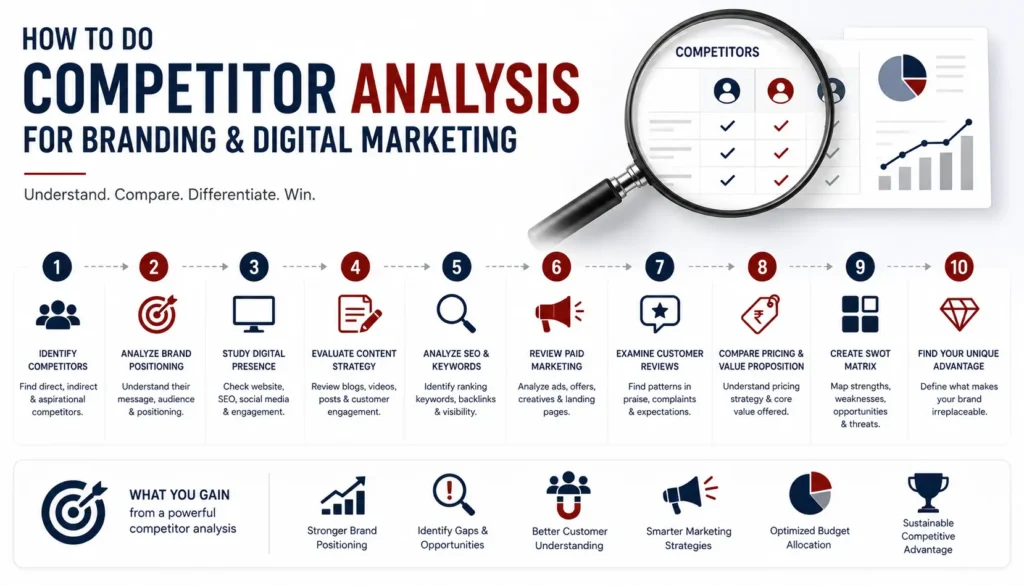
ToggleHow to Do Competitor Analysis for Branding and Digital Marketing Strategy in 10 Steps
In branding and digital marketing, your biggest competitor is rarely the company next door. It is the brand that occupies your customer’s mind before they think of you.
Whether you are launching a startup, scaling an established business, or repositioning a brand, conducting a thorough competitor analysis for branding and digital marketing is one of the most valuable strategic exercises you can do. It helps you understand how other brands communicate, where they succeed, where they fail, and most importantly, how you can stand out.
A well-executed competitor analysis is not about copying. It is about discovering opportunities that others have overlooked.
Why Competitor Analysis Matters ?
Imagine entering a market without knowing how customers perceive existing brands, what messaging already dominates social media, or which keywords competitors are winning online.
That is the equivalent of entering a race without knowing the track.
A competitor analysis for branding and digital marketing helps you:
- Build a stronger brand positioning
- Identify market gaps and customer pain points
- Improve SEO and digital visibility
- Create more compelling content and campaigns
- Differentiate your products and services
- Make smarter marketing investments
The strongest brands do not guess. They observe, compare, and adapt.
Step 1: Identify Your Real Competitors
Most businesses only think about direct competitors, but effective analysis includes three categories.
Direct Competitors :
Businesses offering the same product or service to the same audience. Example: Two premium organic skincare brands targeting women aged 25–45.
Indirect Competitors :
Brands solving the same customer problem in a different way. Example: A herbal soap brand and a body wash brand.
Aspirational Competitors :
Brands that are larger or more established and represent where you want to be in the future. Example: A regional fashion label studying Zara or FabIndia.
Choose 5–10 competitors for a meaningful comparison.
Step 2: Analyze Their Brand Positioning
Ask a simple but powerful question: What do customers remember about this brand?
Visit their website, social media pages, advertisements, and product packaging.
Evaluate:
- Brand promise
- Mission and values
- Target audience
- Tone of voice
- Visual identity
- Premium vs budget positioning
- Emotional appeal
Quick Exercise: Can you describe each competitor in one sentence? If yes, their positioning is probably strong. If no, you may have an opportunity to build a clearer brand identity than they have.
Step 3: Study Their Digital Presence
A brand today lives across multiple digital touchpoints. When evaluating competitor analysis for branding and digital marketing, a competitor with 20,000 highly engaged followers is often more dangerous than one with 500,000 passive followers.
Step 4: Evaluate Their Content Strategy
Content reveals what a brand wants to be known for.
Review:
- Blog topics
- Video content
- Reels and short-form content
- Email newsletters
- Guides and downloadable resources
- Customer testimonials
- Case studies
Ask:
- Which topics appear repeatedly?
- Which posts receive the highest engagement?
- What emotions do they trigger?
- Are they educating, entertaining, inspiring, or selling?
This helps you identify content gaps that your brand can own.
Step 5: Analyze SEO and Keywords
Search visibility is a major competitive advantage.
Check:
- Website keywords
- Blog rankings
- Product page optimization
- Meta titles and descriptions
- Backlink quality
- Domain authority
- Local SEO performance
Useful external tools include:
- Google Search
- Google Keyword Planner
- Ahrefs
- SEMrush
- Ubersuggest
- Moz
For example, if competitors rank for “natural hair oil benefits” but not “South Indian herbal hair oil tradition,” that niche could become your opportunity. Learn more about optimizing your website architecture on Cholanadu Digital Marketing Services.
Step 6: Review Their Paid Marketing
Observe how competitors advertise online. Search for them on Google, Instagram, Facebook, and YouTube.
Analyze:
- Ad headlines
- Visual design
- Offers
- Discounts
- Calls to action
- Landing pages
Questions to ask:
- Are they focused on price?
- Premium quality?
- Trust?
- Social proof?
- Urgency?
Understanding their advertising strategy helps you avoid competing on the same message.
Step 7: Examine Customer Reviews
One of the richest sources of competitor intelligence is customer feedback.
Read reviews on:
- Amazon
- Flipkart
- Social media comments
- App stores
- Review platforms
Look for patterns. Customers may repeatedly praise fast delivery, product quality, packaging, or customer service. They may repeatedly complain about delayed shipping, poor support, a confusing website, or weak product performance. These complaints are opportunities for your brand.
Step 8: Compare Pricing and Value Proposition
Do not compare only prices. Compare value.
Ask:
- What are customers really paying for?
- Convenience?
- Luxury?
- Trust?
- Heritage?
- Performance?
A premium brand should not try to win a price war. It should strengthen perceived value.
Step 9: Create a Competitor SWOT Matrix
Summarize your findings using a matrix during your competitor analysis for branding and digital marketing.
| Matrix Section | Focus Area | Strategic Impact |
| Strengths | What competitors do exceptionally well. | Benchmark standards to match or redefine. |
| Weaknesses | Where they consistently struggle. | Immediate gaps for your brand to solve. |
| Opportunities | Untapped markets, keywords, channels, or customer needs. | High-growth entry points for marketing. |
| Threats | New entrants, changing trends, aggressive advertising, or strong brand loyalty. | Risks to mitigate in your strategy. |
This matrix converts information into strategy.
Step 10: Find Your Competitive Advantage
This is the most important step in competitor analysis for branding and digital marketing.
After all the analysis, identify what your brand can uniquely own:
- Authentic South Indian heritage
- Faster customer support
- Cleaner ingredients
- Better storytelling
- Educational content
- Premium packaging
- Local manufacturing
- Transparent sourcing
- Community-driven branding
Your goal is not to become a better version of your competitor. Your goal is to become a brand that customers cannot easily replace. Explore how our team builds distinct brand positioning via Cholanadu Brand Audit Services.
A Practical Competitor Analysis Checklist
Use this checklist before launching any branding or digital marketing campaign:
- Identify 5–10 competitors
- Review websites and branding
- Analyze social media performance
- Study content strategy
- Compare SEO and keywords
- Evaluate paid advertising
- Read customer reviews
- Compare pricing and value
- Build a SWOT matrix
- Define your unique positioning
If the answer to several of these questions is “no,” the opportunity for growth is significant.
Cholanadu Takeaway
Conducting a competitor analysis for branding and digital marketing is not a one-time project. Markets evolve, customer preferences shift, and digital trends change rapidly.
The brands that consistently grow are the ones that keep observing the market while staying true to their identity.
Study competitors with curiosity, not insecurity. Learn from their strengths, capitalize on their weaknesses, and build a brand that reflects your own vision, values, and voice.
Because in branding and digital marketing, the goal is not simply to be noticed. It is to be remembered.
