


The Science Behind Consumer Perception in Branding
Table of Contents
ToggleConsumer Perception in Branding: 5 Critical Psychology Secrets
In today’s crowded market, why do customers stay loyal to one brand?
Every business faces competition. Whether you run a startup, a local business, or a well-established company, customers have countless options available with just a few clicks. Price wars, discounts, and aggressive marketing campaigns have made it easier than ever for customers to switch brands.
Yet, some businesses continue to enjoy loyal customers who return repeatedly, recommend them to friends, and proudly choose them over competitors.
What’s their secret? The answer relies heavily on consumer perception in branding.
People rarely make purchasing decisions based on facts alone. Instead, they rely on emotions, experiences, memories, visual cues, and trust. This invisible psychological process happens within seconds, shaping whether someone chooses your brand or your competitor’s.
Successful businesses understand this psychology and intentionally create positive perceptions that influence buying decisions long before a transaction ever occurs. Let’s explore the fascinating science behind consumer perception in branding and discover how powerful positioning transforms ordinary businesses into unforgettable industry leaders.
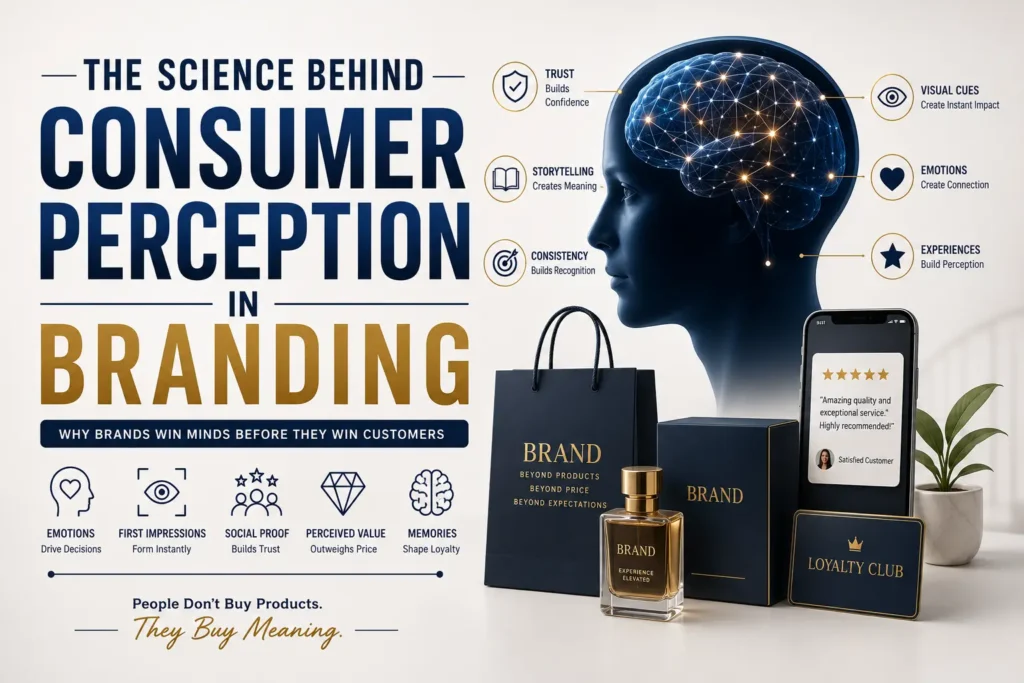
What Is Consumer Perception in Branding?
At its core, consumer perception in branding is the way customers interpret, organize, and evaluate your business based on every single touchpoint they experience.
It is not just one thing; rather, it is a mosaic influenced by:
- Brand identity and messaging
- Logo and visual graphic design
- Product quality and real-world performance
- Customer service responsiveness
- Pricing strategy (premium vs. budget)
- Product packaging and unboxing experiences
- Online reviews and social media presence
- Word-of-mouth recommendations
An important truth every business owner should remember is: People do not just buy products—they buy the meaning they attach to those products.
Your Brain Makes Decisions Faster Than You Think
Scientific studies show that the human brain processes visual information incredibly quickly. Before customers read your product description or compare technical features, they have already formed an subconscious first impression.
Within milliseconds, they subconsciously evaluate:
- Does this brand look trustworthy?
- Is it premium or budget-friendly?
- Can I rely on this company?
- Does this brand reflect my personality?
- Will buying this make me feel confident?
These rapid, gut-level judgments become the foundation of future purchasing decisions. That’s why building positive consumer perception in branding is not simply about physical appearance; it’s about engineering the right psychological response.
The Psychology of First Impressions
Imagine walking into two different local stores. One is clean, well-lit, beautifully organized, and professionally styled. The other is cluttered, poorly maintained, and confusing to navigate.
Even before speaking to a sales associate, you have already decided which business feels more reliable.
The exact same principle applies online. Your website, logo, typography, product images, and brand colors instantly communicate your business’s quality and professionalism. First impressions are rarely accidental—they are carefully designed.
The Emotional Side of Buying
Many people believe purchasing decisions are purely logical. However, neuroscience suggests otherwise. Emotions lead the decision-making process, while logic simply steps in to justify it afterward.
According to foundational research on consumer behavior and branding psychology from the Harvard Business Review, emotional connection drives customer value significantly more than basic customer satisfaction metrics.
Customers may claim they bought a product because it was affordable, but deeper motivations often include:
- Feeling successful or accomplished
- Feeling secure and protected
- Expressing personal style or identity
- Saving time and reducing stress
- Supporting meaningful values (like sustainability)
- Belonging to an active community
Brands that connect on an emotional level build stronger, longer-lasting customer relationships than those that only focus on listing product specs.
Why Consistency Builds Trust ?
Our brains naturally prefer familiarity because familiarity feels safe.
When customers repeatedly experience consistent branding across websites, advertisements, packaging, customer service, and social media, they begin to trust the business.
Consistency ➔ Predictability ➔ Reduced Uncertainty ➔ Customer Confidence ➔ Purchases
Every interaction with your business should reinforce the same promise and personality.
Colors Speak Before Words
Color psychology plays a remarkable role in shaping consumer perception in branding. Different colors naturally trigger distinct emotional and physiological responses in the human brain:
| Color | Emotional Associations | Common Industries |
| Blue | Trust, reliability, security | Finance, Tech, Healthcare |
| Green | Nature, health, growth, balance | Organic foods, Wellness, Sustainability |
| Black | Luxury, sophistication, power | High fashion, Premium tech, Automotive |
| Gold | Prestige, exclusivity, high quality | Luxury services, Premium goods |
| Red | Excitement, passion, urgency | Food, Entertainment, Retail clearances |
| White | Simplicity, purity, cleanliness | Tech, Minimalist design, Skincare |
Choosing the right color palette helps your target customers feel exactly what your brand wants them to experience from day one.
Social Proof Influences Human Behavior
People naturally look to others when making decisions under uncertainty. Positive reviews, customer testimonials, industry awards, media recognition, and user-generated content reassure potential buyers that they are making a safe choice.
This psychological principle is known as social proof. The more people trust your brand publicly, the easier it becomes for new customers to trust it as well.
The Power of Storytelling
Facts explain, but stories persuade.
A memorable brand story creates emotional meaning that customers remember long after they forget product specifications. People connect with:
- Your brand's "Why" (purpose and mission)
- Passion and heritage
- Real challenges overcome
- Genuine customer success stories
The strongest brands don’t simply sell products. They tell stories that customers want to become an active part of.
Perceived Value Is More Powerful Than Price
Two products can perform almost identically, yet one sells for twice the price. Why?
Because branding shapes perceived value. Premium packaging, exceptional customer experience, refined messaging, elegant design, and consistent quality all increase what customers believe a product is worth.
Customers are often willing to pay more when they believe they’re receiving greater value—not merely a better product.
How Businesses Can Shape Consumer Perception ?
Building positive consumer perception in branding doesn’t happen overnight, but every intentional improvement contributes to long-term market authority.
Focus on:
- Delivering consistent quality across your product line.
- Creating a distinctive visual identity that stands out from competitors.
- Understanding customer emotions and speaking directly to their needs.
- Providing outstanding, empathetic customer service.
- Maintaining authentic, honest communication on all public channels.
- Building credibility by showcasing reviews and real testimonials.
The Future of Consumer Perception
In today’s hyper-connected world, consumers have more choices than ever before. Products can be copied, prices can be matched, and features can be replicated.
But the way people feel about your brand is far more difficult to imitate.
Businesses that understand the science behind perception invest in trust, emotion, authenticity, and consistency—not just advertising. Moving forward, the brands that succeed won’t necessarily be those with the biggest marketing budgets. They will be the ones that create meaningful experiences and leave customers with positive emotions every single time.
Cholanadu Takeaway
Consumer perception is the invisible force that drives highly visible business success. Every color choice, conversation, customer interaction, design asset, and promise contributes to how the public views your brand. When businesses intentionally shape these perceptions with authenticity, they create more than repeat buyers—they create loyal advocates.
Branding isn’t about trying to convince people that you are the best. It’s about giving them enough positive, consistent experiences to believe it for themselves.
At Cholanadu, we believe that exceptional brands are built on authentic, emotional relationships. By investing in how your audience perceives your values and experiences today, you lay the foundation for sustainable growth, community trust, and long-term success.
