


The Hidden Branding Lessons Businesses Can Learn From Nike
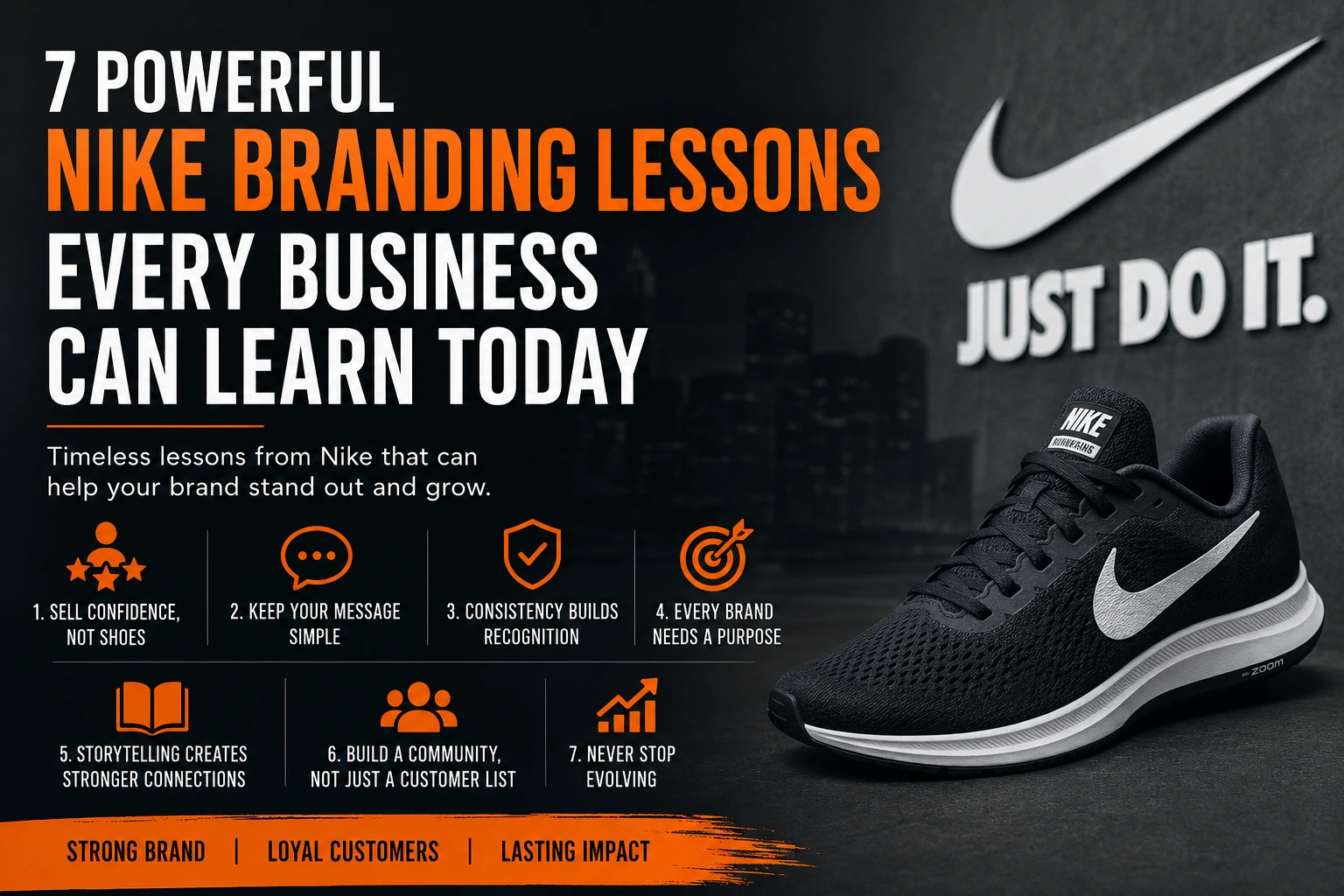
7 Powerful Nike Branding Lessons Every Business Can Learn Today
Many businesses spend countless hours improving their products, services, and marketing campaigns. Yet some still struggle to create a lasting impression in the minds of customers.
That’s where Nike branding lessons become valuable.
Nike is one of the most recognizable brands in the world. From its iconic swoosh logo to its inspiring campaigns, the company has mastered the art of building emotional connections with customers.
For businesses looking to strengthen their branding strategy, Nike offers several practical lessons that can be applied regardless of industry or company size.
If you’re interested in building a memorable brand, you may also find our guide on The Difference Between a Logo and a Brand helpful.
1: Nike Sells Confidence, Not Shoes
Imagine two companies selling running shoes.
One says:
“Made with advanced cushioning technology.”
The other says:
“Just Do It.”
Which message is more memorable?
One of the most important Nike branding lessons is that customers connect more with emotions than features.
Nike doesn’t simply sell footwear. It sells confidence, determination, ambition, and achievement.
Businesses can apply the same principle by focusing on the emotional outcome their products create rather than only listing features.
Ask yourself:
- What feeling does your brand create?
- What transformation do customers experience?
- Why should customers care?
Customers may buy products, but they stay loyal to brands that make them feel something.
2: Keep Your Brand Message Simple
Nike’s famous slogan contains only three words:
Just Do It.
Despite its simplicity, it has inspired millions around the world.
One of the most effective Nike branding lessons is the power of clarity.
Many businesses try to communicate too many messages at once. The result is confusion.
A strong brand message should be simple enough that anyone can understand and remember it.
Try completing this sentence:
“Our brand helps people ________.”
If the answer is clear and concise, your brand message is likely heading in the right direction.
For additional insights on brand positioning, explore the official resources available from the American Marketing Association.
3: Consistency Builds Recognition
Many businesses frequently change:
- Their logo
- Their colors
- Their messaging
- Their social media style
While experimentation can be useful, inconsistency often weakens brand recognition.
Nike maintains a consistent visual identity and message across all customer touchpoints.
Whether customers see a social media post, a television advertisement, or visit a retail store, the experience feels unmistakably Nike.
Among all Nike branding lessons, consistency is perhaps the most overlooked.
Customers trust brands they recognize.
And recognition comes from repetition and consistency.
You can learn more about creating a consistent brand identity through the resources provided by Forbes Branding Council.
4: Every Brand Needs a Purpose
Today’s customers want more than products.
They want to support brands that stand for something meaningful.
Nike represents perseverance, self-belief, ambition, and achievement.
Those values go far beyond sportswear.
This is one of the most powerful Nike branding lessons businesses can adopt.
Ask yourself:
- What does your business stand for?
- Why does your company exist beyond making sales?
- How does your brand improve people’s lives?
For example, your brand may focus on:
✔ Supporting local communities
✔ Promoting sustainability
✔ Preserving traditional craftsmanship
✔ Helping customers achieve personal goals
Brands with purpose are often remembered longer than brands focused solely on transactions.
5: Storytelling Creates Stronger Connections
Think about the advertisements you remember most.
Were they filled with product specifications?
Or were they stories about people overcoming challenges?
Nike consistently chooses storytelling.
Its campaigns focus on athletes, struggles, dreams, setbacks, and victories.
The products support the story rather than dominate it.
One of the strongest Nike branding lessons is that stories build emotional connections.
Instead of saying:
“Our service is high quality.”
Tell customers:
- Why your business started
- What inspired the product
- How customers benefited from it
- What problem you’re solving
If you’re developing a stronger storytelling strategy, read our article on How to Build a Brand from Scratch.
Stories create trust.
Trust creates loyalty.
6: Build a Community Around Your Brand
Nike has created more than customers.
It has created a community.
People proudly wear Nike because they identify with the values the brand represents.
This is another valuable takeaway from Nike branding lessons.
Businesses should look beyond transactions and focus on relationships.
Consider ways to engage customers through:
- Educational content
- Customer success stories
- Interactive events
- Social media conversations
- Community initiatives
When customers feel included, they naturally become brand advocates.
According to research from Harvard Business Review, companies that foster stronger customer relationships often achieve better long-term growth and loyalty.
7: Never Stop Evolving
Imagine if Nike sold exactly the same products it offered twenty years ago.
The brand would struggle to remain relevant.
Nike continuously adapts to changing customer expectations while maintaining its core identity.
This is one of the final but most important Nike branding lessons.
Successful brands regularly ask:
- What do customers need today?
- Which trends are shaping the market?
- How can we improve customer experience?
- What opportunities are emerging?
Growth comes from adaptation.
Strong brands evolve without losing their identity.
A Quick Branding Check for Your Business
Take a moment to answer these questions:
✅ What feeling does our brand create?
✅ What makes our business different?
✅ Can customers describe us in one sentence?
✅ What purpose does our brand stand for?
✅ Are we telling stories or only selling products?
The stronger your answers, the stronger your brand.
For businesses looking to evaluate their current position, our guide on Brand Audit vs Brand Strategy can help identify areas for improvement.
Final Thoughts
The greatest takeaway from these Nike branding lessons is that successful brands sell something bigger than products.
Nike sells belief.
It sells ambition.
It sells possibility.
Businesses of all sizes can apply these same principles by focusing on purpose, consistency, storytelling, and customer connection.
Because in today’s competitive market, customers don’t simply buy what you sell.
They buy what you stand for.
And brands that inspire belief are the brands customers remember, recommend, and return to repeatedly.
So ask yourself: Is your business selling products—or building a brand?
